Military & Defense
AAV-7 amphibious vehicle: Capabilities and limits for Greek Marines
What could AAV-7 amphibious vehicles offer Greek Marines? An assessment of ship-to-shore mobility, weapons, age, safety and the proposed U.S. sale.

The AAV-7 is a tracked amphibious vehicle built to move Marines from ship to shore and then support their movement inland. When Greece examined vehicles from U.S. stocks, the attraction was clear: an armored landing force could arrive on a beach with its own mobility instead of relying entirely on unprotected transport. The question, however, was never whether the vehicle could float. It was whether an aging fleet could be restored, sustained and operated safely at a cost justified by the capability it would add.
This article began as a 2022 question-and-answer assessment of a possible Greek acquisition. The subsequent U.S. notification in March 2023 described a possible sale of 76 vehicles and related equipment, estimated at $268 million; an approval to sell was not a completed purchase or a free transfer. For the later procurement decision and its costs, see our analysis of why Greece did not acquire the 76 AAV-7s.
How old is the AAV-7?
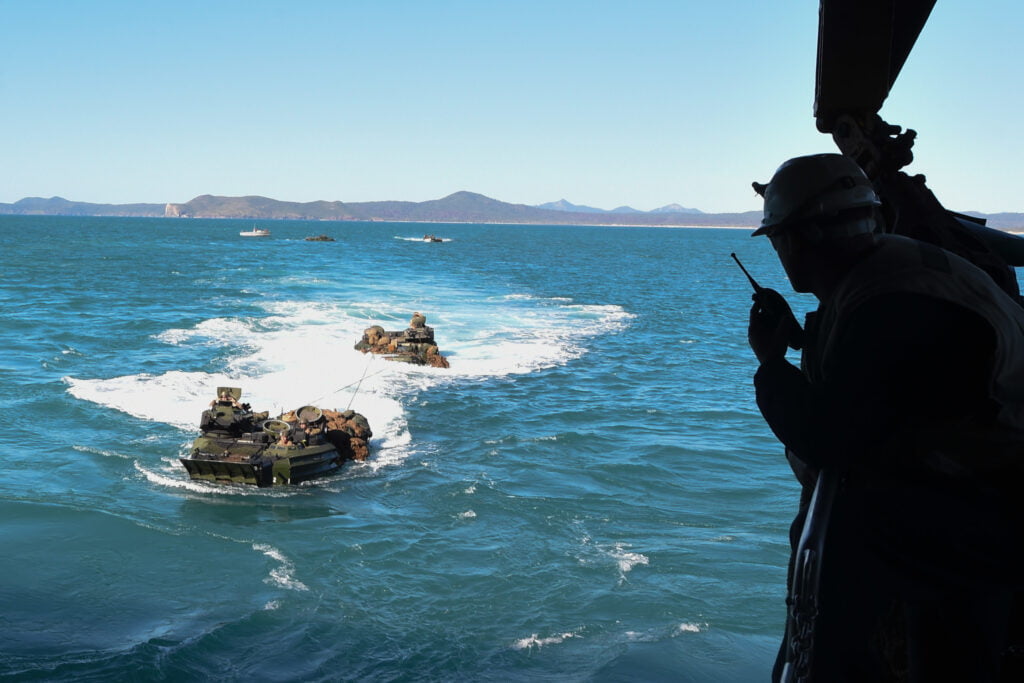
The vehicle traces its origin to the U.S. Marine Corps requirement of the 1960s to replace the LVTP-5. Its predecessor served in Vietnam, while the LVTP-7 entered Marine Corps service in the early 1970s. Later service-life extensions and rebuilds produced the AAV-7A1 standard, with changes to the power train, armament and reliability. The distinction matters: a vehicle modernized decades after its original design is still governed by the condition of its hull, components and maintenance history. A fleet drawn from storage cannot be judged on its designation alone.
The AAV family saw service with forces beyond the United States, including Argentina in the 1982 Falklands War. Its long service record demonstrates the utility of an amphibious personnel carrier, but combat use in an earlier era does not establish survivability against today’s anti-armor weapons, mines, drones or shore defenses. Any Greek assessment would have needed to inspect the individual vehicles and the standard to which they could be restored.
What missions can an AAV-7A1 undertake?
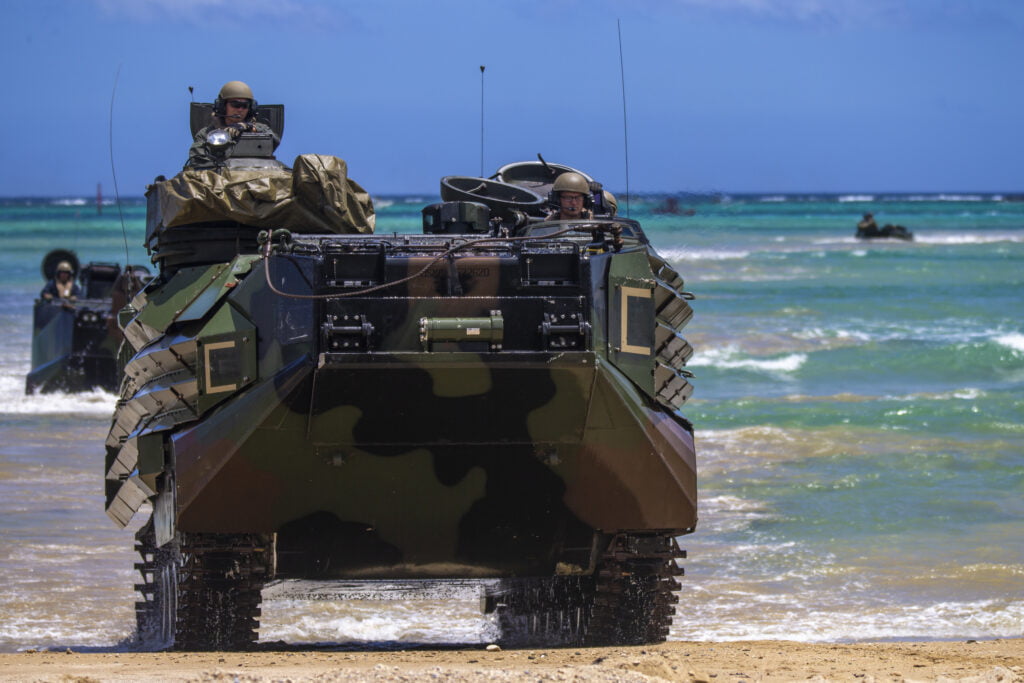
Its central mission is the ship-to-shore movement of assault troops. The personnel variant can carry a crew and a substantial infantry element, commonly described as up to 21 embarked Marines, then continue overland with that force. Command and recovery variants support control and maintenance of the formation. The U.S. Marine Corps describes the AAV as a means of moving troops ashore and supporting them inland, with a 40 mm Mk 19 automatic grenade launcher and a .50-caliber M2 machine gun on the personnel vehicle.
These weapons give the landing force useful fire support against exposed infantry and light targets. They do not turn the AAV into a tank or make a contested beach safe by themselves. A landing still depends on reconnaissance, suppression of enemy fire, naval and air support, and a suitable route from the water to the objective. In the Aegean, the short distances between islands can be an advantage for movement, yet geography also concentrates the force at predictable beaches and exposes a slow vehicle to surveillance and precision fire. The AAV would be one part of a combined operation, not its substitute.
Why did the 2020 accident change the assessment?
On 30 July 2020, an AAV sank during a U.S. Marine Corps training exercise off California, killing eight Marines and a Navy corpsman. The Marine Corps investigation identified a combination of training, material, safety-boat and sea-state failures. It would be wrong to treat that tragedy as proof that every AAV is incapable of amphibious service; it would be equally wrong to dismiss the issues raised by the investigation. Inspection, watertight integrity, crew training, rescue arrangements and operating limits are integral to the capability.
In December 2021 the U.S. Marine Corps decided that AAVs would no longer accompany regularly scheduled deployments or train in the water during exercises, reserving waterborne use for crisis response. Its replacement program is the Amphibious Combat Vehicle. The American decision has its own force-design context, but a prospective Greek operator would still have to demonstrate how it would maintain and certify older vehicles for routine amphibious missions rather than assume the original U.S. operating pattern could simply be copied.
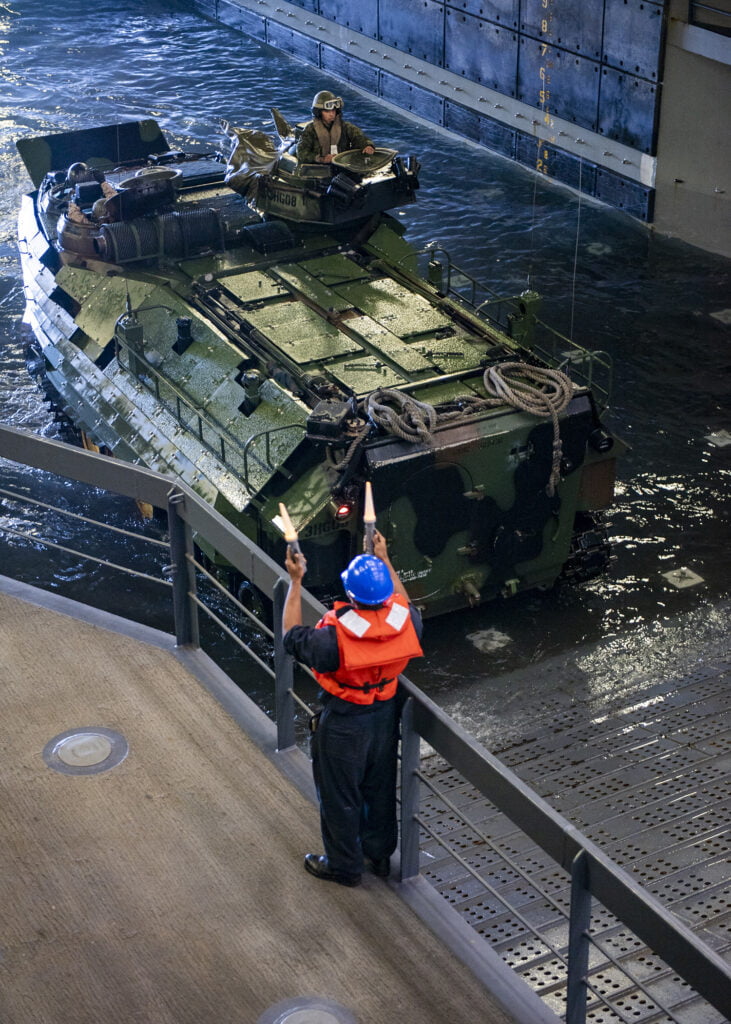
Would the AAV-7 have been useful for Greek Marines?
The original case for the AAV remains serious. Greek Marines require protected mobility in amphibious operations, and a tracked carrier able to take an infantry section from a ship onto land addresses a real gap. It is more relevant to that task than a conventional M113. Yet usefulness is not the same as value at any price. The decisive questions are the usable condition of the offered fleet, the work needed to make it seaworthy, the cost of spares and training over its remaining life, and the degree of protection available once troops leave the beach.

Our initial 2022 view was that safety remediation and a low acquisition cost were essential conditions. The 2023 U.S. notification changed the financial premise: its $268 million estimate covered a broader package of vehicles, weapons, support and associated equipment, rather than a symbolic transfer comparable to the M1117 deliveries. That figure was an estimate for a potential sale, not a final contract price. It made a disciplined comparison with alternative amphibious solutions indispensable. The operational requirement survives a decision against this particular vehicle; the requirement and the platform should be judged separately.
It is forbidden to copy the text of the article or reproduce it via screenshots on other media, social platforms or websites without permission from GEOPOLITIKI.