
Greece
Greek MP says Greece backed down twice at Kasos after Turkish pressure
New Democracy MP Angelos Syrigos says Greece backed down twice during 2024 seabed surveys near Kasos, a description at odds with the foreign minister’s account.

Angelos Syrigos, a New Democracy lawmaker and professor of international law, has said Greece backed down twice during seabed-survey incidents near Kasos involving Turkish naval pressure. His account, given in remarks broadcast this week, concerns work in 2024 connected with the Great Sea Interconnector between Greece and Cyprus.


“Και στα δύο επεισόδια υποχωρήσαμε. Δεν προχωρήσαμε στη συνέχεια των ερευνών βυθού,” Syrigos said. In English, he said that Greece backed down in both incidents and did not proceed with the continuation of the seabed surveys. The statement has revived questions in Greece about how the operations unfolded near the island in the southeastern Aegean.
The remarks are significant because the government had described the earlier survey differently. In a September 2024 interview published by the Greek Foreign Ministry, Foreign Minister George Gerapetritis acknowledged the presence of Turkish warships near a research vessel. He said they withdrew after about 24 hours, no permission had been requested from Turkey, and the research was completed “100% according to plan.”
Different accounts of the 2024 surveys
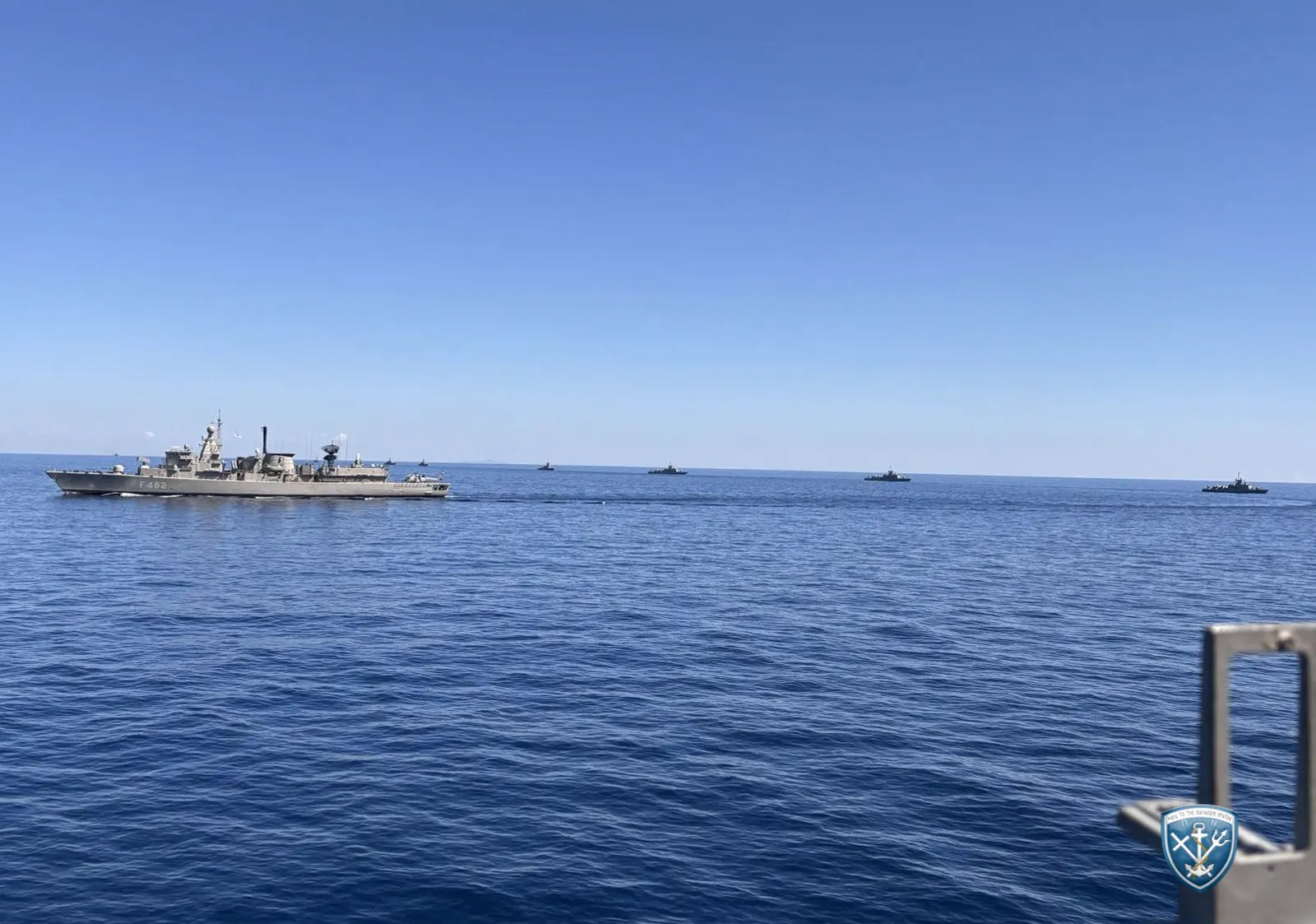
Syrigos’s description and the minister’s account address the same period but make different claims about whether the survey programme continued as intended. Syrigos did not say that Greece accepted Turkish jurisdiction. His point was that, in two episodes, the next stage of seabed research did not proceed after pressure. The government’s stated position was that it made no concession over sovereign rights and completed the planned work.
On September 29, 2026, Gerapetritis again addressed the interconnector and Turkish claims. He said Greece alone grants permission for work in areas under its jurisdiction; informing Turkey through navigational notices is distinct from seeking its authorisation. That remains the official Greek position on the cable project, despite the disagreement over the operational sequence in 2024.
The Great Sea Interconnector is intended to connect Crete and Cyprus by electricity cable, with a later extension to Israel envisaged. Its route has put survey activity amid competing Greek and Turkish maritime claims. Greece rejects the legal basis of the Turkish-Libyan maritime memorandum invoked by Ankara. The European Commission has described attempts by Turkey to impede survey work for the project, which is supported by European funding and aims to end Cyprus’s electricity isolation.
The political dispute over Kasos also sits alongside more recent controversy about the cable’s route. Greece’s energy ministry has rejected claims of a change to the interconnector’s planned course. Syrigos’s comments concern the separate question of what happened during the 2024 seabed operations, and whether subsequent survey stages went ahead.
Syrigos’s statement is politically striking because it comes from a lawmaker in the governing party and uses the word “backed down” to describe the Greek response. The foreign minister’s account maintains that the planned research was completed and that Turkish vessels departed. The two descriptions leave a concrete point in dispute: whether the surveys at the time proceeded through the next intended stage. They should not be treated as a confirmed admission that Greece accepted Ankara’s maritime claims.
The controversy concerns events in 2024, not a new confrontation near Kasos in September 2026. The latest development is the lawmaker’s public description and the government’s reiterated position. For the cable project, the distinction matters because the Greece–Cyprus link is intended to connect the two electricity systems and because maritime survey work has been a focus of Turkish objections.