
Analysis
Montreux Convention explained: who can pass the Bosphorus and the Dardanelles
The 1936 Montreux Convention governs passage through the Dardanelles and the Bosphorus. This explainer sets out the rules for merchant ships and warships and Turkey’s wartime powers.

The Montreux Convention is the 1936 treaty that governs passage through the Dardanelles, the Sea of Marmara and the Bosphorus, the only sea route between the Black Sea and the Mediterranean. It guarantees free passage for merchant ships, limits what foreign warships may do, and gives Turkey wide powers over warship transit in wartime.
Key points
- Signed at Montreux on 20 July 1936, the convention replaced the Lausanne straits convention of 1923.
- In peacetime merchant ships of any flag and cargo enjoy “complete freedom of transit and navigation” (Article 2).
- Foreign warships must notify Turkey in advance, face a 15,000-ton limit on the force in transit, and non-Black Sea powers are capped on tonnage and on time spent in the Black Sea.
- In wartime, if Turkey is not a belligerent, warships of the warring states are barred from the straits, except to return to base (Article 19).
What is the Montreux Convention?
The convention’s preamble says its aim is to regulate transit and navigation in the straits “within the framework of Turkish security and of the security, in the Black Sea, of the riparian States”, while keeping the principle set out in Article 23 of the 1923 Treaty of Lausanne. The signing delegations named in the text include Bulgaria, France, the United Kingdom, Australia, Greece, Japan, Romania, Turkey, the Soviet Union and Yugoslavia. An attached protocol allowed Turkey to remilitarise the zone of the straits.
Article 1 recognises “the principle of freedom of transit and navigation by sea in the Straits”. The convention was to remain in force for twenty years, but Article 28 provides that this principle “shall however continue without limit of time”. Article 29 lets a party propose amendments at five-year intervals, with higher thresholds for changes to the warship tonnage rules in Articles 14 and 18. The Turkish Foreign Ministry describes it as one of the few multilateral treaties still in force since signing.
Which waters does it cover, and how busy are they?
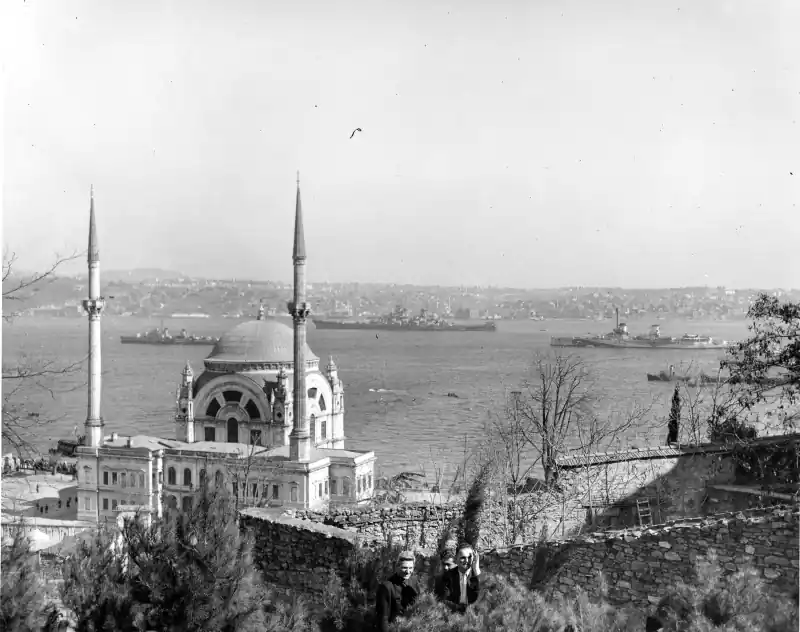
The convention applies to the Dardanelles, the Sea of Marmara and the Bosphorus. According to the Turkish Foreign Ministry, about 17 vessels a day passed through the Bosphorus in 1936, against about 107 today. The ministry says the convention itself does not address safety of life, property, the environment or navigation, and that Turkey regulates these matters through its own rules, including a traffic separation scheme approved by the International Maritime Organization in 1995 and maritime traffic regulations in force since 15 August 2019.
What are the rules for merchant ships?
In peacetime, merchant vessels pass “by day and by night, under any flag any and with any kind of cargo, without any formalities” apart from sanitary control (Articles 2 and 3). Turkey may levy only the charges listed in an annex to the convention, and pilotage and towage remain optional. If Turkey is at war, ships of countries not at war with it may still pass, provided they do not assist the enemy, but they must enter by day and follow the route Turkey indicates (Article 5). The same day-time and route conditions can apply if Turkey considers itself threatened with imminent danger of war (Article 6).
Tanker traffic is the ministry’s main concern today. It reports that in 2025 the Bosphorus recorded 9,554 tankers carrying hazardous cargo, about 169.8 million tons, and the Dardanelles 10,545 tankers carrying about 193.3 million tons.
What are the rules for warships?
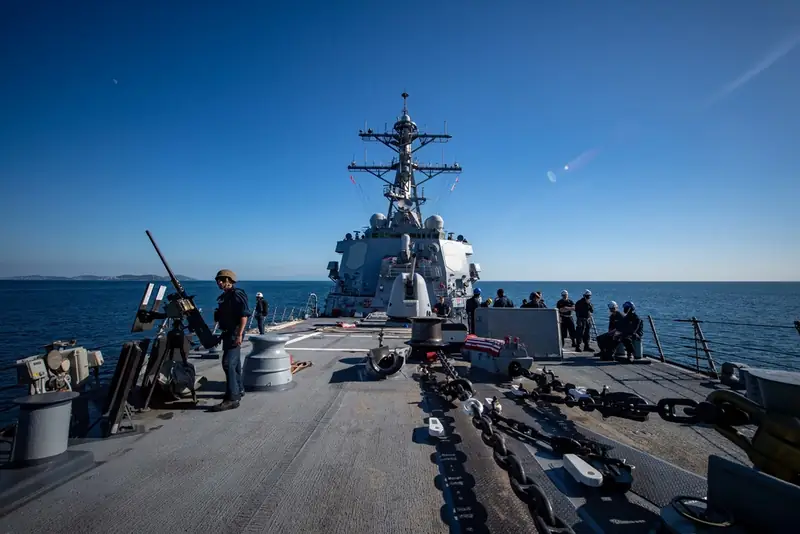
Warships are treated very differently from merchant ships. Light surface vessels, minor war vessels and auxiliaries can transit in peacetime if the passage begins in daylight (Article 10). Other categories, such as capital ships, submarines and aircraft carriers as defined in the convention’s annex, have no general right of transit; Articles 11 and 12 give limited rights only to Black Sea powers. The main limits are these:
| Rule | What the text says | Article |
|---|---|---|
| Notice | Transit is preceded by notification to Turkey through diplomatic channels. The normal notice is eight days, and fifteen days is described as desirable for non-Black Sea powers. | 13 |
| Force in transit | The aggregate tonnage of all foreign naval forces in transit may not exceed 15,000 tons, and may not comprise more than nine vessels. | 14 |
| Aircraft | Warships in transit may not use any aircraft they carry. | 15 |
| Non-Black Sea powers in the Black Sea | Aggregate tonnage limited to 30,000 tons, rising to up to 45,000 tons if the strongest Black Sea fleet grows by at least 10,000 tons. One power may hold two thirds of the total. Stay limited to 21 days. | 18 |
| Humanitarian missions | Forces up to 8,000 tons in total may enter without the usual notification, with Turkish authorisation. | 18 |
| Black Sea powers | May send capital ships singly, escorted by no more than two destroyers, and submarines returning from building or repair outside the Black Sea, on the surface and in daylight. | 11, 12 |
What can Turkey do in wartime?
Three articles set out Turkey’s wartime role. If Turkey is not a belligerent, warships of non-belligerents keep their freedom of transit, but warships of belligerent powers may not pass, apart from cases tied to the League of Nations Covenant and warships returning to their bases (Article 19). If Turkey is itself at war, passage of warships is “left entirely to the discretion of the Turkish Government” (Article 20). If Turkey considers itself “threatened with imminent danger of war”, it may apply the same discretion (Article 21), and must notify the other parties.
How was it applied in 2022?
After Russia’s invasion of Ukraine, Turkey’s foreign minister at the time, Mevlüt Çavuşoğlu, warned on 28 February 2022 all riparian and non-riparian countries not to let warships go through the straits, according to an analysis in the Lieber Institute’s Articles of War, published by West Point. The same analysis says Turkey objected in early March to Russian ships transiting the straits because they were not heading home, after Russia tried to use the return-to-base provision to bring more ships into the theatre.
Lawyers differ on the legal basis. The analysis’s authors argue that a restriction covering all warships, not only those of the belligerents, goes beyond Article 19 and in practice moves into Article 21; they note that others dispute that reading. For a reader this matters less than the structure: the convention leaves the decision on warship passage in wartime with Ankara.
Why does it matter for the Black Sea now?
The Black Sea is again a theatre of attacks on merchant shipping. Geopolitiki has reported drone strikes on merchant ships off Bulgaria, in Black Sea: Drones hit two merchant ships off Bulgaria, one sank; Radev calls it “absolutely unacceptable”, and a Turkish draft for protecting civilian shipping, in Black Sea: Turkey proposes a moratorium on attacks on merchant ships, with separate corridors for Russia and Ukraine, as reported from Turkish media. The convention does not regulate such a moratorium, but it explains why Turkey sits at the centre of the diplomacy: the passage into the sea runs through its waters. An earlier Geopolitiki item on the strait’s routine military traffic is Russian Buyan-class corvette armed with Kalibr missiles crossed Bosphorus.
Sources
This article rests on the text of the 1936 Convention regarding the Regime of the Straits (unofficial copy hosted by the National University of Singapore’s Centre for International Law), the Turkish Ministry of Foreign Affairs page on the Straits, and the Lieber Institute analysis The Montreux Convention and Turkey’s Impact on Black Sea Operations (25 April 2022).