Greece
Joint statement at the UN by Greece, the EU, Cyprus, Egypt, Bahrain and the UAE: the Turkish-Libyan memorandum is “null and void”
Greece, Cyprus, Egypt, Bahrain, the UAE and the EU issued a joint statement at the UN on October 26, delivered by Foreign Minister Giorgos Gerapetritis, saying Libya’s ratification does not change the fact that the 2019 memorandum is null and void.

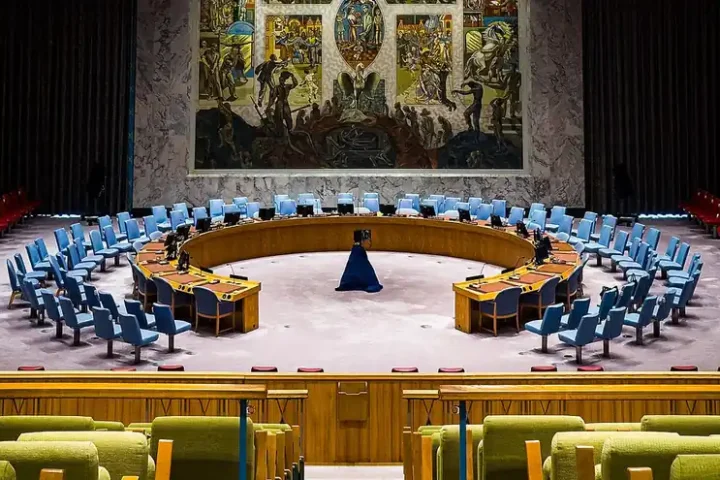
Greece, Cyprus, Egypt, Bahrain, the United Arab Emirates and the European Union took a position in a six-party joint statement at the United Nations on the ratification of the illegal Turkish-Libyan memorandum by Libya’s House of Representatives. Foreign Minister Giorgos Gerapetritis delivered the statement in New York on Monday, October 26. Greece holds the presidency of the Security Council in October. The six parties’ message is that ratification does not change the legal reality: the 2019 memorandum is described as “null and void” and, as the statement notes, “cannot constitute a legal basis for the delimitation of maritime zones nor produce legal effects for third states”.
The islands and UNCLOS
The statement calls the memorandum “spurious” and judges it incompatible with the basic principles of international law. The text, the six explain, ignores geography and what all the coastal states involved are entitled to at sea, including islands, which have maritime zones under the UN Convention on the Law of the Sea (UNCLOS). They also recall that delimitations are made on the basis of UNCLOS and customary law, rules that ensure predictability, legal certainty and peaceful relations between states. If bilateral agreements that bypass these rules were accepted, they warn, a “dangerous precedent” would be set, at a cost to the international legal order.
On the ratification itself by Libya’s House of Representatives, the six speak of “serious concerns” about the security and stability of the region. In their assessment, the episode also shows a broader problem: two states cannot arbitrarily conclude agreements that bypass the rules of international law and harm the rights of third parties.
An open door to Libya
The second part of the statement concerns Libya. The six insist on the reunification of the country’s institutions and on a united, prosperous Libya active in regional cooperation, and ask that its political transition and its relations with its neighbours rest on international law and good neighbourliness. For Athens in particular, the statement recalls that it has already discussed the maritime boundaries of the two countries in good faith with Tripoli and is willing to continue. It closes with the message that without respect for international law there can be neither regional stability nor a rules-based international order.
The joint position follows Greece’s letter to Guterres and Cyprus’s corresponding letter. The same day Recep Tayyip Erdoğan rejected the reactions, mainly those of the EU, asking for respect for the “common will” of Turkey and Libya. Gerapetritis is in New York for the final week of the Greek presidency of the Security Council.
The full statement
I am making this statement on behalf of Egypt, Cyprus, Bahrain, the United Arab Emirates, the European Union, and my own country, Greece.
The recent decision of Libya’s House of Representatives to ratify the spurious 2019 “Memorandum of Understanding between Turkey and Libya on the delimitation of the maritime areas of jurisdiction in the Mediterranean” raises serious concerns for regional security and stability. It also highlights a broader challenge for the international legal order: the need to ensure that arbitrary bilateral agreements do not undermine the established rules of international law or infringe the rights of third states.
International law and, in particular, the United Nations Convention on the Law of the Sea (UNCLOS), as well as customary international law, constitute the legal framework for the delimitation of maritime zones. These rules are fundamental to ensuring predictability, legal certainty and peaceful relations among states. Accepting bilateral agreements that disregard the applicable rules and principles of international law would create a dangerous precedent, undermining the international legal order and the principles on which the peaceful settlement of disputes rests.
The spurious Turkish-Libyan memorandum runs counter to these fundamental principles. It disregards geographical reality and the rights of all the coastal states involved over maritime zones, including the rights of islands under the United Nations Convention on the Law of the Sea. The subsequent decision of Libya’s House of Representatives does not change this legal reality. The memorandum remains null and void, contrary to international law, and cannot constitute a legal basis for the delimitation of maritime zones nor produce legal effects for third states.
We remain committed to the reunification of Libya’s institutions and to the prospect of a united and prosperous Libya. A stable Libya, actively participating in regional cooperation, is essential for peace and security across the Mediterranean. Libya’s political transition and its relations with neighbouring countries must be governed by respect for international law and good-neighbourly relations.
As members of the United Nations, we have consistently supported the peaceful settlement of disputes through dialogue and in accordance with international law. In this spirit, Greece has conducted bilateral talks with Libya on the delimitation of maritime zones, in good faith and in accordance with international law, and expresses its readiness to continue these efforts.
Respect for international law is a prerequisite for regional stability and for the preservation of a rules-based international order.