
Greece
“Deukalion” and “Amphictyon”: the HNDGS vehicles for natural disasters that passed in the parade
Two vehicles built for disasters, not war, passed in the October 28 parade: the mobile operations centre “Deukalion” and the communications station “Amphictyon”, together with the Air Force’s “Metoikos”.

Among the missiles, drones and armoured vehicles of the parade, the vehicles that concern the citizen most directly were two not built for war: “Deukalion” and “Amphictyon”. They passed in the military parade of October 28, 2026 in Thessaloniki together with the Air Force’s transportable communications station “Metoikos” and a mobile first-aid station, and form the “army of disasters”: the means with which the Armed Forces can set up within a few hours a command centre, communications and an aerial picture where a flood, an earthquake or a fire has destroyed the infrastructure. After “Daniel” in Thessaly and the big fires of recent years, the question is not whether the army will be called again but how quickly it can coordinate everyone else.
“Deukalion”: the mobile disaster operations centre
“Deukalion” is a Mobile Operations Centre for the response to and management of natural disasters, on a 400-horsepower MAN TGS 6×6 truck that can move over any kind of terrain, even when local infrastructure has collapsed. It has two work areas: a room for six staff officers and a conference room for the leadership. It connects with land, sea and air assets, and directly with the Fire Service, the Hellenic Police, the National Emergency Aid Centre (EKAB) and the Coast Guard, which in major disasters is often the hardest part. It also carries two unmanned aircraft and a thermal and optical camera, which send real-time pictures to the National Operations Centre of the Hellenic National Defence General Staff (HNDGS).
The vehicle was not bought from the budget. It is a donation from the companies ARIEXPO Mechanical S.A. and NK Trailers S.A. and was delivered on June 20, 2025, at the NK Trailers plant in the Volos industrial area, to the HNDGS Directorate of Construction and Natural Disaster Response (DIKAFKA), in the presence of its commander, Lieutenant General Michail Kloupas. The place was no accident: Volos and Thessaly experienced in 2023 with “Daniel” what it means for a whole region to be left without roads, power and communications. The name is no accident either. In mythology, Deucalion and Pyrrha were the two people who survived the Flood and repopulated the earth.
“Amphictyon” and “Metoikos”: communications when networks fall
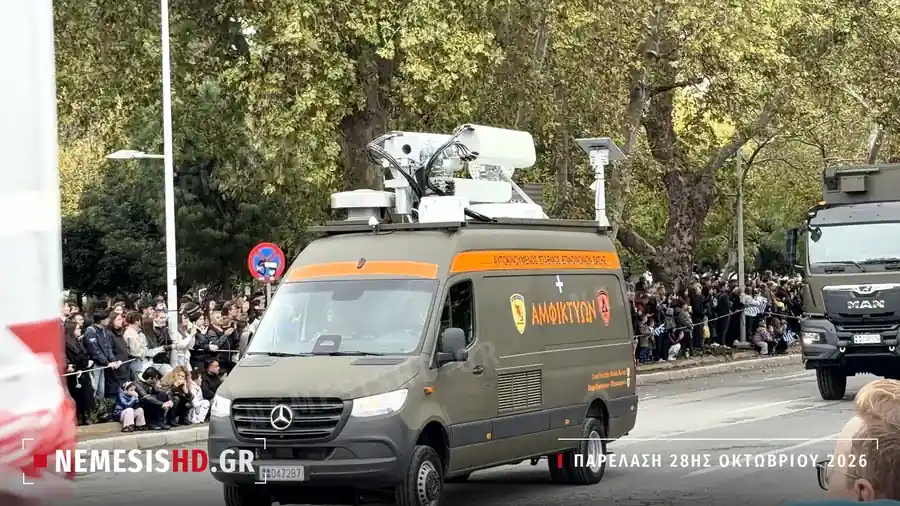
In every major disaster the first thing lost is communication: mobile antennas fall or are left without power, optical fibres are cut and rescue teams cannot talk to one another or to the citizens who need help. “Amphictyon” is the HNDGS answer to that problem. It is a self-propelled base communications station on a civilian-type Mercedes-Benz Sprinter Van PRO 519CDi Long, with the telecommunications equipment built in and a telescopic mast for the antennas. The most important element of its description is that it provides communications coverage not only to the units operating but also to the residents of the affected areas. In mythology, Amphictyon was the son of Deucalion, and the two vehicles are designed to work together.
“Metoikos” is the Air Force’s equivalent system, and what is interesting is that it is entirely Greek military work: it was designed and assembled by the Air Force’s Telecommunications and Electronic Means Plant (ETIM). It is an autonomous, transportable communications hub that supports satellite, microwave, 4G/5G LTE and wired IP links and operates for up to 13 hours on its built-in generator. In practice it can restore or boost communications either at an air unit that has lost its connection or in a disaster area where civilian networks are down. Alongside them passed a mobile first-aid station, a self-sufficient medical unit in a specially fitted cabin that is set up quickly near the units.
Why these vehicles are military assets too
Their presence in a military parade is not decorative. The same assets that coordinate rescue in an earthquake are those the army needs in a crisis on the islands or at Evros, when fixed infrastructure may be hit or jammed. A mobile command centre with its own drones, a quickly deployed base station and a hub with satellite and microwave links are as useful in a war as in a flood. DIKAFKA, which was set up in the reorganisation of the Armed Forces to coordinate their participation in civil protection, shows with these vehicles that the role is now becoming permanent and gaining its own equipment, instead of relying each time on the improvisation of units near the disaster.