Air Force
EA-18G Growler: new NGEAU electronic attack unit goes into full production under a $184 million General Dynamics contract
General Dynamics Mission Systems announced on October 21 a $184 million contract for full-rate production and support of the Next Generation Electronic Attack Unit for the EA-18G Growler Block II upgrade.

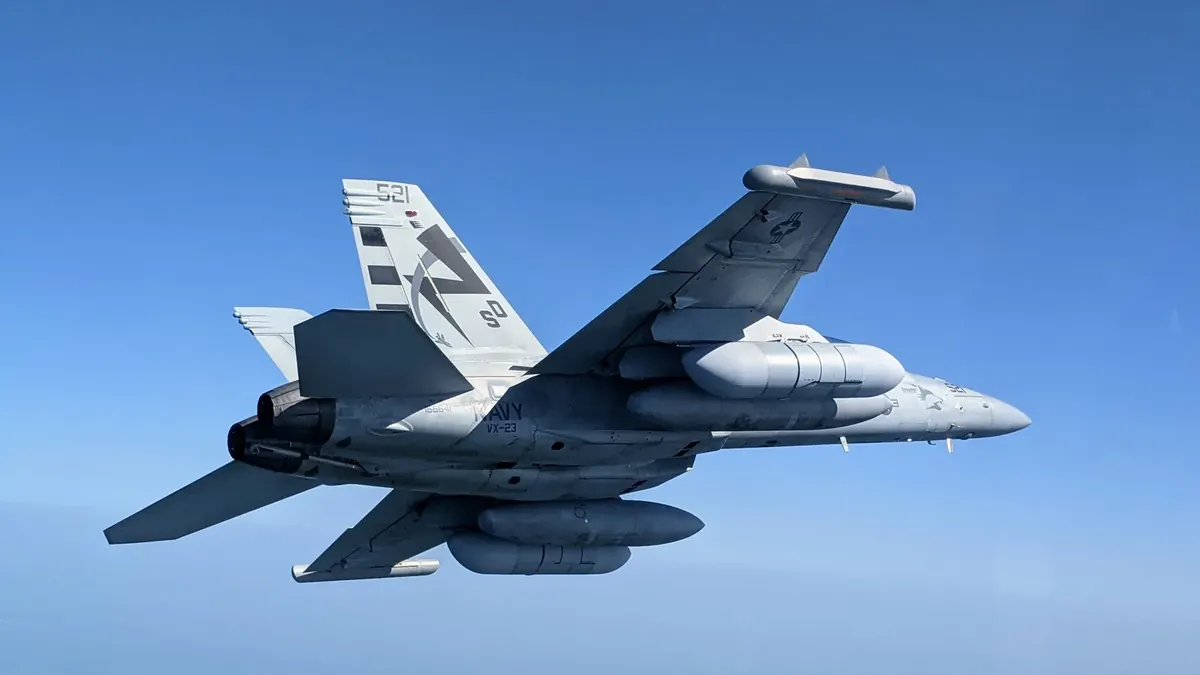
The US Navy is moving the new “brain” of the EA-18G Growler’s electronic attack into full production. General Dynamics Mission Systems (GDMS) announced on Wednesday, October 21, that it had won a $184 million contract for full-rate production of the Next Generation Electronic Attack Unit (NGEAU) and for its support. The unit is part of the Growler Block II upgrade programme.
The NGEAU is a unit within the avionics of the aircraft’s electronic attack suite. As described in the justification document published by Naval Surface Warfare Center Crane, it processes the data of the electronic attack suite (AEA) and feeds the results to the other systems. In Block II it replaces the older Electronic Attack Unit. The unit was designed, and is built, by GDMS itself.
A sole-source award
The contract was awarded directly, through the sole-source procedure. It carries the number N0016426DWS86, is dated September 14 in the SAM.gov listing, has a five-year term and an estimated value of $185 million for fiscal years 2026 to 2031, while the company announced $184 million. The Navy explains that it does not have a complete technical data package with the necessary rights to run an open competition. If the award went to another contractor, the US government would pay again 30-40% of the total development cost and face a 60-month delay in creating a second source, which would hold up the Block II upgrade programme. No company responded to the request for expressions of interest of June 16, 2025 or to the notice of intent for a direct award of July 3, 2025.
Production is covered by a firm-fixed-price indefinite-delivery, indefinite-quantity (IDIQ) contract, while support is covered by a cost-plus-fixed-fee contract. Work begins immediately at GDMS facilities in Bloomington, Minnesota, and will run until 2032. The same package includes support for the Advanced Capability Mission Computer (ACMC), the computer that controls and interconnects all avionics on the EA-18G and the F/A-18E/F Super Hornet. Boeing developed the ACMC and GDMS supplies its hardware.
“The contract advances the production and sustainment of a resilient, open-architecture capability designed to ensure the fleet can adapt quickly to evolving electronic warfare threats,” said Scott Dunderdale, the company’s vice president and general manager of Land and Air Systems.
The Block II supply chain
In Block II the chain of manufacturers has three levels. Boeing is the prime contractor. Northrop Grumman is the subcontractor for the upgrade of the electronic attack suite, and GDMS supplies the NGEAU as a subcontractor to Northrop Grumman. NAVAIR states that Block II is still in development and brings the Advanced Cockpit System, common internal improvements with the Super Hornet Block III and an upgraded electronic attack suite, so the aircraft stays ahead of threats throughout its planned life cycle.
The Growler replaced the EA-6B Prowler and combines the two-seat F/A-18F with a dedicated electronic warfare suite, keeping the Super Hornet’s multirole capability. It first flew in August 2006, and the first production unit was delivered on June 3, 2008 to squadron VAQ-129 at Naval Air Station Whidbey Island. It reached initial operational capability and full-rate production in 2009, and its baptism of fire came in 2011 over Libya, in Operation Odyssey Dawn. The Navy is the only US operator, and the aircraft also flies with the Royal Australian Air Force. The cost per aircraft is $68 million.
The suppression of enemy air defences that the Growler offers also figures in the Greek debate, in proposals for new SEAD/DEAD capabilities for the Hellenic Air Force.