Air Force
FQ-42: General Atomics brings Boeing’s Spirit Defense into production of the US Air Force unmanned fighter
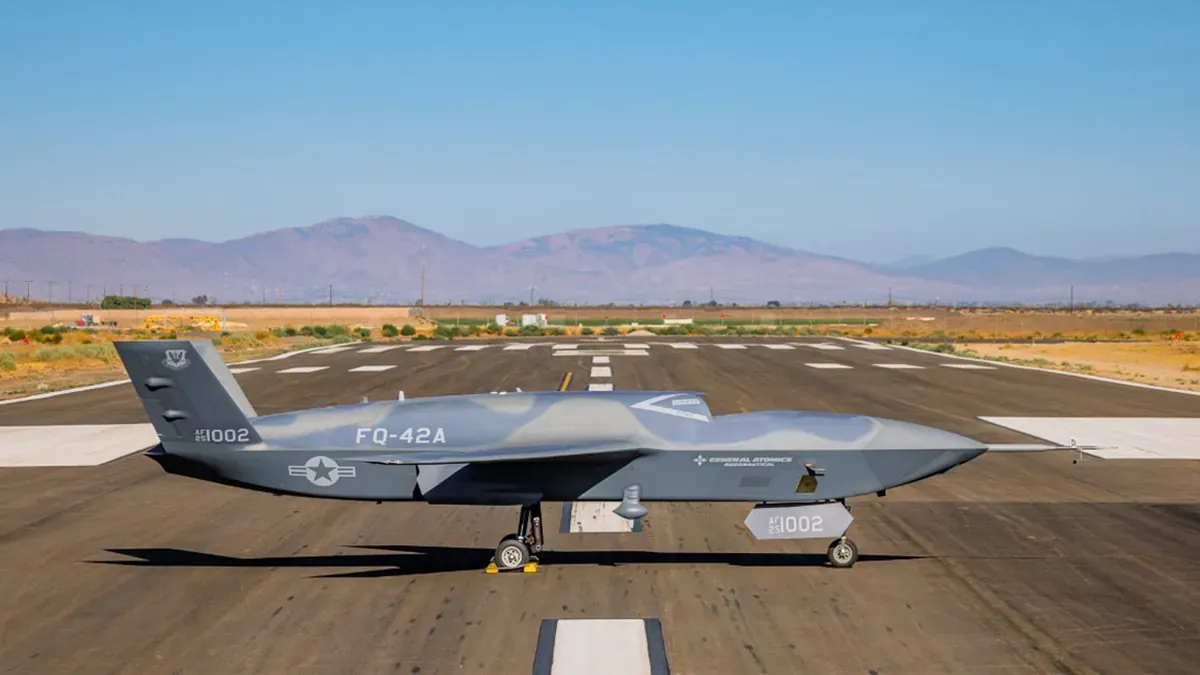
For the first time in its history General Atomics will not build an aircraft entirely in-house: Spirit Defense, a Boeing subsidiary, will take on the fuselage of the FQ-42 Vengeance Collaborative Combat Aircraft.

General Atomics Aeronautical Systems (GA-ASI), which since its founding in 1992 has built every one of its aircraft by itself, is bringing an outside partner onto the line of the FQ-42 Vengeance, the unmanned fighter of the US Air Force (USAF). The company announced on Friday, October 23, from San Diego, that Spirit Defense, a Boeing subsidiary based in Wichita, Kansas, will take on the fuselage of the Collaborative Combat Aircraft (CCA), from design through production.
GA-ASI won a USAF production contract in June. Until now all its unmanned aircraft, from the MQ-9A Reaper and MQ-1C Gray Eagle to the MQ-20 Avenger and the MQ-9B SkyGuardian/SeaGuardian, were built exclusively by the company itself. It now presents the partnership as a “force multiplier”: more production capacity and industrial depth so that output can ramp up faster, greater resilience and fewer points where a single failure could stop the whole line.
“We have proven our ability to design, develop and build the FQ-42. With Spirit Defense we are adding capacity, which is exactly the production resilience the Air Force is asking for as it raises the CCA production rate,” said GA-ASI president David R. Alexander, adding that such partnerships are the scalable industrial base the USAF and the Department of War are looking for. “Our team understands the responsibility that comes with supporting critical national defence programmes,” said Spirit Defense president and CEO Keith Schrader.
Spirit Defense is the defence arm of the former Spirit AeroSystems, whose acquisition Boeing completed in December 2025. As an independent supplier to the defence industry, based in Wichita, it covers engineering, design-build, production, rapid prototyping and lifecycle support, drawing on more than a century of experience in designing and building aircraft.
A programme with several players
The FQ-42 was designed from the outset as an unmanned fighter, in cooperation with the USAF, as part of investments in next-generation semi-autonomous fighters. Its modular design allows quick integration of mission systems and autonomy software, while GA-ASI’s software architecture has been demonstrated in real test flights with many different aircraft and is the basis for human-machine teaming in complex combat scenarios. In the USAF’s CCA programme, Anduril’s YFQ-44A has also flown, and recently received in-flight commands from an F-22 pilot, while Northrop Grumman flew the YFQ-48A Talon Blue.
GA-ASI hints that more manufacturing partnerships may follow. It is talking with several foreign armed forces about the Gambit series, a family of modular unmanned fighters derived from the FQ-42, the XQ-67A and the MQ-20, intended for electronic warfare, suppression and destruction of enemy air defences (SEAD/DEAD) and precision standoff strikes. Countries interested in buying it can include domestic manufacturing and integrate their own sensors and weapons. In Greece, the Hellenic Air Force is studying unmanned fighters to team with its F-35s.