Greece
Greek forces in Afghanistan: ten years in Kabul, from ELDAF to TESAF
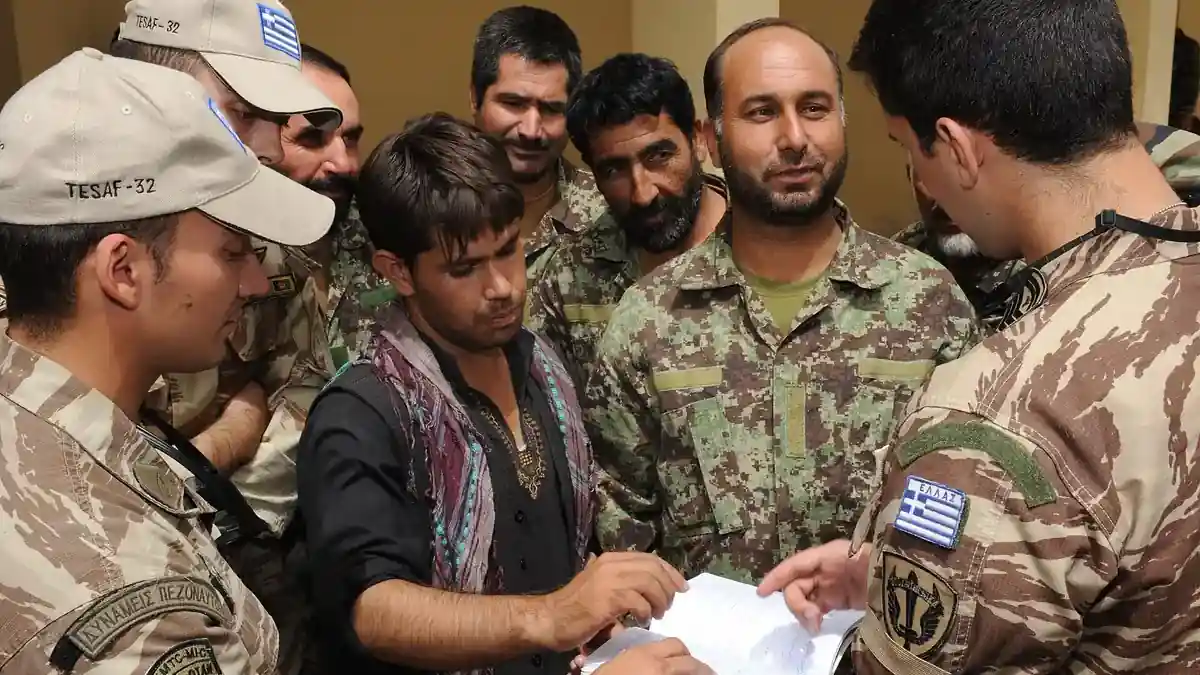
From February 2002 to November 2012, more than 3,000 Greek officers and NCOs served in Kabul, first as the Hellenic Force Afghanistan (ELDAF) and later as the Special Composition Battalion (TESAF): a mission without front-line combat but with mines, ambushes, a field hospital and rebuilt schools.

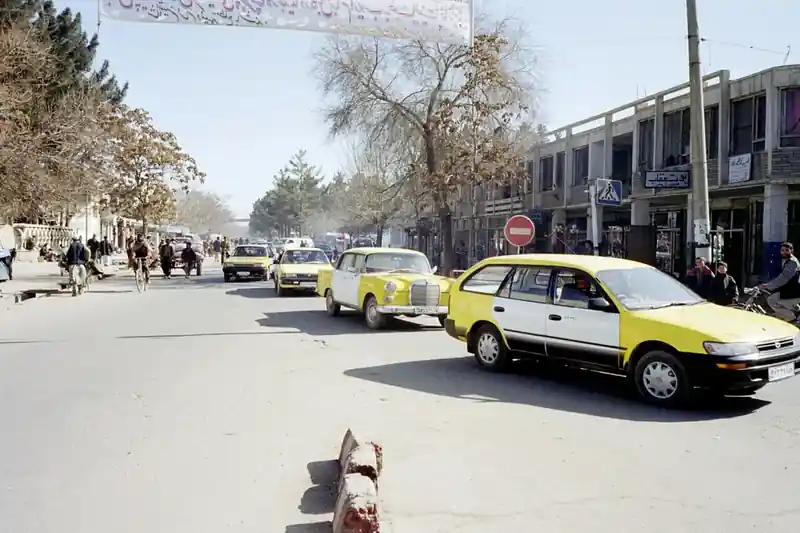
Winter 2002. Kabul is emerging from twenty-three years of war. Government buildings are ruins, the edges of the city are full of mines and the Taliban have only just left. In February the first group of the Hellenic Force Afghanistan (ELDAF) arrives there: 15 officers and 34 non-commissioned officers. They do not yet know that a mission that began as a three-month deployment will last ten years and pass through the hands of more than three thousand Greek servicemen and women.
This is the story of the Greek military in Afghanistan. A mission without front-line combat, but with mines, ambushes, field surgery, schools rebuilt from the foundations, and a political decision that marked it.
The prelude: from Bonn to Kabul
After the attacks of September 11, 2001, the United States and its allies toppled the Taliban regime within a few weeks. In December 2001 the Bonn Agreement set up a transitional Afghan government. On a UN Security Council mandate, an international force was born to secure the capital: the International Security Assistance Force, ISAF. At first its mandate covered only Kabul, according to NATO.
Athens decided quickly. On January 15, 2002, the Government Council for Foreign Affairs and Defence (KYSEA), by decision 3/2002, approved the dispatch of a Greek force to Kabul. With it came a condition that would matter eight years later: the force would not be deployed outside the Kabul area. This was the so-called national caveat.
The initial decision gave the mission a duration of three months, until April 30, 2002. After that, the Council extended it again and again, according to the account of the Hellenic National Defence General Staff (HNDGS).
The arrival: an engineer company, two C-130s and a base in Karachi
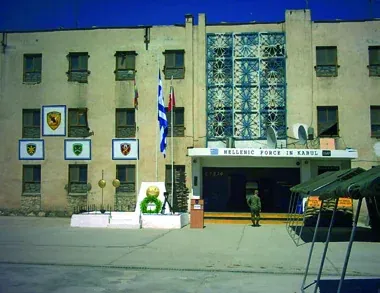
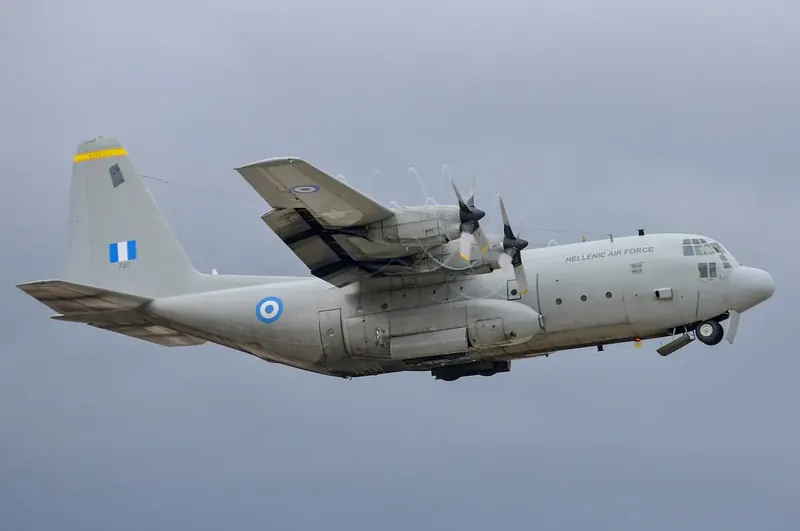
The first Greek force was not a strike force. Its core was the Hellenic Peacekeeping Engineer Company (ELMCHEA), together with support and security elements. The deployment officially began on February 19, 2002. A national support element was set up in Karachi, Pakistan, and two C-130s of the Hellenic Air Force flew from there. According to the HNDGS, the total Greek contribution in the first phase reached 175 personnel.
The C-130s became the lifeline of the mission. They carried personnel and equipment from the United Arab Emirates to Kabul, to an airport that had only just begun operating again. For the Hellenic Air Force it was one of its most distant and demanding airlift missions.
The Associated Press recorded the arrival of the first Greek peacekeepers:

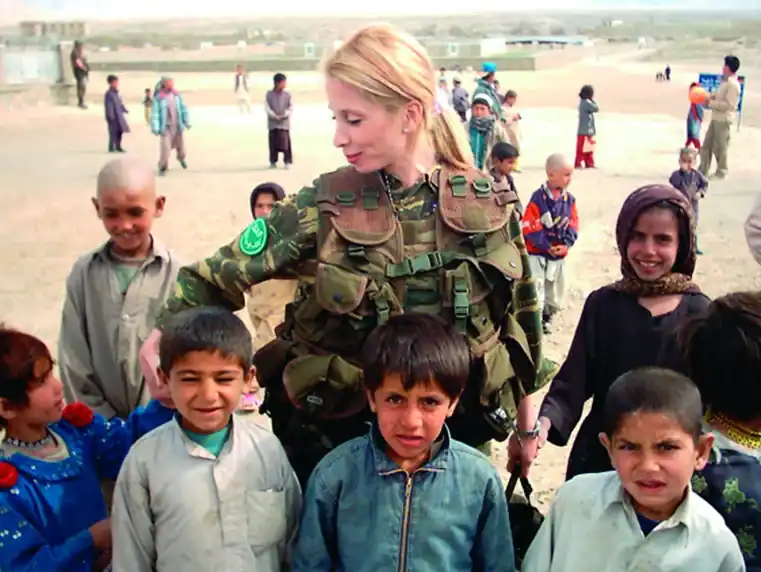
The first months were engineering work in its rawest form. Roads and bridges had to be widened, and schools and government buildings rebuilt. ELDAF distributed humanitarian aid and opened roads in a city that had seen no maintenance for decades. The HNDGS report on the engineers’ contribution covers the work of the Greek engineers in Kabul from February 2002 to March 2011.
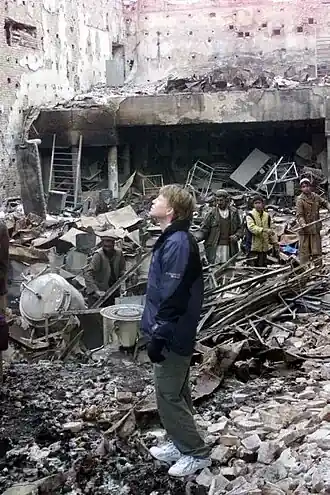
Camp Invicta: the Greek camp east of the airport
The Greek force settled in Camp Invicta, a few kilometres east of Kabul airport, in a multinational camp under Italian command. There the Greeks would live, work and sleep for a decade.
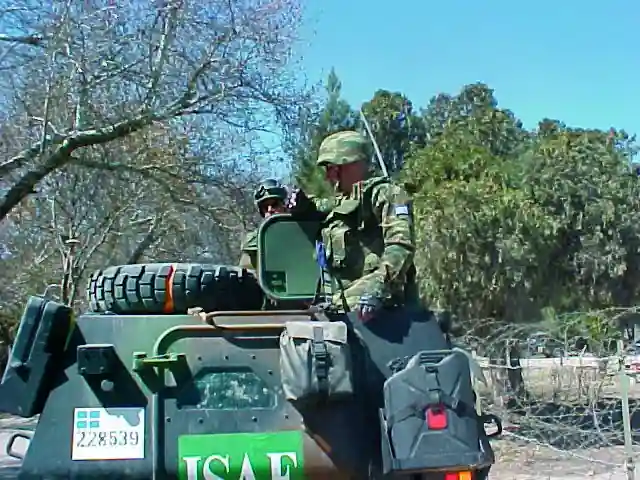
Over the years ELDAF was renamed the Special Composition Battalion Afghanistan, TESAF. Deployments succeeded one another every three to six months. The personnel were professionals, officers and non-commissioned officers, not conscripts.
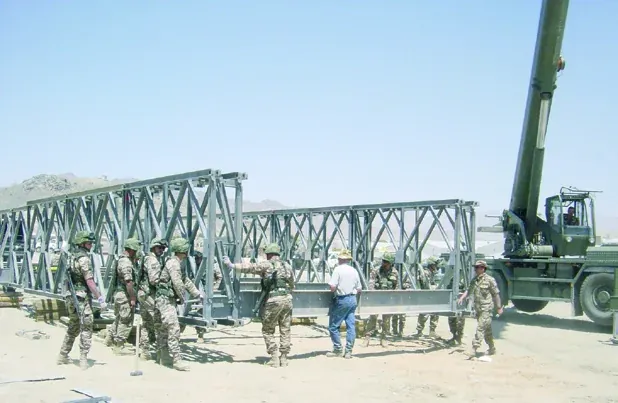
The Greek force did not take part in offensive operations. Its job was to build and support: construction sites, clinics, training. But daily life had all the elements of a theatre of operations: armoured movements, checkpoints and constant alertness for roadside bombs.
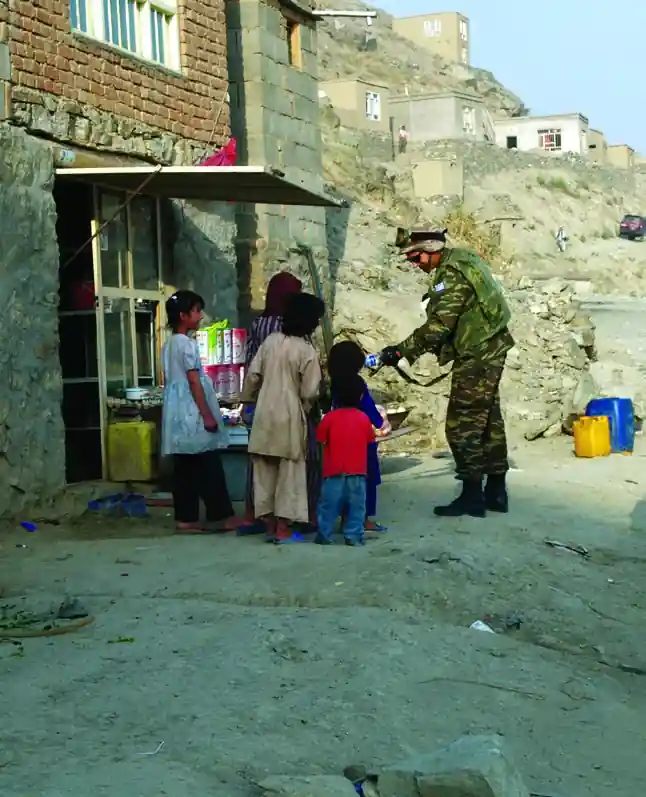
On July 26, 2004, Greek servicemen also took part in a major rescue operation to free Afghan civilians trapped after the collapse of a hospital in Kabul.
The 299 Mobile Surgical Hospital
On July 26, 2005, the 299 Mobile Surgical Hospital (299 KICHNE) was deployed in Kabul. It served TESAF personnel, soldiers of other ISAF countries and Afghan civilians.
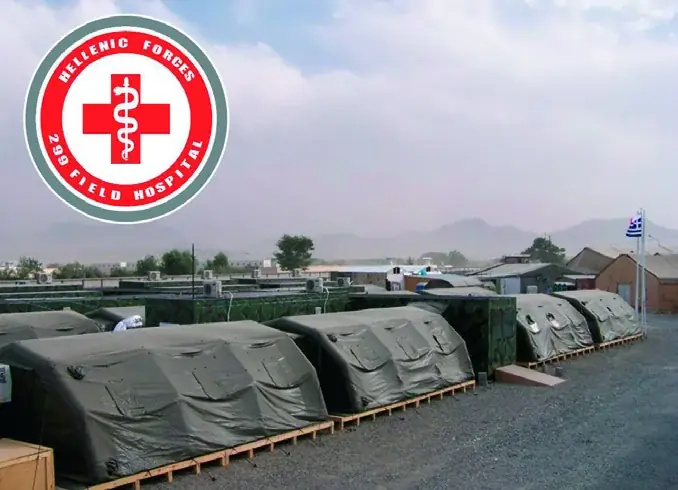
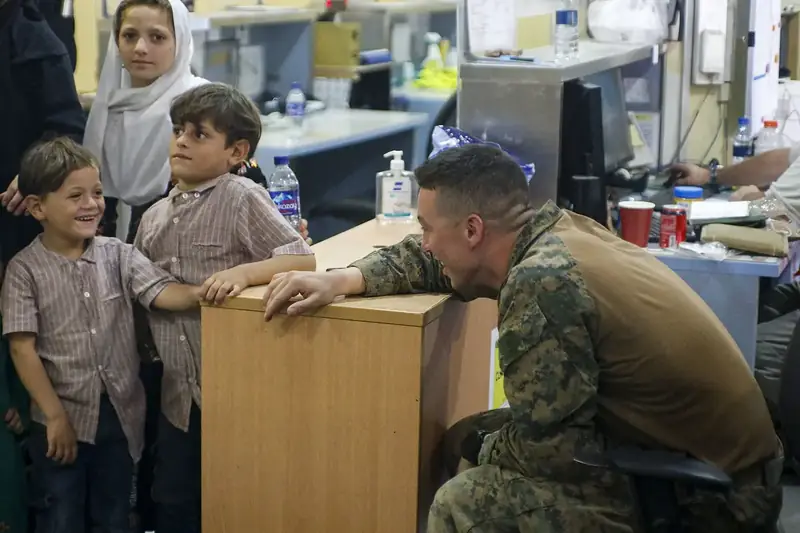
For a country with a destroyed health system, a military surgical hospital staffed by Greek doctors was more than a medical unit. It was the most visible face of the Greek presence.
The hospital operated in Kabul until April 2, 2007, according to the HNDGS.
November 2005: the ambush on the outskirts of Kabul
Kabul was never safe. In November 2005 a convoy of seven Greek vehicles was returning from a mission to an Afghan school. On the outskirts of the city it came under attack. Two Greek servicemen were injured, according to the HNDGS (ISAF’s record, however, states that three Greek servicemen were injured).
It was not the only incident. Greek units were attacked from time to time with improvised explosive devices or fire. For a force that was not fighting, the threat was always there: on the road, at checkpoints, on the way to the construction sites.
In 2006 the Greek presence also took on command weight. From February to August 2006, the headquarters of the Multinational Brigade of South-Eastern Europe (SEEBRIG) took over command of the Kabul Multinational Brigade, with 28 Greeks on its staff, according to the HNDGS.
The Afghan partners
Every foreign force in Afghanistan relied on local interpreters. ELDAF and TESAF were no exception. English-speaking Afghans were the voice of the Greeks in the villages, in the schools, in meetings with local leaders.
When the Taliban returned to power in 2021, the fate of these people also became an issue in the Greek parliament, with questions about how many of those who had worked with the Greek force had been left behind.
November 2009: the decision on Herat
By 2006 ISAF had expanded step by step across the whole of Afghanistan: the north in 2004, the west and south in 2006, the east in October 2006, according to NATO. The Alliance was now asking its members for forces outside Kabul.
The Athens government had considered moving TESAF to the west, to Herat and Farah, areas far more dangerous than the capital. On November 13, 2009, KYSEA decided that the Greek force would not be moved and that the national caveat would be maintained. The government cited the levels of risk and the security needs of the personnel.
ISAF’s operations in 2009, the year of the Herat decision, are summarised in this NATO video:

The decision had a cost. ISAF’s new structure turned towards combat and training units in the provinces, and an engineer battalion tied to Kabul fitted less and less into the Allied plans. The Greek presence began to shift from engineering work to training and support roles.
Kabul airport under Greek command
In the same period Greece took on a role that is not widely known. In 2010 a Hellenic Air Force element took over command of Kabul International Airport (KAIA), with dozens of officers and NCOs on a six-month tour. It was a mission the Air Force had already carried out with complete success from December 2005 to March 2006.
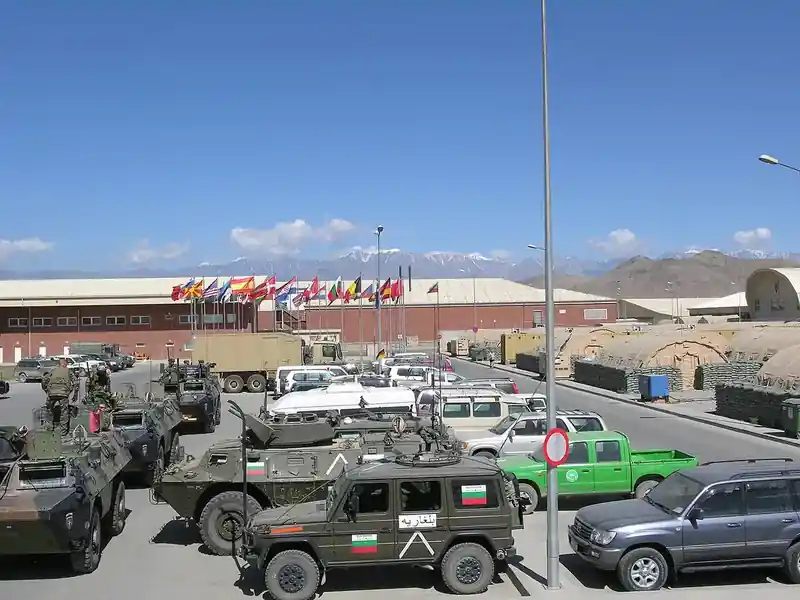
The airport was the gateway of the whole mission. Rotations of forces, supplies and casualties passed through it. TESAF had already built technical-services buildings there. In 2010 it was run by a Greek team.
Greek trainers for the new Afghan army
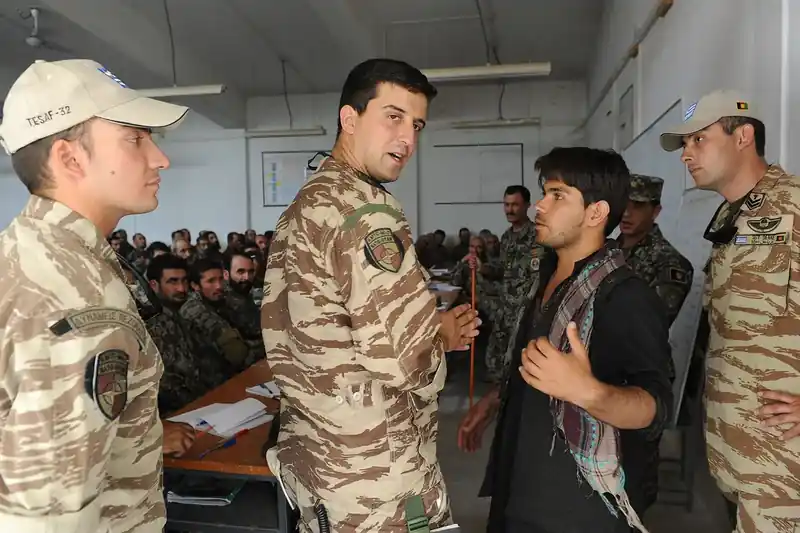
From 2009 NATO set up the NATO Training Mission-Afghanistan (NTM-A), with the aim of creating an Afghan army and police that would take over the security of the country. Greek officers went there too.
In February 2011 Greek advisers were teaching at the Kabul Military Training Centre (KMTC). They took part in the Mujahideen Reintegration Programme, a 26-week programme that returned former fighters to the Afghan security forces, as NTM-A itself records in the photograph.
The projects and the numbers
| Item | Detail |
|---|---|
| KYSEA decision | 3/2002, January 15, 2002 |
| Start of deployment | February 19, 2002 |
| First group | 15 officers, 34 NCOs |
| Initial force | 175 personnel (including Karachi and the C-130s) |
| Rotations | 33, each lasting 3 to 6 months |
| Total personnel | 3,295 officers and NCOs (2002–2012) |
| 299 Mobile Surgical Hospital | July 26, 2005 to April 2, 2007 |
| SEEBRIG in Kabul | February–August 2006, 28 Greeks |
| Decision on Herat | KYSEA, November 13, 2009: stay in Kabul |
| Withdrawal of the main force | November 2012 |
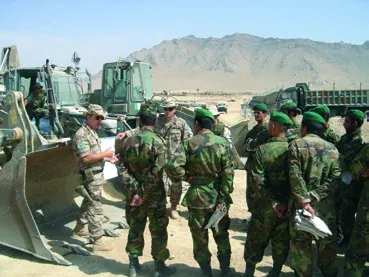
The HNDGS account speaks of the construction, reconstruction and improvement of infrastructure in the city of Kabul and at the airport, the training of Afghan soldiers and the distribution of humanitarian aid.
November 2012: the withdrawal
At the end of November 2012 the last commander of TESAF returned to Greece and the withdrawal was completed. The government decided on it for reasons of economy, in a year when the country was in the heart of its crisis. All the equipment and vehicles returned on three special flights.
Seven Hellenic Air Force officers stayed in Kabul to train Afghan personnel, and two officers on the international staff of ISAF. NATO’s tables then record Greece with 3 to 10 troops, as in the December 2012 ISAF “placemat”.
When ISAF ended at the close of 2014, its flag was lowered in Kabul and returned to Brussels:

ISAF was succeeded by the non-combat Resolute Support mission, from January 1, 2015. Greece stayed with a small team at Kabul airport, according to the HNDGS.

The last Greek officers left in the summer of 2021, together with the American and NATO forces. A few weeks later the Taliban were entering Kabul, and the airport that the Hellenic Air Force had once commanded filled with thousands of people trying to leave.
The legacy: what remained from the ten years
The Greek mission in Afghanistan did not write a history of battles. It wrote a history of presence. It was one of the longest-running Greek missions outside Europe since Korea: a Greek unit that lived for ten years in an active theatre of operations, inside a multinational NATO structure.
Three lessons stand out. First, the value of engineering and medical support as a diplomatic tool: a surgical hospital and a school won more goodwill than any patrol. Second, the cost of national caveats: the decision on Herat protected the Greek servicemen but limited TESAF’s place in the Allied plans. Third, the experience in long-range airlift support with C-130s, which was used again in today’s Greek missions abroad, such as ELDYSA with the Patriot battery in Saudi Arabia.
The Afghanistan the Greeks left behind fell again into the hands of the Taliban, who in 2024 paraded at Bagram with Western vehicles and Black Hawks. The war that began to eliminate al-Qaeda ended without victory, although Bin Laden was killed in Pakistan in 2011 and his successor in 2022 in Kabul itself. For the 3,295 Greeks who passed through the long-suffering Kabul, however, the mission ended the way they wanted it to: building, not fighting.
Frequently asked questions
When did the Greek army go to Afghanistan?
The decision was taken by KYSEA on January 15, 2002. The deployment of ELDAF in Kabul began on February 19, 2002, as part of ISAF. The main force remained until November 2012.
Did Greek soldiers fight in Afghanistan?
Not in offensive operations. The Greek force had an engineering, medical support, humanitarian aid and training role, with a national caveat not to deploy outside Kabul. It did, however, come under attack, such as in the ambush of November 2005.
What was TESAF?
The Special Composition Battalion Afghanistan, the renaming of the original Hellenic Force Afghanistan (ELDAF). It was based at Camp Invicta, east of Kabul airport.
How many Greeks served in Afghanistan?
From 2002 to 2012, 3,295 officers and NCOs served in 33 successive rotations.
Why did the Greek force leave?
The government decided on the withdrawal in 2012 for reasons of economy, in the middle of the financial crisis. A small group of officers stayed in the Resolute Support mission until 2021.
Sources
Hellenic National Defence General Staff (HNDGS): “Contribution of the Hellenic Armed Forces in Afghanistan”, the pages “Afghanistan (ISAF)” and “Afghanistan – Resolute Support Mission”, and “Hellenic Contribution to the Reconstruction of Afghanistan” (2013). NATO: ISAF’s mission in Afghanistan (2001–2014) and the ISAF “placemat” of December 2012.