Military & Defense
U.S. Navy warfare center tests camera system that alerts a ship’s bridge when a sailor goes overboard
Engineers at Port Hueneme tested thermal cameras and video analytics on the Self Defense Test Ship, dropping a rescue dummy over the side. The team now seeks funding for a trial on a destroyer.

Engineers at the U.S. Navy’s Naval Surface Warfare Center, Port Hueneme Division in California have completed a proof-of-concept test of a camera system designed to spot a sailor who falls overboard and raise the alarm automatically. The command described the trial on 21 October.
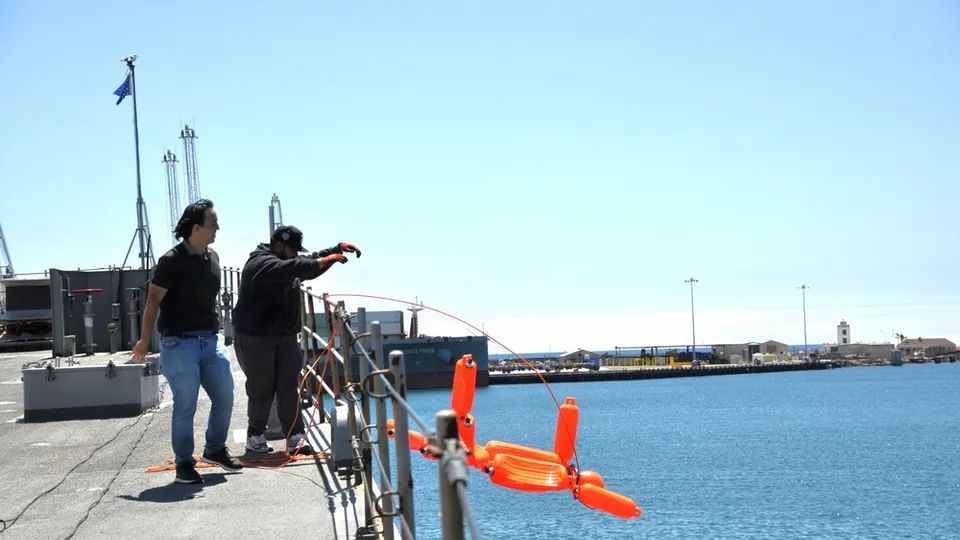
The prototype, called the Man Overboard (MOB) Detection System, was installed on the bow of the command’s Self Defense Test Ship on 14 August while the vessel was docked at Port Hueneme. To stand in for a person, the team threw a bright orange 6-foot, 35-pound vinyl rescue dummy, nicknamed OSCAR after the international call sign for man overboard, over the starboard side on a rope, then hauled it back and repeated the drop several times.
According to the warfare center, the system worked flawlessly. The only part not exercised was the link that sounds an alarm on the ship’s bridge. Branch manager Eric King said he believes the system “bridges a gap” by giving immediate, automated alerts so that search and rescue can start “when seconds count.”
How the system works
Each camera pedestal carried two thermal cameras, one covering the blind spot close to the hull and one covering medium to long range. The two pedestals sat about 200 feet apart on the test ship. Video analytics software compares the overlapping views of opposing cameras, which lets it trigger an alarm in real time and give the exact location of the person in the water, according to systems engineer David Dozal, who leads the team.
The analytics software was developed by private industry for the cruise ship sector, and part of the project funding was used to license it. The same company fabricated the metal pedestals to the command’s design, and the four thermal cameras were bought commercially. For the test the pedestals were held on deck with magnets fixed to counterweights. Permanent pedestals would be welded to the deck. Dozal said the ideal layout would run cameras around the whole perimeter of a Navy destroyer.
The work was first funded through the Naval Innovative Science and Engineering programme, which has now ended.
What comes next
The team now needs new money to continue. King said the results were needed to show proof of concept and that talks have begun with potential sponsors, including the possibility of folding the system into a larger programme. Dozal said the preferred next step is a temporary installation on an operational U.S. Navy destroyer in San Diego, in port and underway. That would require a longer window, such as a ship’s maintenance availability, to run the cabling safely, and the team must also work out the cost of equipping an entire ship.
No decision to adopt the system has been announced. The test is one more example of the U.S. Navy’s warfare centres adapting commercial technology for shipboard use, a theme also seen in the recent selection of a commercial microreactor for the US Navy picks Radiant’s Kaleidos nuclear microreactor for Naval Surface Warfare Center Crane in Indiana.