
Balkans
Opinion: Greece and Serbia could co-produce ammunition and simple defence systems, with Cyprus as the guide
Cyprus already fields Serbian howitzers, armoured vehicles and rocket launchers. Our proposal is for Greece to go a step further: not to buy ready-made systems, but to co-produce simple and plentiful ones, mortar rounds, 122 mm rockets and wheeled armour, on Greek soil.

Before we describe our proposal, let us start from an observation that is clearly visible in Cyprus: the most useful things in a war are not always the most expensive. The National Guard already has in service Serbian NORA B-52 self-propelled howitzers, Miloš armoured vehicles and Tamnava multiple rocket launchers, and in October 2026 it signed with Belgrade a memorandum on the procurement of defence systems. Greece, for its part, needs mortar rounds, rockets, artillery ammunition and a domestic industry that can produce them in quantity. The Serbian defence industry has exactly this know-how, while Greece has the factories, EU membership and the 25% domestic participation rule. Our proposal is a cooperation on the simple and the plentiful, with production in Greece.
What Cyprus has already bought from Serbia
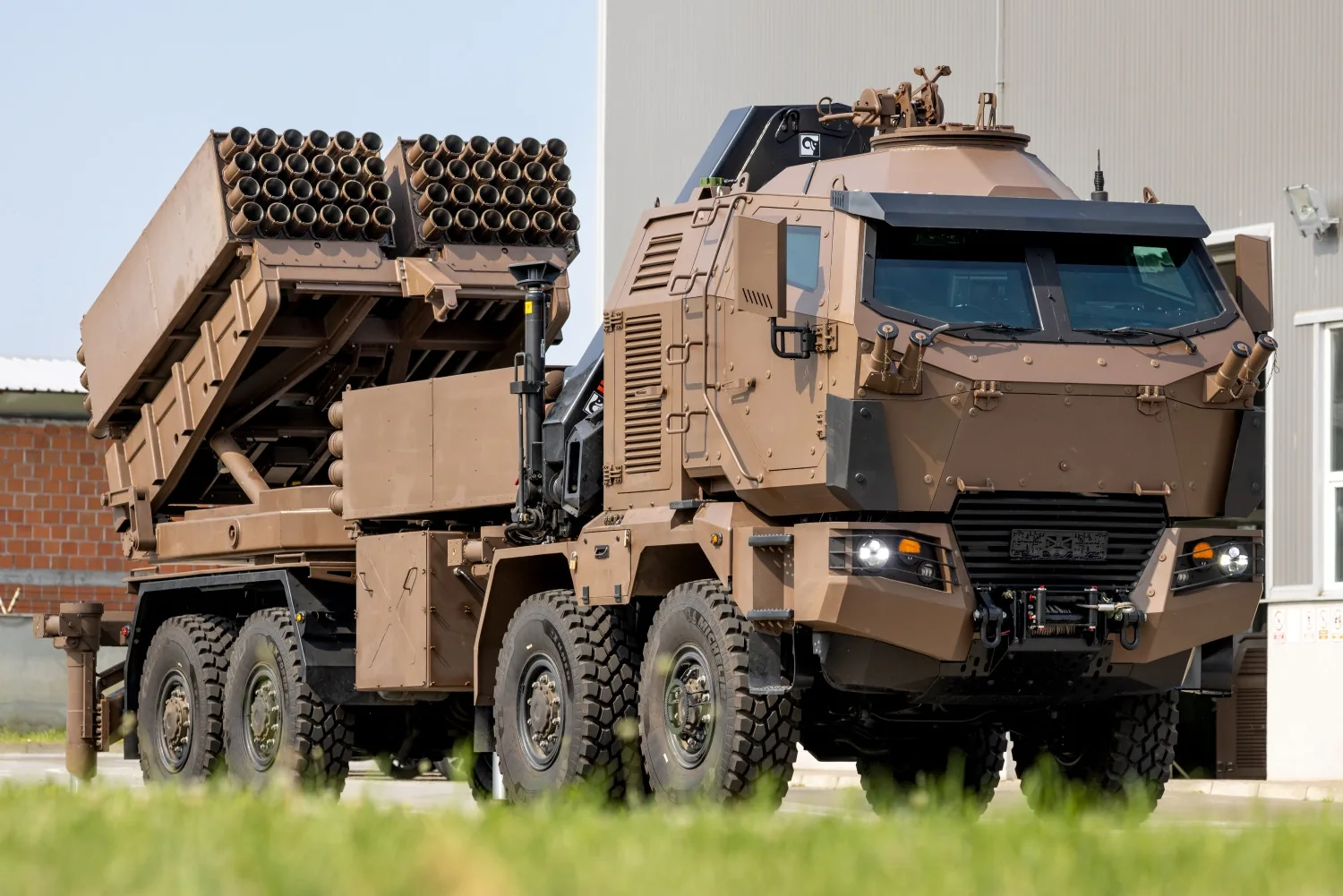
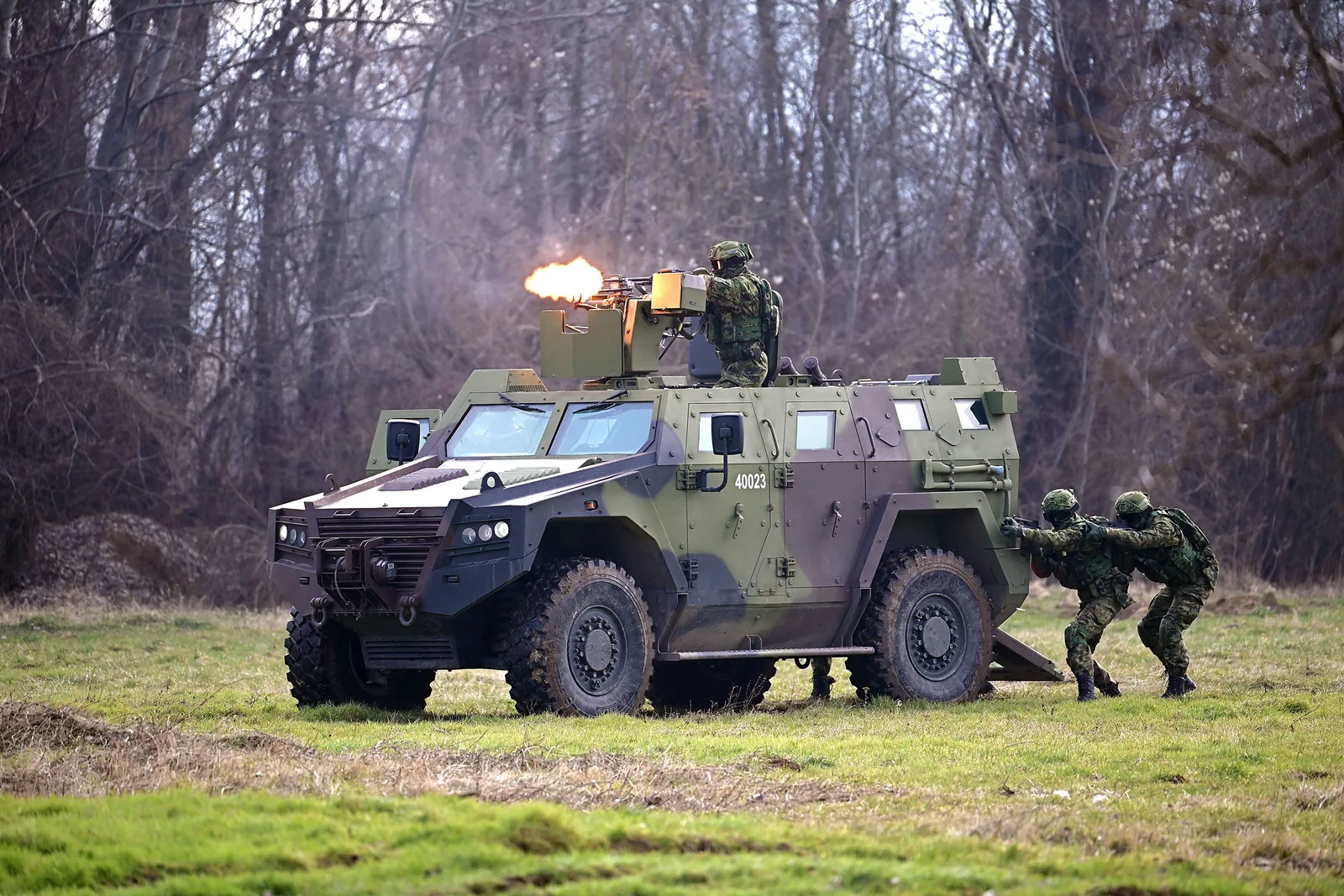
Cyprus is the best example of what Serbian industry offers a European country facing Turkey. The 155 mm NORA B-52 howitzers were acquired from 2017 and, at the parade of October 1, 2019 in Nicosia, were presented together with the Miloš 4×4 armoured vehicles. It was, according to the state-owned Yugoimport SDPR, the first time such Serbian equipment appeared in the parade of an EU country, and one of the largest export contracts of the Serbian industry with the Cypriot Armed Forces. The Tamnava multiple rocket launchers followed, firing 122 and 262 mm rockets, with acceptance firings at the Kition Firing Range on December 11, 2025, and operational firings together with the NORAs against sea targets in February 2026.
The political base followed the operational one. In September 2025 Cypriot Defence Minister Vasilis Palmas visited Belgrade and the PARTNER-2025 exhibition, with an interest in unmanned systems, guided munitions and multiple rocket launchers. A Status of Forces Agreement (SOFA) was signed on December 10, 2025, and on October 6, 2026 the memorandum of cooperation between the two defence ministries, which according to the Cypriot announcement deepens cooperation in the procurement of defence systems and encourages dialogue between the defence industries. Nicosia, in other words, has already opened the road we propose Athens follow, with one difference: Greece does not need to buy ready-made systems, but to produce them together.
The simple things: mortars, 122 mm rockets and 155 mm
The first field is mortar rounds. Serbia’s Krušik in Valjevo produces mortar ammunition of 60, 81, 82 and 120 mm, grenades, 40 mm ammunition, 155 mm rounds, and now also drone-dropped munitions and warheads for suicide drones. These are exactly the consumables that run out first in a conflict, and which the war in Ukraine showed no state has in sufficient supply. A filling and assembly line in Greece, with a Serbian design and a production licence, would cover the mortars of the Hellenic Army and the National Guard, while the drone munitions would be tied to the projects of the Hellenic Centre for Defence Innovation (ELKAK).
The second field is 122 mm rockets. The Hellenic Army keeps RM-70 launchers of this calibre, and in October 2025 the Defence Ministry tendered the modernisation of 111 launchers with a budget of €90.58 million and at least 25% participation by Greek industry. A modernised launcher, however, is only worth as much as its rockets. Krušik makes 122 mm surface-to-surface rockets, and Cyprus’s Tamnavas use the same calibre. A joint Greek-Serbian 122 mm rocket line would serve the RM-70s and the Cypriot Tamnavas at the same time. We have covered the weapon before, in the Greek Army’s examination of the Tamnava.
The third field is 155 mm ammunition, used by the Greek M109s and PzH 2000s and the Cypriot NORA B-52s. Here Europe’s problem was not the metal shells but the propellant and the explosives. Hellenic Defence Systems has at Lavrio a NATO-certified loading and propellant plant and European funding for new explosives units. Serbia has a long tradition of producing nitrocellulose and propellant at the “Milan Blagojević” plant in Lučani. Serbian know-how in raw materials and the Greek loading line can complement each other.
And the vehicles: APCs, IFVs and 4×4s
The proposal does not stop at ammunition. The second field is armoured vehicles, where Greece has its biggest gap. The Hellenic Army relies for infantry mobility on about 2,000 M113 armoured personnel carriers and a total of 2,478 vehicles of the family, as we have recorded. It cannot replace such a fleet one for one with expensive tracked IFVs. The solutions from American surplus had their limits: the Bradleys needed, according to the Defence Minister, repairs “of the order of 8 million each”, and for the Stryker from EDA the real question is how much each will cost once it arrives fully operational in a Greek unit, as we examined in our analysis of the Stryker for Greece. Serbian industry has a whole family of wheeled vehicles. The Lazar 3 8×8 is an APC that, according to Yugoimport, carries 12 people with a weapon station, that is the driver, the commander, the gunner and nine infantry, and has an IFV version (Lazar 3M) with a remotely operated 30 mm gun. The Lazanski 8×8 carries a 57 mm gun, with a maximum weight of 36 tonnes and a 711 hp engine. The Miloš 4×4, which the National Guard already has, weighs up to 14 tonnes and has ballistic protection of level III at the front and II on the sides under STANAG 4569, with mine protection of levels IIa and IIb.
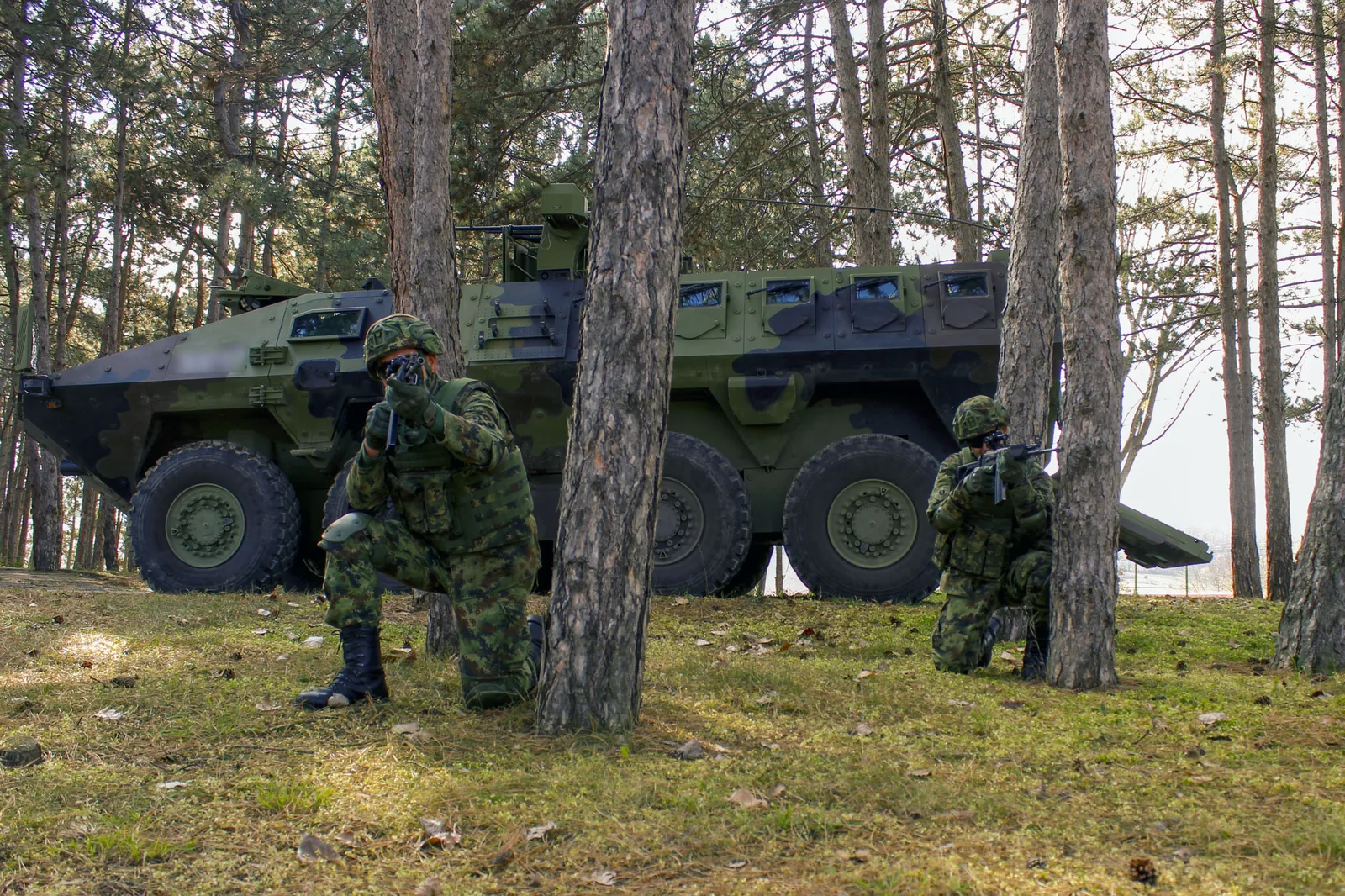
Our proposal is not for Greece to buy ready-made Serbian vehicles, but for Greek defence industry to assemble and develop them, with a Serbian hull design and subsystems: weapon stations, communications, command systems and additional armour. ELVO already has the experience, since it has built military vehicles for decades and assembled under licence most of the 170-plus Leopard 2A6 HEL of the Hellenic Army. A Greek-Serbian family of 4×4 and 8×8 vehicles could gradually cover M113 roles such as APCs, 120 mm mortar carriers, ambulances and command vehicles, and at the same time serve the National Guard, which already uses the Miloš. Greece and Cyprus would thus have a common fleet, common training and common logistics, with a production line on European soil.
The Cypriot argument: ammunition from Greece for the National Guard
The strongest argument for co-production is not Greece, but Cyprus. The National Guard’s NORAs, Tamnavas and Miloš today depend on spare parts and ammunition produced in a country outside the EU and NATO. In June 2025 Serbia halted all arms and ammunition exports, on a decision by President Vučić, after Russian accusations that Serbian ammunition was reaching Ukraine, and every new export now also needs the approval of the National Security Council. In November 2025 Vučić said he was open to sales to EU countries, but the lesson is clear: one decision in Belgrade can close the tap. If the ammunition for Cyprus’s Serbian systems is produced in Greece, under a licence that has already been granted, supply to the National Guard moves onto European soil.
There is also a European framework that eases it. According to the official summary of the EU’s SAFE regulation, joint procurements funded by European loans can also include candidate countries, such as Serbia. If production takes place in Greece and the Serbian components stay under the 35% limit for third countries, a joint Greek-Cypriot ammunition programme could find European funding. If such cooperation stays with simple systems, it does not compete with Greece’s big programmes with France, Israel and the United States, but fills their gaps.
The conditions: what Athens must watch
A Greek-Serbian co-production has risks, and our proposal takes them into account. Serbia is not a member of the EU or NATO, maintains close relations with Russia and China, and in February 2026 Vučić spoke in Ankara of military cooperation with Turkey, only months after accusing it of arming Kosovo. On the other hand, Serbia bought 12 Rafales in 2024 and is turning to French industry, like Greece. That is why we propose three conditions: production to take place in Greece, with Greek ownership of the technical data. The licence to be permanent and not dependent on future Serbian export decisions. And the agreement to contain a clause prohibiting the transfer of technology or of the products of the cooperation to Turkey.
The political ground exists. Defence Minister Nikos Dendias visited Belgrade on November 5, 2024, met Vučić and Defence Minister Bratislav Gašić, and visited the Military Technical Institute (VTI). In February 2026 he stated that, through “Agenda 2030” and ELKAK, Greece seeks to promote joint actions between the defence ecosystems of the two countries. What is missing is a concrete first project. Mortar rounds and 122 mm rockets are the most realistic. They are cheap, needed in large numbers, serve Greece and Cyprus together, and do not touch sensitive technologies. As the discussion of the National Guard’s tanks showed, common Greek-Cypriot logistics are often more important than the weapon itself.
Frequently asked questions about Greece-Serbia co-production
Is there a Greece-Serbia co-production agreement?
No. The article is a proposal. There is political will to strengthen defence cooperation, with Dendias’s visit to Belgrade in November 2024 and his statements in February 2026, but no announced co-production agreement.
Which Serbian systems does Cyprus have?
The National Guard has the 155 mm NORA B-52 self-propelled howitzers, the Miloš 4×4 armoured vehicles and the Tamnava rocket launchers with 122 and 262 mm rockets. In October 2026 Cyprus and Serbia signed a memorandum of cooperation between their defence ministries.
What could Greece and Serbia co-produce?
Simple and plentiful ammunition: 60, 81 and 120 mm mortar rounds, drone munitions, 122 mm rockets for the RM-70s and Tamnavas, and 155 mm ammunition, as well as assembly of 4×4 and 8×8 armoured vehicles at ELVO, with production in Greece.
What are the risks?
Serbia is outside the EU and NATO, has relations with Russia and China and is discussing military cooperation with Turkey. That is why Greek ownership of the technical data, a permanent licence and a clause barring transfer to Turkey are needed.