
Politics & Diplomacy
US sends USS Theodore Roosevelt towards Iran as Trump weighs renewed strikes
The USS Theodore Roosevelt is heading towards the Middle East as Trump weighs further action against Iran and talks over the Strait of Hormuz remain unresolved.

The United States is sending the USS Theodore Roosevelt carrier strike group towards the Middle East as President Donald Trump again raises the possibility of renewed strikes on Iran. The move could place a third American aircraft carrier in the region, alongside the USS George H.W. Bush and USS George Washington, while Washington and Tehran remain divided over a proposal involving the Strait of Hormuz.
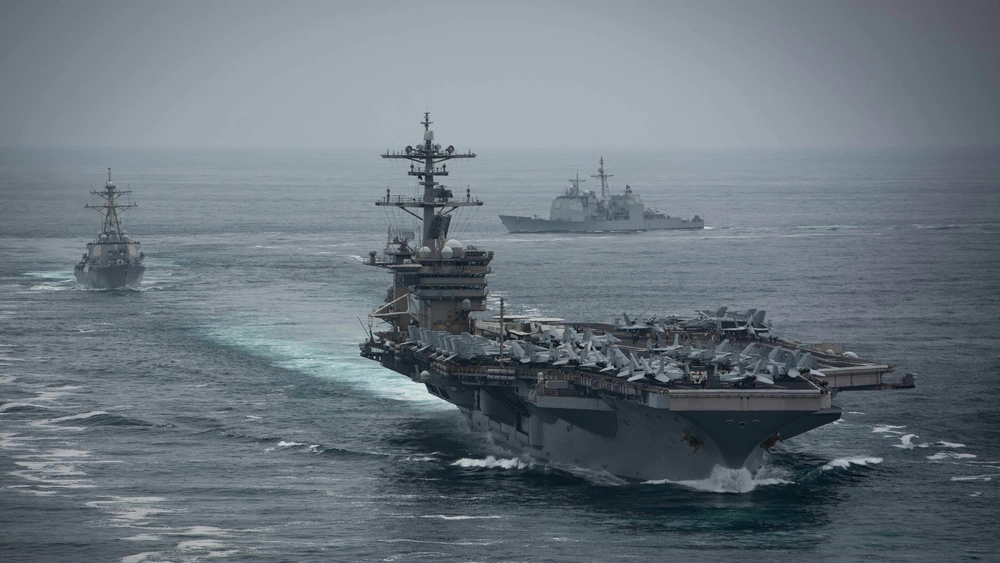
The Theodore Roosevelt left San Diego on Sunday, September 27, according to a U.S. official who described the deployment to Al Jazeera. The Navy’s own September 29 account of the ship’s departure also describes a Middle East deployment. The Makin Island amphibious readiness group departed a day after the carrier, bringing more than 2,000 Marines. The carrier group includes the cruiser USS Chosin; the amphibious group includes the USS John P. Murtha and USS Anchorage.
These forces are still in transit. A U.S. official cited by the Associated Press said the ships together carry more than 7,000 sailors and 2,000 Marines. The same official said three carriers could be in the region by late October. An official speaking to Al Jazeera projected three carriers and two amphibious groups by the end of November. Neither estimate is a confirmed arrival date.
Trump keeps military action on the table
In an interview with Time published on October 1, Trump said it was possible to increase bombing in Iran after the November 3 U.S. midterm elections. He declined to give a detailed account of potential targets or timing. His comments came as the latest attempt to bridge the differences over a ceasefire and maritime access remained unresolved.
Tehran has offered to reopen the Strait of Hormuz as part of a broader arrangement, but Trump said the overall proposal was not good enough. The disagreement concerns more than transit through the waterway: Iran has sought an end to the U.S. naval blockade and sanctions relief, while Washington has not accepted those terms. Geopolitiki previously covered the indirect talks and the rejected Hormuz proposal.
The parallel military and diplomatic tracks carry different degrees of certainty. The deployments and the president’s public remarks are established developments. Reports that bombing may resume on a particular date describe possible decisions rather than an order issued to the armed forces. The timeline for all the newly deployed ships to reach the region also remains subject to change.
Iranian officials have warned that a new American strike could bring retaliation against U.S. bases and interests in the Middle East. Foreign Minister Abbas Araghchi has said Tehran is prepared for a return to fighting while continuing to discuss a negotiated solution. Those warnings are statements of intent; they do not establish that a further American attack has been ordered or that Iranian retaliation has begun.
The USS Theodore Roosevelt’s departure adds a substantial naval formation to forces already operating near Iran at a moment when both governments are publicly leaving open the possibility of further escalation. For now, the carrier is moving towards the region while the terms of a possible deal over Hormuz remain unsettled.
Other developments around the Iran talks
The carrier movement comes amid a wider series of diplomatic and security developments. The United States delivered its response to an Iranian seven-day plan through Qatar on September 30. Iranian Foreign Minister Abbas Araghchi said Tehran had begun examining it, while Iranian sources described disagreement over the order in which steps would be carried out. The proposal’s reference to reopening Hormuz has not resolved the broader dispute over sanctions and the U.S. naval posture.
Washington also announced further sanctions aimed at weapons-procurement networks and offered a reward for information that could disrupt financing for the Islamic Revolutionary Guard Corps. In a separate incident, the United Kingdom Maritime Trade Operations reported an attack on a tanker in the Strait of Hormuz. These events form part of the tense setting for the carrier deployment, but the reported attack and the diplomatic exchanges do not establish a decision by the United States to resume strikes.
Iranian officials continued to issue warnings. Parliament speaker Mohammad Bagher Ghalibaf threatened regional infrastructure if Iran’s security and oil exports were not protected, while the Revolutionary Guards warned of a response if fighting restarted. Those positions remain statements by Iranian officials. The publicly reported American naval movements and the unresolved negotiations are the immediate developments.