Greece
ERMIS-3: Greece’s first laser link with a low-orbit satellite, at Mount Holomontas
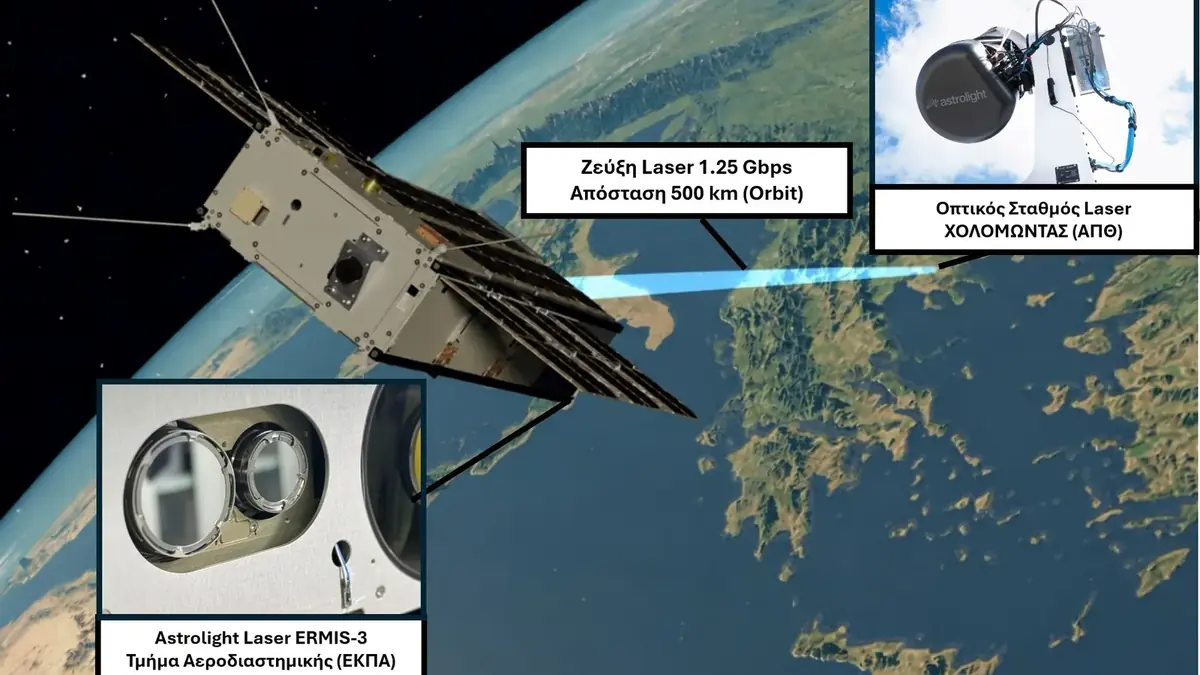
A Greek satellite “spoke” for the first time with a ground station in Greece by laser beam: the University of Athens nanosatellite ERMIS-3 and the Aristotle University telescope at Holomontas.

A Greek satellite “spoke” for the first time to a ground station in Greece by laser beam. The satellite is ERMIS-3, a nanosatellite built by the National and Kapodistrian University of Athens (NKUA) at Psachna, Euboea, and the telescope that picked up its signal belongs to the Aristotle University of Thessaloniki (AUTh) on Mount Holomontas. The university released the news on Thursday, October 22, in an announcement on the NKUA Hub about the first experiments with the optical link.
An optical link carries data with an infrared laser rather than radio waves: the satellite emits the beam and a telescope on Earth catches it. ERMIS-3 is a CubeSat, a tiny satellite of standard dimensions (here the 8U type), moving in low Earth orbit (LEO) at an altitude of about 500 km. A link with a low-orbit satellite, which passes quickly over the station, is harder: NKUA calls it a first in Greece with a LEO satellite and one of the first stable nanosatellite links in the world.
Who took part
Many bodies took part. The optical ground station was built by AUTh’s Department of Physics, specifically the Laboratory of Theoretical Mechanics and Astrodynamics, with partners Astrolight and the European Space Agency (ESA). Lithuania’s Astrolight also built the laser transmitter on the satellite and the receiver on Earth. Support came from ESA, the Hellenic Space Center and the Ministry of Digital Governance, while ERMIS belongs to the National Microsatellite Programme, funded by the Recovery Fund.
NKUA judges the link’s performance sufficient for operational or commercial use. The link worked at night and by day, with partial cloud cover and with the satellite at an elevation angle even below 10 degrees, while trees or clouds at times obstructed the line of sight. After calibration, availability exceeded 85% of the time. There was signal from the first active pass (“first light”) and by the third both ends of the link were fully calibrated and operating autonomously on a preset schedule. Two links a day are now made routinely. The ATLAS-1 laser terminal currently transmits at 1 Gbps (a billion bits per second), while the link budget, the calculation of signal power and losses, leaves room for up to 10 Gbps.
Vaios Lappas and Antonis Paschalis, NKUA professors and ERMIS scientific leads, spoke of “the first stable laser links from a nanosatellite worldwide”. Kleomenis Tsiganis, who leads AUTh’s SSA and OGS activities and is principal investigator in the HolOGS programme, called the success “a significant milestone” for his team and for optical communications in the country. The Holomontas station is being upgraded through HolOGS, backed by ESA (ARTES ScyLight), and is part of HellasQCI, the national quantum communications network.
Why it matters
A laser can carry huge volumes of data for 5G networks and AI applications, link satellites to one another and, as NKUA underlines, serve national security and defence, since the beam cannot be intercepted. The university adds that the way is opening to quantum communications, which few countries have.
Frederic Rouesnel, head of the ESA office managing the implementation of resilience initiatives, said the success proves that Europe can offer “world-class innovation”. Digital Governance Minister Dimitris Papastergiou said that through the National Microsatellite Programme the country’s investment in space is becoming “substantial know-how”, while the programme gives young scientists and engineers training and hands-on experience.
ERMIS-3 travelled with ERMIS-1 and ERMIS-2 on March 30 from California on a SpaceX Falcon 9, and on June 25 captured the first Greek satellite image.