
Analysis
Iran war timeline 2026: Epic Fury, Hormuz and the US blockade
A dated timeline of the 2026 Iran war, from the February 28 strikes and the closure of the Strait of Hormuz to the ceasefire, the June memorandum and the reimposed U.S. blockade, based on Congressional Research Service reports.

The war between the United States, Israel and Iran began on February 28, 2026, when U.S. and Israeli forces started striking targets in Iran. Iran answered with attacks across the Gulf and by closing the Strait of Hormuz to most shipping. A ceasefire on April 7 and a memorandum of understanding on June 17 did not hold, and by August the U.S. naval blockade of Iranian ports had been reimposed.
Key points
- Operation Epic Fury (the U.S. name) and Operation Roaring Lion (the Israeli name) began on February 28, 2026.
- Days later Iran declared the Strait of Hormuz closed; in 2025 about 25% of the world’s oil trade and 19% of its LNG trade passed through it.
- A U.S.-Iran ceasefire was agreed on April 7; the U.S. ordered a blockade of Iranian ports on April 13.
- The June 17 memorandum of understanding collapsed after Iranian attacks on ships on June 25 and July 7-8, and the blockade was reimposed.
This timeline rests on two reports of the U.S. Congressional Research Service (CRS), the research arm of Congress: R48887 of March 26, 2026 and R45281, updated August 7, 2026. Events after that update are covered in our separate reporting, linked at the end.
Iran war timeline at a glance
| Date (2026) | Event |
|---|---|
| Late December 2025 to late February | President Trump directs a buildup of U.S. forces near Iran. |
| February 28 | U.S. and Israeli forces begin striking Iran (Operation Epic Fury and Operation Roaring Lion). Supreme Leader Ali Khamenei is killed. |
| Early March | Iran declares the Strait of Hormuz closed; traffic largely halts. |
| March 11 | The International Energy Agency announces the largest-ever coordinated release of emergency oil stocks, 400 million barrels. |
| April 7 | U.S.-Iran ceasefire agreed. |
| April 13 | After talks in Islamabad fail, President Trump orders a blockade of Iranian ports. |
| May 3 | “Project Freedom” announced to guide ships through a southern route; paused two days later. |
| June 17 | U.S.-Iran memorandum of understanding signed. |
| June 25 and July 7-8 | Iranian attacks on ships off Oman; U.S. airstrikes follow. |
| Mid-July | The U.S. blockade is reimposed (CENTCOM announcement dated July 13). |
How did the war start?
The CRS places the roots in the second Trump administration’s “maximum pressure” policy of February 2025 and in the 12-day war of June 2025, when Israel struck Iran and the United States hit three nuclear facilities on June 22. According to the same report, President Trump then directed a military buildup near Iran from late December 2025 to late February 2026.
On February 28 U.S. and Israeli forces began strikes. Announcing them, President Trump said the goal was to “eliminate imminent threats from the Iranian regime.” U.S. officials listed objectives including destroying Iran’s ballistic missile arsenal and navy. Ali Khamenei, in office since 1989, was killed and his son Mojtaba Khamenei became Supreme Leader.
By March 25 U.S. Central Command (CENTCOM) reported more than 10,000 targets struck in Iran, and U.S. officials claimed “air superiority over vast swaths of Iran,” according to the CRS. The CRS also notes reports that a Tomahawk missile hit a school in Minab on February 28, killing 168 people, mostly children, and that a preliminary U.S. military investigation reportedly found the United States responsible.
The video below, from the BBC, reviews how the conflict escalated in its first weeks.

Why did the Strait of Hormuz become the centre of the war?
The Strait lies between Iran and Oman and is 22 nautical miles wide at its narrowest point, within Iranian and Omani territorial waters. In 2025 roughly 20 million barrels a day of oil moved through it, about a quarter of world oil trade, along with 19% of global LNG exports, mainly from Qatar and the UAE, the CRS reports.
Within days of the first strikes Iranian forces declared the Strait closed and traffic largely stopped, leaving hundreds of vessels and thousands of mariners trapped in the Gulf. Iran let ships of some nations pass through its own waters and reportedly charged fees. In May it set up a “Persian Gulf Strait Authority” and claimed that no vessel could pass without its permit; the CRS describes the claim to control the whole Strait as unprecedented and notes it runs against the fact that part of the Strait is Omani water.
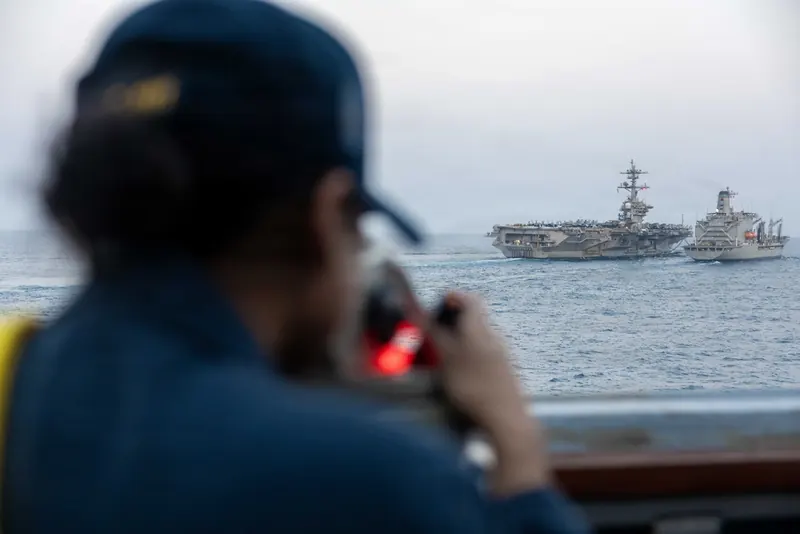
Markets reacted quickly. On March 11 the IEA announced a coordinated release of 400 million barrels from the emergency stocks of 32 member countries, of which the United States pledged 172 million barrels. The CRS reports that between February and May European gas prices rose 44% and Asian prices 66%, while global oil prices rose 50%. For background on the waterway itself, see our explainer Strait of Hormuz explained: why the narrow passage matters.
What happened after the April ceasefire?
The ceasefire of April 7 stopped major combat, but President Trump made it conditional on the “COMPLETE, IMMEDIATE, and SAFE OPENING of the Strait of Hormuz,” and Iran halted traffic again in response to Israeli attacks in Lebanon. After the Islamabad talks failed, the blockade of Iranian ports began on April 13. During this first phase, which lasted until mid-June, CENTCOM reported redirecting more than 140 ships and “disabling” 9.
The June 17 memorandum, signed by Presidents Trump and Pezeshkian, declared the “removal of [the U.S.] naval blockade” and committed Iran to arrange safe passage with no charge for 60 days. In late June the International Maritime Organization and Oman organized an evacuation of trapped ships through Omani waters. Days later, on June 25, Iran attacked a ship in Omani waters and the United States responded with airstrikes. After a second round of Iranian attacks on July 7-8, President Trump said the memorandum was no longer in force.
The CRS says that by mid-July the volume of attacks was higher than at any time since April, and that as of early August conflict had abated amid Iran-Oman talks on the Strait. The U.S. blockade was back in force. Our report CENTCOM marks 100 days of Iran blockade, claiming $25 billion in crude kept off the market as the IRGC threatens US bases covers the position in late October, and Waltz: Iran war could last another year, US can hold blockade “for the foreseeable future” records what the White House says about its duration.
What options does Washington have, according to Congress’s researchers?
The CRS lists several possible paths for the Strait: military action to control Iran’s coast, naval escorts as in the 1980s, a U.S.-run administration of the Strait, a cooperative arrangement modelled on the Strait of Malacca, continued instability, or a shift of U.S. resources away from the Gulf. It does not predict which will occur. It notes that Iran’s Speaker of Parliament Mohammad Baqer Qalibaf reportedly said on June 23 that management of the Strait “will never return to the way it was before the war.”
Sources
Congressional Research Service, The Strait of Hormuz: Security Developments and Impacts on Oil, Gas, and Other Commodities (R45281, updated August 7, 2026), and U.S. Conflict with Iran (R48887, March 26, 2026). Figures and quotations are as reported in those documents; claims by governments are attributed to them.