
Analysis
F-14 Tomcat and Top Gun: the fighter, the school and the film that built the legend of the US Navy
The F-14 Tomcat was designed to defend US carriers from Soviet bombers, but it became a global symbol through the TOPGUN school and the 1986 film. A look at the aircraft, the school born of Vietnam’s lessons, and the film that made the legend.

There are fighters that won wars and fighters that won generations. The F-14 Tomcat is one of the few that did both. Grumman designed it to protect American carriers from Soviet bombers and cruise missiles at distances no other naval fighter could reach, and for thirty years it was the US Navy’s “fleet defender”. What made it a global symbol, however, was not its radar or its missiles. It was its meeting with two other legends: the Navy Fighter Weapons School, TOPGUN, born of the bitter lessons of Vietnam, and the 1986 film that turned a demanding training school into a dream for millions of teenagers. To understand why an aircraft retired in 2006 still fills cinemas, forums and shelves of scale models, one has to look at the aircraft, the school and the film together.
From Calverton to USS Enterprise: a fighter built for the fleet
The first F-14A flew on December 21, 1970, with Grumman test pilots Robert Smyth and William Miller, at the company’s plant in Calverton, Long Island. The Navy wanted an aircraft that could detect threats long before they reached the carrier group and shoot them down at long range, while remaining capable in close air combat. Grumman’s answer was a large, twin-engine, two-seat fighter with variable-geometry wings, which opened for safe deck landings and swept back for supersonic flight. In the back seat sat the Radar Intercept Officer (RIO), the film’s “Goose”, who operated the AWG-9 radar, one of the most powerful airborne radars of its day, able to track dozens of targets at once and direct missiles against six of them.
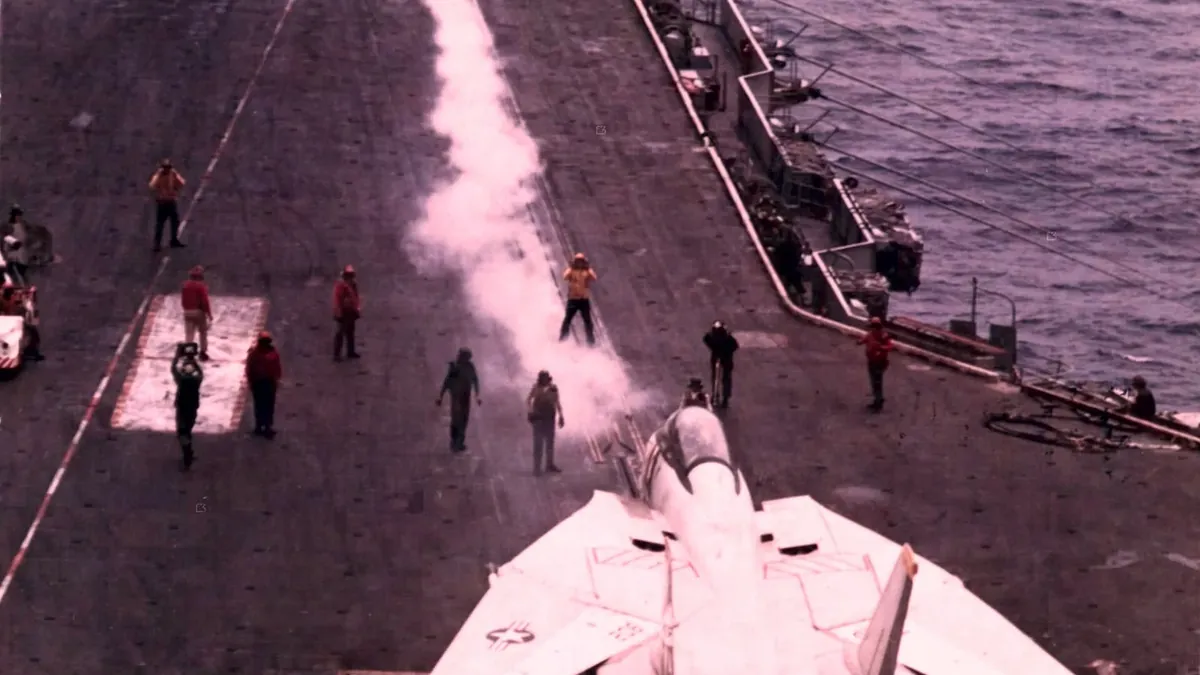
The first operational mission came almost at once. The squadrons VF-1 “Wolfpack” and VF-2 “Bounty Hunters” embarked on the nuclear-powered USS Enterprise for the deployment from September 17, 1974 to May 20, 1975, and on April 29, 1975 flew to cover Operation Frequent Wind, the evacuation of Saigon. It was a symbolic start: the fighter that would become the face of American naval aviation entered service on the day the chapter of the war that gave birth to TOPGUN closed. In all, 712 F-14s were built in three main versions: the original F-14A with TF30 engines, the F-14B with the more powerful General Electric F110, and the F-14D, with the same engines, digital electronics and the APG-71 radar.
AIM-54 Phoenix: the missile that made the Tomcat unique
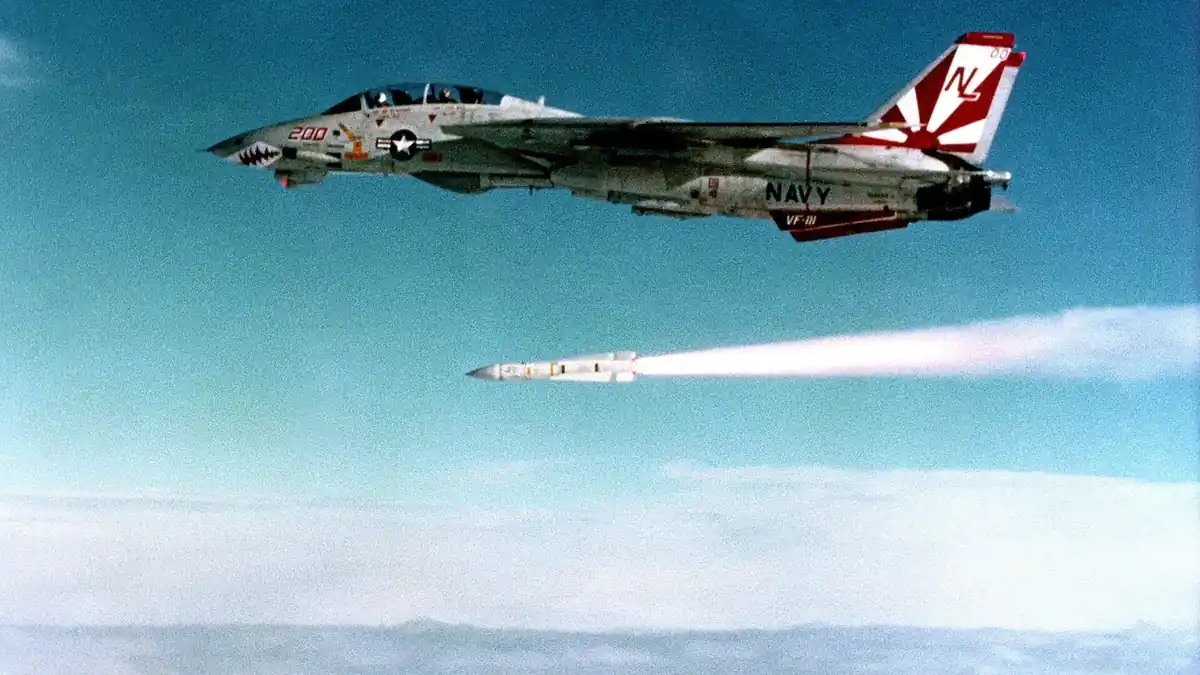
If the AWG-9 was the Tomcat’s eyes, the AIM-54 Phoenix was its fist. It was the first American air-to-air missile with active radar in its terminal phase and a range of more than 100 nautical miles, about 185 kilometres, something that sounded like science fiction in the 1970s. An F-14 could carry up to six Phoenix and, in a famous 1973 test, a Tomcat fired six missiles at six targets in less than a minute. The AWG-9 and Phoenix combination gave each carrier group an “umbrella” hundreds of kilometres deep, exactly what was needed against Soviet Tu-22M Backfire bombers and their cruise missiles. The same combination explains why the F-14 stayed for decades without a real replacement in the long-range interception role, until it was retired in 2006, two years after the Phoenix in 2004.
TOPGUN: the school born of Vietnam’s defeats
The TOPGUN school came before the Tomcat. It was founded on March 3, 1969 at Naval Air Station Miramar in California, when the US Navy found that its pilots over Vietnam were shooting down far fewer enemy aircraft than expected. The Navy had bet that missiles would make dogfighting a thing of the past, and Phantom pilots found themselves in close engagements with agile MiGs without the training they needed. The answer was a small team of instructors teaching dissimilar air combat training (DACT), with “aggressors” flying like Soviet pilots, and returning graduates to their squadrons as instructors for the rest. When the F-14 arrived at Miramar, the school and the aircraft became almost synonymous. In 1996 TOPGUN moved to Fallon, Nevada, and today runs as the Strike Fighter Tactics Instructor (SFTI) programme, as Northrop Grumman recalls.
Top Gun (1986): when Hollywood climbed onto the flight deck
Producers Don Simpson and Jerry Bruckheimer secured the full support of the US Navy before a final script even existed, with Pete “Viper” Pettigrew, a former TOPGUN instructor, as technical adviser. The American Film Institute catalogue records that Paramount paid up to $7,800 an hour for fuel and the cost of each flight outside the aircraft’s normal duties, and in August 1985 the crew spent five days on USS Enterprise for the sea filming. The F-14s came from the Miramar squadrons, with aircraft of VF-51 “Screaming Eagles” and VF-111 painted in fictional markings, while the enemy “MiG-28s” were in reality Northrop F-5s painted black with red stars. Tony Scott’s directing choices, with deck shots against the sun and cameras in the cockpits, gave the F-14 a cinematic image no other fighter ever acquired.
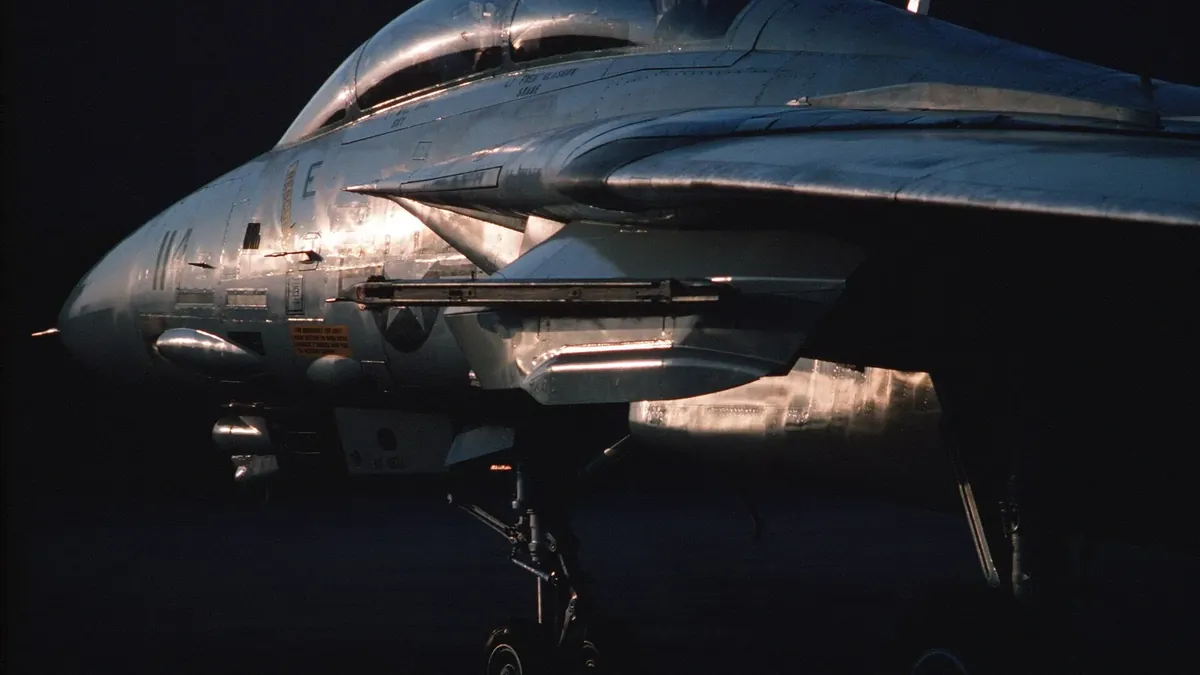
The result exceeded every expectation. “Top Gun” was the highest-grossing film of 1986, its soundtrack was a best seller, and Tom Cruise and Val Kilmer shot to the top of Hollywood. In 2015 the Library of Congress selected the film for preservation in the National Film Registry. The view of those who served on F-14s then is interesting too: an RIO of the period who appears as an extra in the background later told Northrop Grumman that the film was fairly accurate about TOPGUN’s lessons and flights, but that the 12-hour daily schedule left no time for singing at a piano bar or volleyball on the beach. The film did not only change the US Navy’s image. It made the F-14 the fighter a whole generation of aviation enthusiasts grew up with around the world, and in Greece.
Sidra, Kuwait, Iran: the Tomcat in combat
Beyond cinema, the F-14 had a real combat record, its best-known page very close to our own neighbourhood. On August 19, 1981, over the Gulf of Sidra, which Gaddafi claimed as Libyan waters, two F-14As of VF-41 “Black Aces” from USS Nimitz were attacked by two Libyan Su-22s. One Su-22 fired a heat-seeking missile that missed, and the two Tomcats, crewed by Henry “Hank” Kleemann and David Venlet in one and Larry Muczynski and James Anderson in the other, shot down both Libyan aircraft with AIM-9L Sidewinders. On January 4, 1989 history repeated itself when two F-14As of VF-32 from USS John F. Kennedy shot down two Libyan MiG-23s in the same area.
In Operation Desert Storm in 1991 the F-14s flew combat air patrols and reconnaissance missions with the TARPS pod, but Iraqi pilots systematically avoided contact with them. In the 1990s, with the retirement of the A-6 Intruder, the Tomcat gained precision-strike capability with the LANTIRN targeting pod and the nickname “Bombcat”, which took it to missions over Iraq and Afghanistan. The F-14’s other combat story, however, was written in different colours. The Shah’s Iran received 79 F-14As before the 1979 Revolution and used them extensively in the war with Iraq. After 2006 it remained the type’s only user. Iranian Tomcats were kept flying for decades by cannibalising spare parts and local production, with accidents such as the one in 2022 in Isfahan, and the last of them became targets of Israeli air raids in 2025 and 2026.
Retirement and Top Gun: Maverick: why the legend did not die
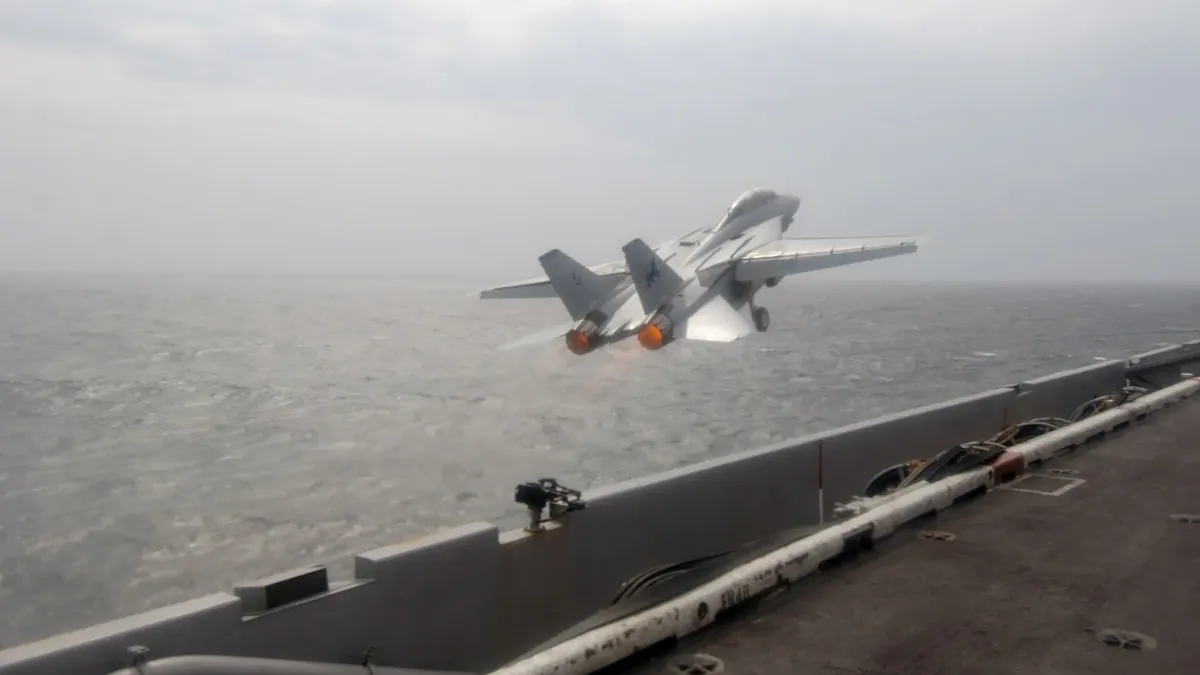
On March 10, 2006 the F-14Ds of VF-213 “Black Lions” and VF-31 “Tomcatters” took off from USS Theodore Roosevelt for the last return from an operational deployment, and on September 22, 2006 the US Navy officially said goodbye to the Tomcat with a ceremony at Oceana, Virginia. Northrop Grumman recalls that in the same year Lt. Cmdr. Chris Richard flew the last F-14 back to Long Island, a few kilometres from where it was built. Its place was taken by the F/A-18E/F Super Hornet, cheaper to maintain and far more flexible in the strike role, but without the range and the “charisma” of its predecessor. Most retired American F-14s were scrapped so that spare parts would never reach Iran.
In 2022 “Top Gun: Maverick” brought the legend back to the big screen. The new film flew Super Hornets, but its most moving moment for enthusiasts was Maverick and Rooster’s escape from an enemy airfield in an F-14, with the veteran pilot rediscovering the aircraft of his youth. That the only real F-14 user today is Iran did not go unnoticed by viewers. Four decades after the first film, the F-14 Tomcat shows that the power of a weapon system is measured not only in kills and nautical miles but in how many people it made look up at the sky.
Frequently asked questions
Which aircraft were used in the 1986 film Top Gun? The F-14A Tomcats came from Naval Air Station Miramar squadrons, among them VF-51 “Screaming Eagles” and VF-111, with aircraft painted in fictional markings. The enemy “MiG-28s” were Northrop F-5s painted black, and scenes at sea were also filmed on USS Enterprise.
When was the real TOPGUN school founded? On March 3, 1969 at Naval Air Station Miramar, California, in response to the disappointing performance of American fighters in Vietnam air combat. In 1996 it moved to Fallon, Nevada, and today runs as the SFTI programme.
How many F-14 Tomcats were built and when were they retired? 712 aircraft were built. The last operational deployment ended in March 2006 and the US Navy officially retired the F-14 on September 22, 2006.
Who uses the F-14 today? Only the Iranian Air Force, which received 79 F-14As before the 1979 Revolution. The number of flyable aircraft is now very small, as several were destroyed in Israeli raids in 2025 and 2026.