Greece
Ankara challenges Greece’s new muftis of Komotini and Xanthi in Turkish Foreign Ministry statement No. 207
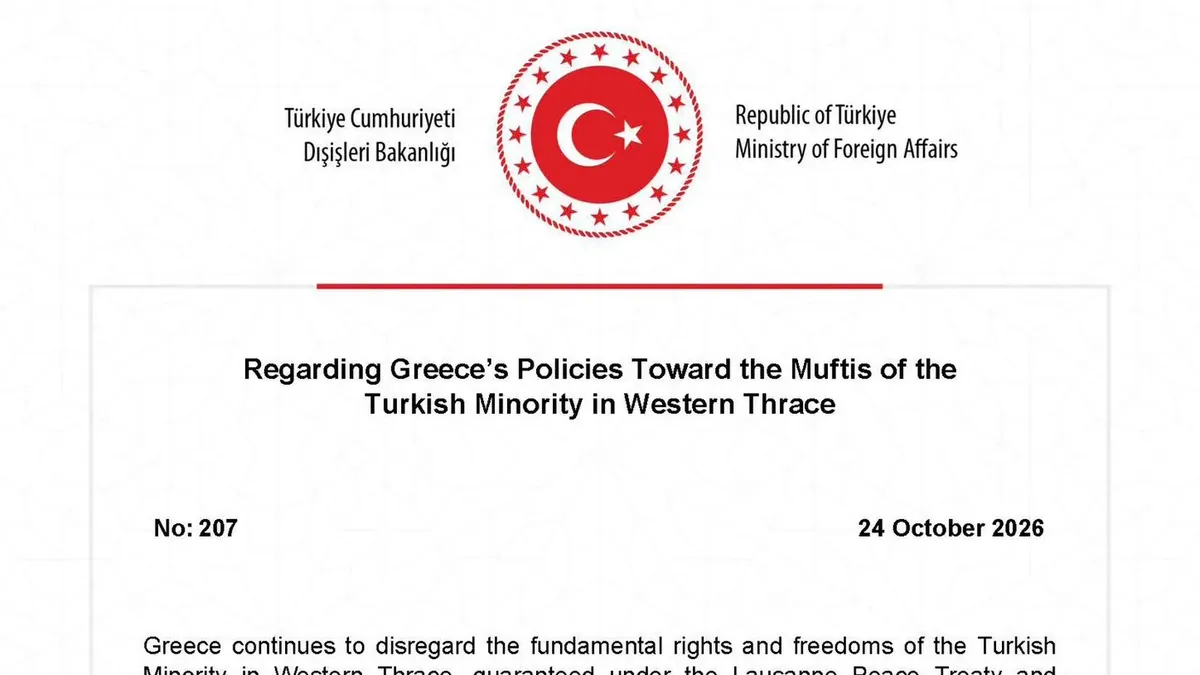
Turkey’s Foreign Ministry accused Athens of ignoring the rights of the Muslim minority of Thrace by appointing “so-called muftis”. Greece appoints the muftis by law, with a five-year term renewable once.

Turkey has officially reacted to the appointment of the new muftis of Komotini and Xanthi. Turkey’s Foreign Ministry issued on Saturday, October 24 statement No. 207, in which it accuses Athens of continuing to ignore the fundamental rights and freedoms of the minority by appointing “so-called muftis”.
Ankara invokes the Treaty of Lausanne and other international agreements and argues that the institution of the mufti is an integral part of the religious, social and cultural identity of the minority, which the statement calls “Turkish”. According to the Turkish Foreign Ministry, Greece’s refusal to recognise the muftis “elected” by the minority ignores its will and religious freedom and once again reveals a “distorted understanding” of fundamental human rights. The text closes with an appeal to the Greek authorities to recognise the “legitimate” elected muftis and to abandon efforts to “impose” appointed ones.
The Greek legal framework
In the Greek legal order, the muftis of the Muslim minority of Thrace are religious officials appointed by the state who exercise competences assigned to them by law. That is why Athens does not recognise those who emerge from informal “elections” with Ankara’s backing, and who in Greece are called pseudo-muftis. The Lausanne Treaty protects a religious minority, not an ethnic “Turkish” one.
The statement comes two days after the appointments were made public. As Geopolitiki reported on Thursday, October 22, on the proposal of Minister of Education, Religious Affairs and Sports Sofia Zacharaki, Siukri Serif Damadoglou becomes mufti of Xanthi and Bilal Kara Halil mufti of Komotini. With the appointment of Emin Serif in Didymoteicho, all three Muftiates of Thrace now have heads. Their term is five years and can be renewed only once.
A pattern of Turkish statements
It is not the first time in 2026 that the Turkish Foreign Ministry has targeted Athens’s policy in Thrace. In July its spokesman Öncü Keçeli condemned the closure of eight minority primary schools because of low enrolment, speaking of a violation of the Treaty of Lausanne. The same issue returned in October with Daily Sabah’s report on the minority schools.
The new Turkish statement adds to a period of heightened tension in Greek-Turkish relations, with the illegal Turkish-Libyan memorandum and Athens’s reactions at the UN at the centre of the diplomatic confrontation of recent days.