Greece
Truman Doctrine explained: why the US aided Greece in 1947
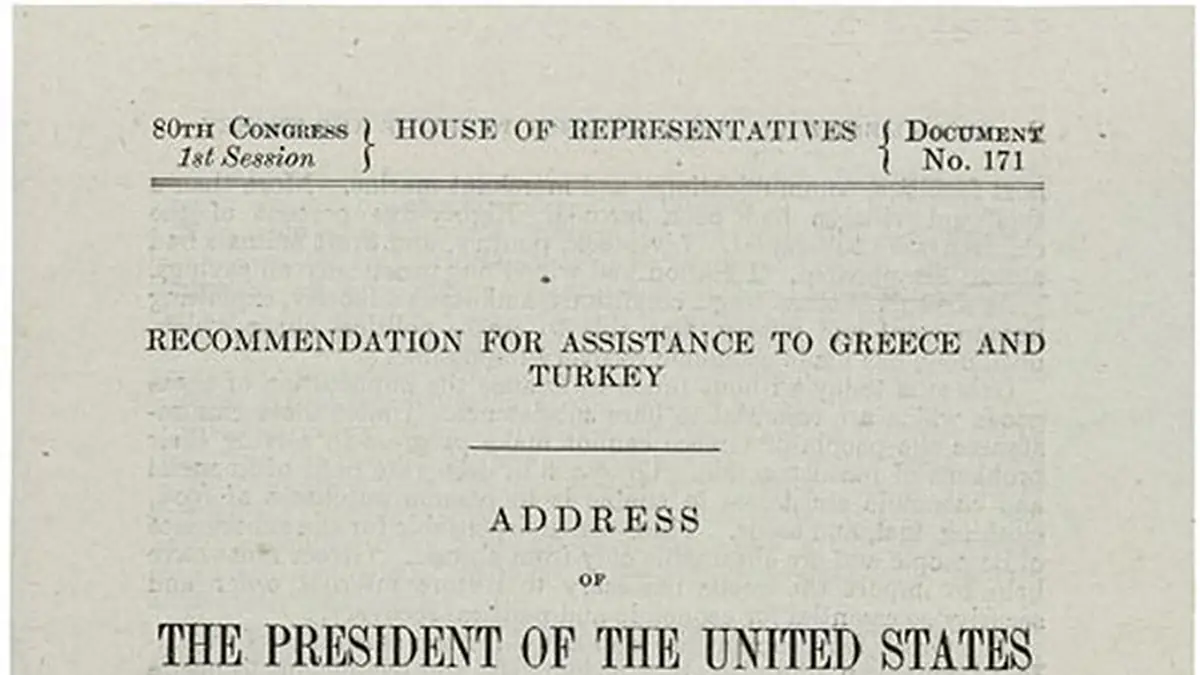
On March 12, 1947 President Truman asked Congress for $400 million to help Greece and Turkey after Britain pulled back. Here is what he said, why Greece needed the aid and how the first results looked.

The Truman Doctrine was President Harry S. Truman’s request, made to a joint session of Congress on March 12, 1947, for $400 million in aid to Greece and Turkey. It followed a British warning that London could no longer pay for Greece’s survival, and it committed the United States to support “free peoples who are resisting attempted subjugation by armed minorities or by outside pressures.” Congress approved the aid, and Truman signed it into law on May 22, 1947.
Key points
- Britain told Washington in late February 1947 that it could not go on carrying the financial burden for Greece and Turkey; its aid to Greece was to end on March 31.
- Truman asked Congress for $400,000,000 for the period ending June 30, 1948, plus American civilian and military personnel to supervise how the money was used.
- He described a Greece devastated by invasion, “four years of cruel enemy occupation” and internal strife, and argued that its fall would endanger Turkey and the wider Middle East.
- The U.S. State Department’s historians say the speech turned American policy from withdrawal from distant conflicts to possible intervention in them.
Why did Greece need American help in 1947?
In his address Truman said that since 1940 Greece had suffered “invasion, four years of cruel enemy occupation, and bitter internal strife.” When the retreating Germans left, he told Congress, they had destroyed virtually all railways, roads, port facilities, communications and the merchant marine. “More than a thousand villages had been burned,” he said, and “inflation had wiped out practically all savings.”
The president linked this ruin to the civil conflict. He spoke of “the terrorist activities of several thousand armed men, led by Communists” who defied the government, especially along the northern frontier, and noted that a commission appointed by the UN Security Council was investigating border violations between Greece and Albania, Bulgaria and Yugoslavia. The Greek army, he said, was “small and poorly equipped.”
Truman also said the request came from Athens itself: the United States had received from the Greek Government “an urgent appeal for financial and economic assistance.” He defended the government’s democratic legitimacy by saying it represented 85 percent of the members of the Greek Parliament chosen in an election the year before, which foreign observers, “including 692 Americans,” considered “a fair expression of the views of the Greek people.”
How did Washington decide to act?
The immediate trigger was Britain. The historians of the U.S. Department of State write that the British Government announced it would stop providing military and economic assistance to the Greek Government as of March 31. The declassified record shows how seriously Washington took the notes: a special committee on aid to Greece and Turkey reported to Under Secretary of State Dean Acheson on the “Analysis of the Proposals Contained in British Notes of February 24,” and warned that a sweeping deterioration of the Greek situation could have “profound repercussions in other parts of the Near East and Europe.” The committee proposed a wider State-War-Navy study of what Britain’s retreat meant for American policy.
The same Office of the Historian account stresses the Cold War setting. In 1946, it notes, the Soviet Union had not withdrawn troops from northern Iran on schedule, had pressed Iran for oil concessions, had sought base and transit rights from Turkey through the Straits, and had rejected the Baruch plan for international control of nuclear weapons. U.S. officials believed Moscow backed the Greek Communists. The Office adds a caveat: Joseph Stalin had in fact deliberately refrained from supporting them and had forced Yugoslavia’s Josip Broz Tito to do the same.
What did Truman ask Congress to do?
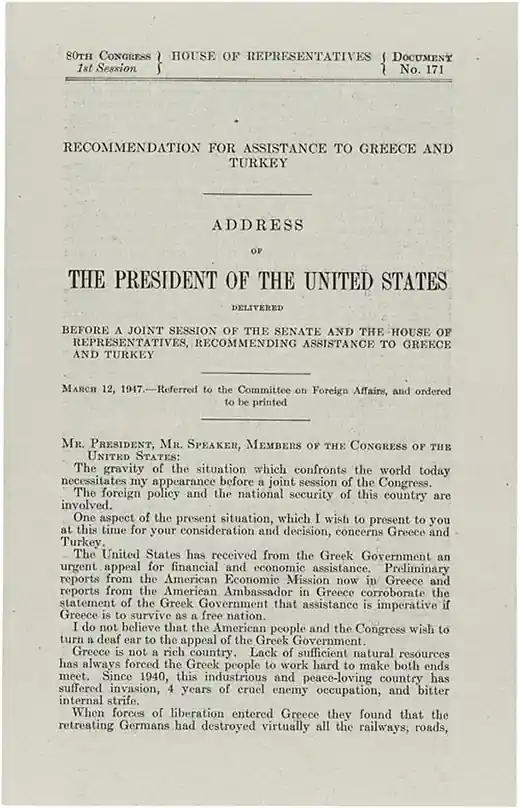
The speech made three requests: $400,000,000 for Greece and Turkey for the period ending June 30, 1948; authority to send American civilian and military personnel to the two countries, at their request, to help with reconstruction and to supervise the use of the money; and authority for the instruction and training of selected Greek and Turkish personnel.
He set conditions and limits. American supervision was needed, he said, so that “each dollar spent will count toward making Greece self-supporting.” He acknowledged that the Greek government “has made mistakes” and that American aid did not mean the United States “condones everything that the Greek Government has done or will do,” adding: “We have condemned in the past, and we condemn now, extremist measures of the right or the left.” He argued that the United Nations could not provide help of the needed kind quickly enough.
The principle he drew from the crisis became the doctrine itself: “I believe that it must be the policy of the United States to support free peoples who are resisting attempted subjugation by armed minorities or by outside pressures.” He added that the help should be “primarily through economic and financial aid.”
Watch a short explanation of how the speech shaped the early Cold War.
What about Turkey?
Truman presented Turkey as the second case. He said its future as an independent and economically sound state was “clearly no less important” than Greece’s, that Turkey had been “spared the disasters that have beset Greece,” and that its integrity was essential to “the preservation of order in the Middle East.” Britain had told the United States it could no longer extend financial or economic aid to Turkey either. For Greece the argument was survival after occupation and war; for Turkey it was modernization and strategic position. The two cases are linked in the law, not in their histories.
Key dates
| Date | Event |
|---|---|
| February 24, 1947 | British notes to Washington on Greece and Turkey, analysed by a U.S. committee. |
| March 12, 1947 | Truman asks Congress for $400 million in aid to Greece and Turkey. |
| March 31, 1947 | Date from which Britain said it would stop aiding Greece. |
| May 22, 1947 | Truman signs Public Law 75 (61 Stat. 103); Executive Order 9857 sets out the rules for carrying it out. |
| November 10, 1947 | Truman sends Congress the first quarterly report on the program. |
Did the aid work?
At the signing, Truman said the act had passed “by overwhelming majorities in both Houses of the Congress” and that American ambassadors to Greece and Turkey were being instructed to negotiate agreements on how the aid would be applied. He promised the aid would “benefit all the peoples of Greece and Turkey, not any particular group or faction.”
The first quarterly report, sent to Congress in November 1947 and covering the quarter to September 30, was candid. Truman wrote that the economic situation in Greece “has not basically improved” since his speech, although economic collapse had been averted. He listed unfavourable developments: a smaller cereal harvest because of the European drought and guerrilla activity, higher prices that cut the buying power of Greek foreign exchange, and the intensification of military operations, which forced a transfer of funds from the economic to the military program. The first months, he said, were “largely one of preparation.”
Why does the Truman Doctrine still matter?
The Office of the Historian says the doctrine established that the United States would help democratic nations under threat from external or internal authoritarian forces, a reorientation of foreign policy away from its usual stance of withdrawal from regional conflicts. For Greece, it began a security relationship with Washington that later continued inside the Atlantic alliance. Our explainer NATO Article 5 explained: what it covers and why Greece joined follows that story, and Ohi Day explained: how Greece answered Italy’s ultimatum in 1940 covers the start of the wartime ordeal Truman described. For the older settlement behind the region’s disputes, see Treaty of Lausanne explained: borders, islands and minorities.
Sources
Truman Library: Special Message to the Congress on Greece and Turkey, March 12, 1947, statement on signing the bill, May 22, 1947, and the special message transmitting the first quarterly report on assistance to Greece and Turkey (November 10, 1947). U.S. Department of State, Office of the Historian: The Truman Doctrine, 1947 and Foreign Relations of the United States, 1947, Volume V, document 33.