
Cyprus
BREAKING: NAVTEX issued for the Abeille Marengo – surveys for the Greece–Cyprus cable resume
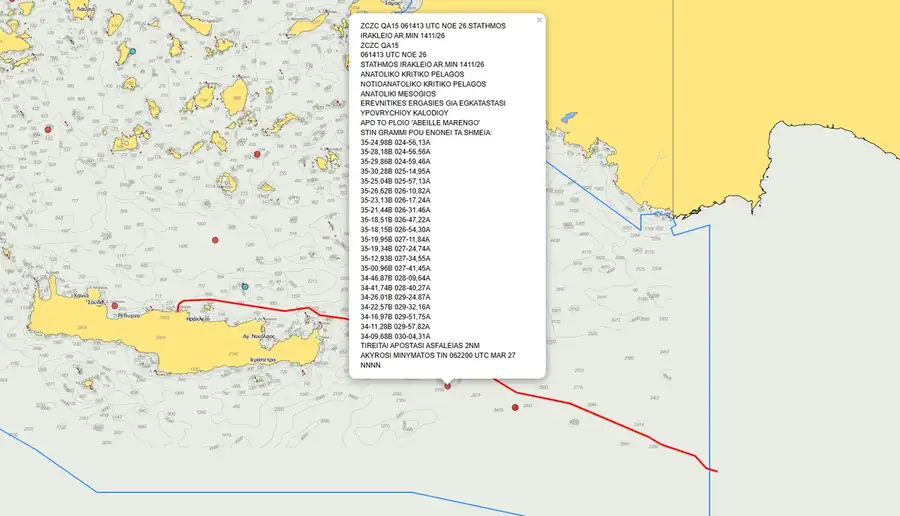
The Heraklion station of the Hellenic Navy Hydrographic Service has issued NAVTEX 1411/26, clearing the way for the Abeille Marengo to resume seabed surveys for the Greece–Cyprus cable.

Green light for the Abeille Marengo: the NAVTEX has been issued, opening the way for surveys for the Greece–Cyprus electricity interconnector (GSI) to resume. The warning, number 1411/26, was issued by the Heraklion station of the Hellenic Navy Hydrographic Service. It reserves sea areas for the ship’s work for four months, taking effect on Friday, November 6 and expiring on March 6, 2027.
The warning covers areas east and southeast of Crete, as well as the Eastern Mediterranean. The French survey vessel has anchored in Heraklion, and its work is expected to begin over the weekend, starting from Greek territorial waters.
The Foreign Ministry’s announcement
The Ministry of Foreign Affairs announced that “the foreseen licensing procedures by the competent Greek Authorities have been completed” for the survey and cable-laying work. The request had been submitted by the French company Nexans on behalf of GSI, the company that owns the project.
The Interministerial Committee for the Licensing of Marine Research (EXAETH) gave a positive opinion, and Foreign Minister George Gerapetritis then issued on Friday, November 6 the decision licensing the survey and the laying. The survey vessel subsequently requested the issuing of the notice to mariners, “which was issued immediately”, as the ministry notes.
The procedure followed the steps that had become known: the Committee’s positive opinion, the permit, the final request for the navigational warning and its issue by the Hydrographic Service. Only on Thursday, November 5, as we reported, the NAVTEX was considered a matter of hours, with government spokesman Pavlos Marinakis stating that Athens is “prepared for all eventualities”.
What Athens expects from Ankara
The big question is Turkey’s reaction. The vessel itself is responsible for informing neighbouring coastal states of the start of the work, but it is not clear whether Ankara will be satisfied with that or will insist again that surveys in the area also require its own permission, a claim that has no basis for Greek waters and the Greek continental shelf.
The scenarios under consideration range from a Turkish NAVTEX, to which Heraklion would reply with a counter-NAVTEX, as it did for the KOBI RUEGG, to radio harassment or the appearance of Turkish warships near the survey vessel. In 2024 the presence of Turkish warships led to a halt in the work. Mr Gerapetritis has told Parliament that there will be an operational response if Turkey obstructs the laying.
The Greek government has repeatedly made clear that licensing the project is a matter of Greek competence. Brussels also stresses that the GSI is a European project that Ankara has no right to obstruct: it is an EU Project of Common Interest (PCI), with European funding of 657 million euros.