Greece
Counter-NAVTEX from Heraklion: Greece declares Turkey’s NAVTEX 1032/26 for the KOBI RUEGG surveys “null and void” – lines south of Crete lie on the Greek continental shelf
The Hellenic Navy’s Heraklion NAVTEX station issued NAVWARN 1337/26 declaring Turkey’s NAVTEX 1032/26 for the research vessel KOBI RUEGG null and void, stating that most survey lines south of Crete, Kasos, Karpathos and Rhodes lie on the Greek continental shelf.

Greece has answered with a counter-NAVTEX to Turkey’s NAVTEX 1032/26 on the surveys of the research vessel KOBI RUEGG south of Crete, Kasos, Karpathos and Rhodes. With NAVWARN 1337/26, issued by the Heraklion NAVTEX station of the Hellenic Navy Hydrographic Service at 21:05 UTC on Tuesday, October 20 (00:05 Greek time), the Turkish announcement is declared “null and void”.
According to the text, an “unauthorised station” transmitted message FA41-1032/26 on geophysical surveys by the KOBI RUEGG (IMO 9713753) along lines “the overwhelming majority of which”, specifically the coordinates cited, “lie within the Greek continental shelf, as defined by international law and Law 4001/2011”. The station makes clear that surveys in the area of the Greek continental shelf will be carried out “in accordance with the terms of Greek permit No. 2461/2.10.2026” and that the lines are in the Greek NAVTEX area of responsibility, where the Heraklion station “has exclusive competence to transmit NAVTEX messages”.
From south of Crete to off Rhodes
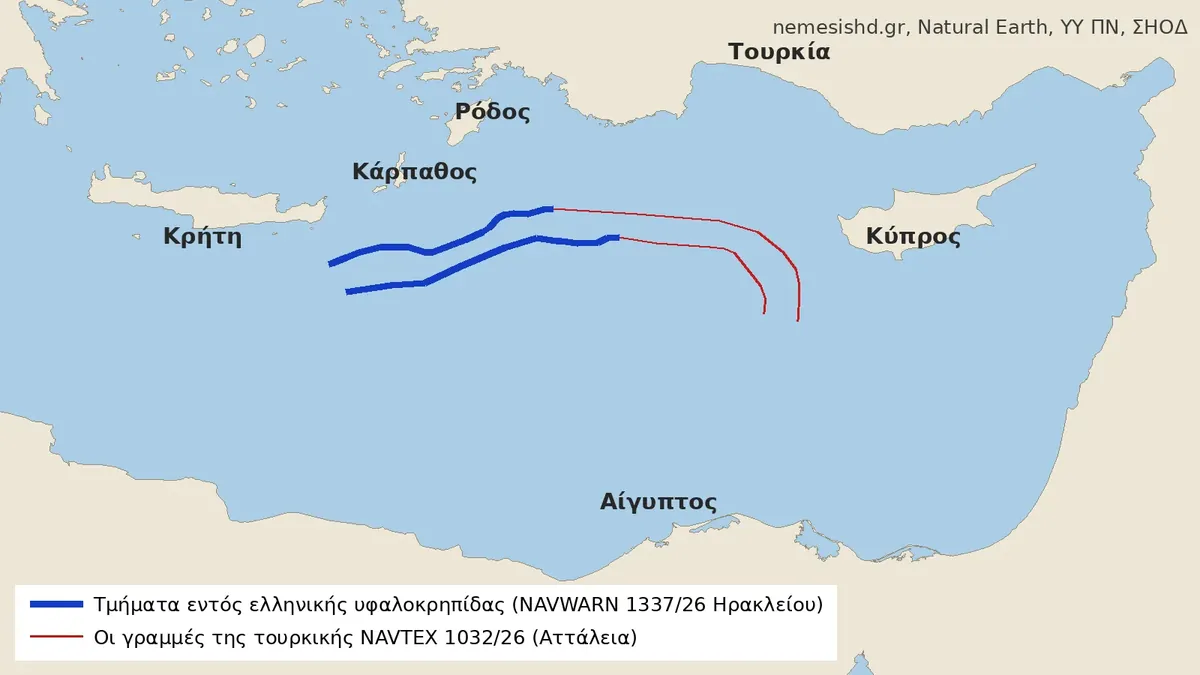
The segments cited in the Greek NAVWARN begin at 34°11′ N, 26°32′ E for the first line and 34°31′ N, 26°20′ E for the second, south-east of Crete. They reach east as far as 29°43′ and 28°57′ respectively, south of Karpathos and Rhodes. The Turkish lines continue further east, to south-west of Cyprus. On the map, the parts the Greek station places on the continental shelf are shown in blue.
Turkey’s NAVTEX 1032/26 from Antalya, issued the same afternoon, presented the surveys for the East to Med Data Corridor (EMC) fibre-optic cable as work on the “Turkish continental shelf”, whose limits Ankara notified to the UN in March 2020, and said that “the Turkish authorities have permitted the activity”. The Republic of Cyprus had already announced the KOBI RUEGG surveys with a NAVTEX from the Larnaca Joint Rescue Coordination Centre, to which Antalya had replied with a counter-NAVTEX. Days earlier Turkey had also issued a counter-NAVTEX for the EUNOMIA exercise south of Crete, disputing the competence of Heraklion.
The exchange comes as Turkish Foreign Minister Hakan Fidan said Ankara does not react to cables but asks for written notification with coordinates for every survey, and only hours after the approval of the illegal Turkish–Libyan memorandum by Libya’s House of Representatives, which also disregards Crete. For the legal framework see our explainer on UNCLOS and the Aegean dispute.