Europe
Fall of the Berlin Wall explained: what happened on 9 November 1989
How the Berlin Wall went up in 1961, how many people died at it, and how a premature announcement opened the border on 9 November 1989.

The Berlin Wall fell on the night of 9 November 1989 because an East German official announced new travel rules too early and without clear instructions. Thousands of East Berliners went to the crossings, border guards had no orders, and by late evening the barriers were open. The Wall had stood since 13 August 1961, and its fall opened the way to German unity on 3 October 1990.
Key points
- The Wall went up on Sunday 13 August 1961, less than two months after Walter Ulbricht said: “Nobody intends to build a wall.”
- Research by the Centre for Contemporary History in Potsdam and the Berlin Wall Foundation documents at least 140 deaths at the Wall between 1961 and 1989.
- The opening on 9 November 1989 was an accident of timing, not a planned decision to end the border.
- Germany was formally reunited on 3 October 1990, after the Two Plus Four negotiations with the four wartime Allies.
Why was the Berlin Wall built?
In the early hours of Sunday 13 August 1961, East German army troops, border police, police and workers’ brigades closed off streets and rail lines in Berlin, according to the German Federal Government’s own historical account. Barbed wire went up along the line between East and West, paving was torn up on roads that linked the two halves, and every transport connection was shut. Families, friends and neighbours were separated overnight.
Two months earlier, on 15 June 1961, the East German head of state Walter Ulbricht had said: “Nobody intends to build a wall.” The Federal Government’s archive notes that the statement stopped being true in less than two months. Over the following days and weeks the wire was replaced by concrete.
How many people died at the Berlin Wall?
Early counts differed widely. The Chronicle of the Wall, run by the Berlin Wall Memorial and the Centre for Contemporary History (ZZF) in Potsdam, notes that earlier lists gave anything from 78 to more than 200 deaths depending on the criteria used. The joint research project, run between 2005 and 2011 and still updated, settled on a documented minimum.
The ZZF says that between 1961 and 1989 at least 140 people were killed at the Berlin Wall or died in circumstances directly linked to the East German border regime. That number includes 101 escapees who were shot, died in accidents or took their own lives during an attempt to cross, 30 people from East and West and one Soviet soldier with no intention of fleeing, and eight East German border soldiers killed on duty. A further 251 travellers died before, during or after checks at Berlin crossing points. The researchers add that the number of people who died of grief and despair caused by the Wall is unknown.
One of the first victims, Günter Litfin, was shot by transport police on 24 August 1961 as he tried to swim across the Osthafen, eleven days after the border was sealed. The last fatal shots were fired on 5 February 1989, about nine months before the Wall opened.
How did the East German system start to crack in 1989?
The U.S. State Department’s Office of the Historian describes a chain of events across the region. Soviet leader Mikhail Gorbachev made clear, first privately and then more openly, that the Soviet Union had given up military intervention to prop up communist governments. On 6 February 1989 talks between the Polish government and the Solidarity union opened in Warsaw, and by 24 August Tadeusz Mazowiecki had become the first non-communist prime minister in Eastern Europe.
Hungary opened its border with the West, giving East Germans a route out. Thousands also sought refuge in West German embassies in other communist countries. When Gorbachev visited Berlin in early October he warned the East German leadership of the need to reform, and two weeks later Erich Honecker was forced to resign while hundreds of thousands marched in East German cities.
Years earlier, on 12 June 1987, U.S. President Ronald Reagan had spoken at the Brandenburg Gate. The official transcript held by the Reagan Presidential Library records him saying: “Mr. Gorbachev, tear down this wall!”
What happened on 9 November 1989?
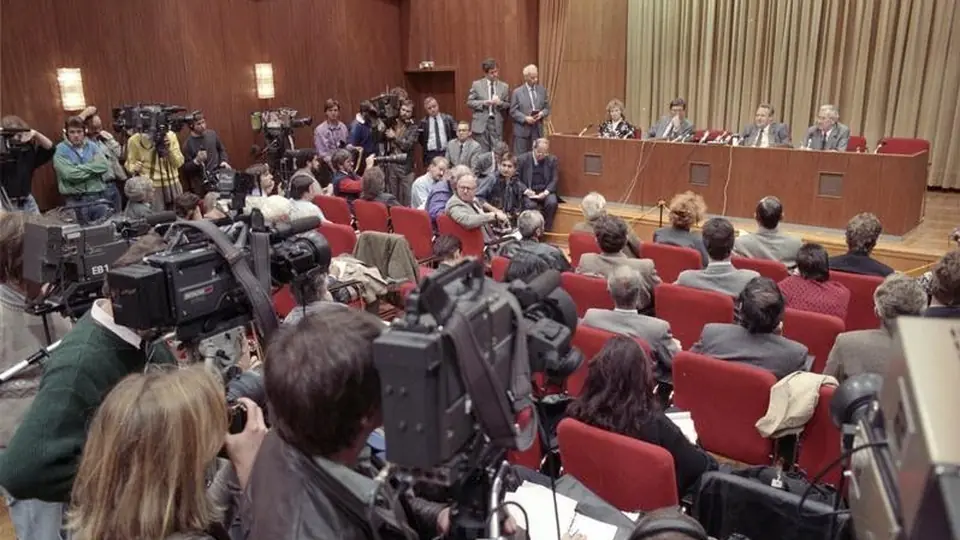
Berlin.de’s official history page sets out the sequence. On 6 November the East German leadership published a draft travel law, and on the morning of 9 November the rules were revised to cover visits as well as permanent exit. Shortly before 7 p.m. Günter Schabowski announced them at a press conference, prematurely and without clear instructions. He said applications could be made “without proof of eligibility, reasons for travel, or family ties”. Asked when the rules took effect, he answered: “Immediately! Without delay!” The German Federal Government’s media archive records that reply.
The timeline that evening, as the same account gives it:
- About 8 p.m.: West Germany’s ARD broadcast the news under the heading “GDR opens border”, and crowds of East Berliners gathered at the checkpoints. Guards had no instructions.
- 9:20 p.m.: guards at Bornholmer Strasse let the first people through to ease the pressure.
- 11:30 p.m.: the crowd was too large, and the guards raised the barrier without official orders. About 20,000 people crossed the Bösebrücke bridge in the next hour.
- Overnight: other crossings opened. Over the following days millions of East Germans made short trips to the West.
- 22 December 1989: a crossing opened at the Brandenburg Gate.
The U.S. Office of the Historian also reports that President George H. W. Bush and National Security Advisor Brent Scowcroft watched the scene on television in the White House study. Gorbachev’s foreign policy adviser Anatoly Chernyaev wrote on 10 November 1989 that the fall of the Wall represented “a shift in the world balance of forces” and the end of Yalta.
How did the fall of the Wall lead to German reunification?
Before the end of November 1989 West German Chancellor Helmut Kohl unveiled a plan for reunification of the two Germanies, the Office of the Historian notes. On 2 December Bush and Gorbachev met in Malta. Because of Germany’s legal position after 1945, the United States, the United Kingdom, France and the Soviet Union also had to agree.
Dr Peter Hartmann, a senior Federal Chancellery official under Kohl, told the Federal Government’s archive that France and the UK had serious reservations because they feared a united Germany would shift the balance of power in Europe, and that Gorbachev did not give the go-ahead for negotiations until the end of January 1990. He credits the resolute stance of the United States with bringing them to the table. The foreign ministers of the two German states and the four Allies signed the Two Plus Four agreement in Moscow on 12 September 1990, and East Germany joined the Federal Republic on 3 October 1990.
From June to November 1990 most of the Wall through the city was torn down. Today a double row of cobblestones marks its course for about 20 kilometres through the centre, and the Berlin Wall Memorial on Bernauer Strasse shows the border strip and its fortifications.
Why does the Berlin Wall still matter?
The Wall remains the reference point for how a closed border regime can end suddenly when the power behind it withdraws support. The Office of the Historian stresses that the peaceful collapse was not pre-ordained: Soviet tanks had crushed protests in East Berlin in 1953, in Hungary in 1956 and in Czechoslovakia in 1968. For a Cold War-era alliance story closer to home, see our article Greece and NATO: why Athens left in 1974 and came back in 1980.
The DW documentary below explains how the border system around West Berlin worked.
Sources: U.S. Office of the Historian, Fall of Communism in Eastern Europe, 1989; ZZF Potsdam, The Victims at the Berlin Wall; German Federal Government, A dark day for Germany; Reagan Presidential Library, remarks at the Brandenburg Gate; Berlin.de, Opening and fall of the Berlin Wall.