Air Force
Marinos Mitralexis: the daring Greek airman who rammed an Italian bomber – November 2, 1940, minute by minute
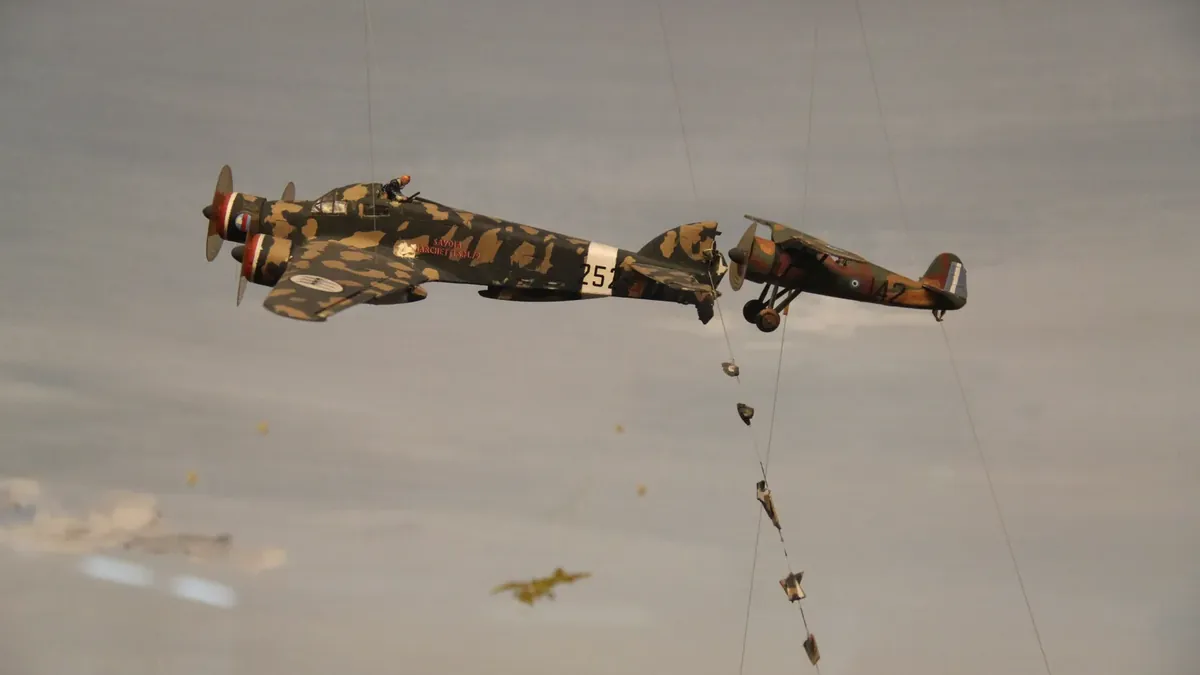
On November 2, 1940, Marinos Mitralexis, out of ammunition, cut the rudder of an Italian Cant Z.1007bis with his propeller. A reading of the Hellenic Air Force record and the Rome communiqués.

Mitralexis’s ramming on November 2, 1940 is usually told as an act of spirit, and it is. Read through the official records of both sides, however, it is something more: the last move of a fighter pilot who had exhausted his weapons against a target that would not fall, on the first big day of air combat of the Greco-Italian War. That same day the Hellenic Air Force fought over Thessaloniki and Ioannina, lost two pilots in Epirus and, with an old Breguet, located the “Julia” Division in the Pindus. On the feast day of the Air Force and its patron, Archangel Michael, we reconstruct November 2, 1940 from the history of the Hellenic Air Force General Staff (HAGS), the album of fallen airmen and the official war communiqués of Rome, which read differently today.
The Hellenic Air Force in October 1940: 79 combat aircraft against 463
The balance of forces is the starting point for understanding why a pilot came to use the propeller of his aircraft as a weapon. According to the Air Force’s official history of the period 1940-1941, at the start of operations there were 158 combat aircraft of all types, of which 128 were serviceable. Of these, only 79 were fighters and bombers, 59 of them serviceable, while the Italian Air Force (Regia Aeronautica) fielded 463 front-line aircraft, generally of better performance. Air power was not unified, because the Army, the Navy and the Air Force each controlled the aircraft serving their own doctrine, and the Fighter Command had four squadrons: the 21st at Trikala with PZL P.24F/G and Gloster Gladiators, the 22nd at Thessaloniki with PZL P.24F/G, the 23rd at Larissa with PZLs and the 24th at Elefsina with Bloch MB.151s and Avia B.534s.
The 22nd Fighter Squadron was the air shield of Thessaloniki, the country’s second-largest port and an important rail hub, and operated from the Megali Mikra airfield outside the city. The front in Epirus and Western Macedonia was far away, but Thessaloniki was a bombing target from the first days, because part of the supply chain to the front passed through its port and railway. The Italian bombers that struck it did not take off from Albania but from Apulia, because the rains of the first days of November had turned the Albanian airfields to mud, which meant a long distance, escorted formations and attacks in waves.
PZL P.24 against the Cant Z.1007bis: a single-seater with four guns and a wooden three-engined bomber
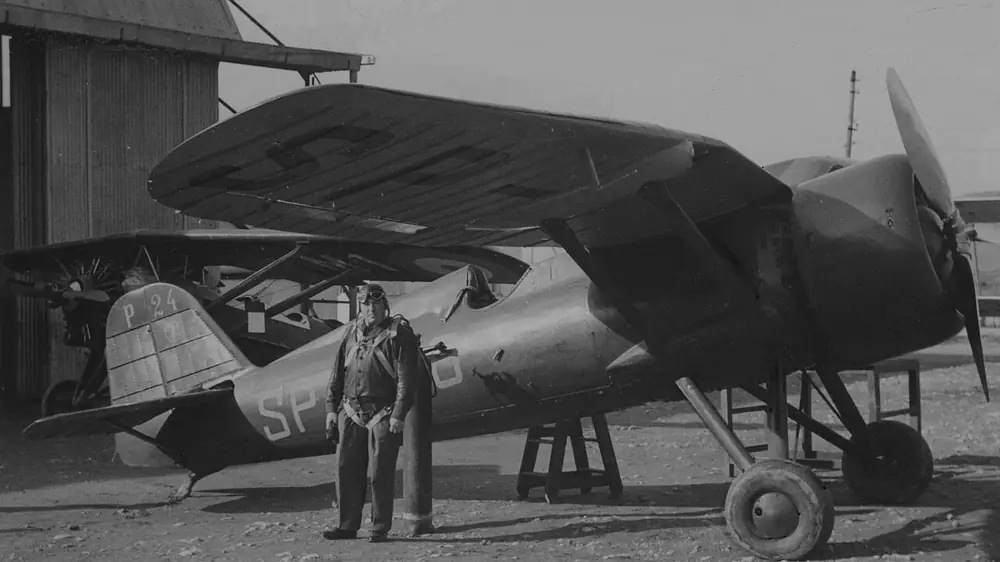
The PZL P.24 was a Polish single-seat fighter with a characteristic “gull” wing (a wing that starts sloping upward from the root and then breaks outward, giving the pilot better visibility). The contract was signed in September 1936 and deliveries were completed in May 1937. The HAGS records 36 PZL P.24F and G aircraft, with a 950 hp Gnome-Rhône 14N07 engine, a wingspan of 10.68 m, a length of 7.60 m, a German-made radio and an American-made oxygen system. The F version carried two 20 mm Oerlikon FF cannon and two 7.92 mm machine guns, while the G had machine guns only, and the difference matters: within the same formation there were aircraft with very different ability to destroy a large bomber. The P.24s were, in the HAGS’s words, the aircraft that “carried the weight of the air battles” over the six months of the war, and the figures the HAGS gives say that 35 Greek P.24s shot down 40 enemy aircraft from November 1940 to April 1941, one of them by ramming.
Opposite stood the Cant Z.1007bis “Alcione,” a three-engined medium bomber built largely of wood, with three Piaggio radial engines and defensive machine guns in dorsal and ventral positions. At high altitude the Cant was no slower than the PZL: period figures give the P.24F/G a top speed of about 430 km/h and the Z.1007bis about 450 to 460 km/h at 4,000-4,600 metres. That means a fighter that did not already have altitude and position above the formation could not “chase” a bomber from behind, and that every attack had to be made in a dive from higher up or head-on, with a few seconds of fire per pass and under the fire of the defensive machine guns. A large three-engined aircraft can keep flying with one engine out and absorb many hits, so a fighter with four guns could empty all its ammunition into a target without bringing it down. That is exactly what happened to Mitralexis.
The minutes of the air battle over Lagadas
On the morning of November 2, 1940 the 22nd Fighter Squadron was on full alert when the order came for six PZLs to take off immediately, as fifteen Cant Z.1007bis escorted by seven fighters approached Thessaloniki to bomb it. The Greek aircraft located the formation and the combat moved just outside the city, to the Lagadas area, where Greek anti-aircraft guns were deployed to reinforce the engagement from the ground. The numbers were roughly one Greek fighter against four Italian aircraft, and in such an engagement the fighters’ aim is to break up the bomber formation before it reaches the target, because a formation that disintegrates loses the concentration of its defensive fire and drops its bombs scattered.
Second Lieutenant Marinos Mitralexis, a graduate of the Air Force Academy since August 1938, attacked one of the three-engined bombers and emptied all his ammunition into it, without the Cant going down. The official HAGS text describes the next minute in one sentence: Mitralexis, having exhausted his ammunition, “struck” with the propeller of his aircraft the rudder of an Italian CANT Z.1007 Alcione bomber, which crashed to the ground. The detail of the “rudder” is the key to the analysis. Mitralexis did not crash into the fuselage or the wings of the bomber, which would almost certainly have meant his own destruction, but approached the tail section and cut off with his propeller blades the rudder, the control surface on the vertical stabiliser with which the pilot steers the aircraft about its vertical axis. Without it, an already damaged bomber loses control, and the Cant went into a spin and crashed.
The PZL itself paid the price with a bent propeller. An engine with a deformed propeller produces strong vibrations and loses thrust, and Mitralexis had no choice but a forced landing near the spot where the bomber crashed. There he found that of the Cant’s five-man crew, four had bailed out and survived, and here comes his second heroic act: he captured them at pistol point, put them in a Gendarmerie car and took them to the Thessaloniki Military Command. The image of a young officer who shoots down a bomber without ammunition and returns with four prisoners at once became known to the Greek and foreign press, and the record of the Panhellenic Association of Families of Fallen Airmen (PASOIPA) notes that the act “soon found imitators.”
The same day in Epirus: two dead of the 21st Squadron and a Breguet over the Pindus
November 2 was not only the day of Thessaloniki, and the analysis of the air battle loses its meaning if it is separated from the rest of the front. Over Ioannina, three PZLs of the 21st Fighter Squadron faced fifteen Italian fighters and bombers heading for the city. In this unequal air battle Flight Lieutenant Ioannis Sakellariou, the formation leader, whose aircraft was hit and fell in the Zitsa area, and Sergeant Christos Papadopoulos were killed, as the official biographies of the fallen record. The ratio was even worse than at Thessaloniki, five Italian aircraft for every Greek one, and shows how the Air Force spread a few fighters across many places at once.
The same day saw one of the most critical air reconnaissance episodes of the war. A Breguet 19, a biplane of the 1920s, flying low along the Albanian border, spotted the Italian Alpini “Julia” Division just as it had penetrated the Pindus and was moving to take Metsovo. The HAGS notes that this event radically changed the situation on the front in favour of the Greeks, because the information arrived at the moment when the battle of the Pindus, and with it the first phase of the Greco-Italian War, was being decided. For the wider campaign, see our account of how the Greek Army stopped the Italian invasion. One of the country’s most obsolete aircraft supplied the most valuable piece of information, and one of its most modern fighters ended up fighting with its propeller: November 2 condenses the whole reality and heroism of the Greek air arm of 1940.
What Rome’s official communiqués said
The daily war communiqués of the General Headquarters of the Italian Armed Forces are state documents of the period and survive in full. Communiqué No. 148 of November 2 reports for the previous day bombings of Salamis, Corfu, Larissa, the Corinth Canal and, “in two successive waves,” Thessaloniki, noting that “all our aircraft returned.” Communiqué No. 149 of November 3, covering November 2, lists attacks on Corfu, Patras, Larissa, Ioannina, Navarino, Chania and Thessaloniki, “where during combat with the enemy fighters one enemy aircraft was shot down,” and ends with the phrase “two of our aircraft did not return.” It is the official Italian admission of losses for the whole front that day, and among them is the Cant that fell at Lagadas.
The HAGS records for the whole war against Italy 64 confirmed and 20 probable kills by Greek airmen, against 24 successes by the Italians in the air, as well as 28 Italian aircraft destroyed by Greek bombers and 23 by anti-aircraft weapons. Greek losses from the corresponding Italian actions were 8 and 5 aircraft, and the Air Force had 49 dead and 22 wounded in the struggle against the Italians. The Fighter Squadrons flew 804 combat missions with 1,530 flying hours, a figure that for a force of a few dozen fighters means pilots taking off again and again every day, often young and inexperienced, as the HAGS itself notes.
Why the ramming went down in history and what it teaches about air combat today
Mitralexis was awarded the Gold Cross of Valour, the highest wartime decoration for bravery, and was the only Greek airman to receive the distinction while the war was still under way. After the collapse of the front in April 1941 he found himself in the Middle East, where he continued to fight. He was killed on September 19, 1948, when the Airspeed Oxford numbered D130, in which he was flying with Squadron Leader Dimosthenis Politis and Flight Lieutenant Dimitrios Galanakos on a reconnaissance mission in the Aegean, crashed into the sea near Tinos after an engine failure. He was posthumously promoted to Wing Commander.
Marinos Mitralexis did not enter history because he had the best aircraft or the most powerful weapons. He did so because, at the moment his ammunition ran out, his courage and determination did not. Eighty-six years later, his story still reminds new generations of Icaruses that the real strength of the Air Force lies not only in its aircraft, but above all in the people who fly them. Many happy returns to our Air Force, and to all those who continue to write its history in Greek skies.
Questions and answers
What exactly did Mitralexis do on November 2, 1940?
Second Lieutenant Marinos Mitralexis of the 22nd Fighter Squadron exhausted the ammunition of his PZL P.24 on an Italian Cant Z.1007bis bomber that did not go down, and then cut the bomber’s vertical rudder with the propeller of his aircraft. The bomber fell into a spin and crashed near Lagadas.
How did Mitralexis survive the ramming?
Contact was made only with the propeller and only on the tail section of the bomber, at a very small difference in speed. The PZL’s propeller was bent and Mitralexis made a forced landing near the crash site.
What happened to the crew of the Italian bomber?
Of the five-man crew, four bailed out and survived. Mitralexis captured them at pistol point and handed them over, in a Gendarmerie car, to the Thessaloniki Military Command.
What did the Italian communiqués admit about November 2, 1940?
Communiqué No. 149 stated that two Italian aircraft did not return from that day’s operations. Communiqués 150 and 151 raised the Greek aircraft claimed shot down to eleven plus one probable, a figure that cannot be reconciled with the 14 total losses of the Greek Fighter Squadrons in air combat across the whole war.
What distinction did Mitralexis receive?
He was awarded the Gold Cross of Valour and was the only Greek airman to receive it while the war was under way. He was killed on September 19, 1948 in the crash of an Oxford aircraft near Tinos and was posthumously promoted to Wing Commander.