Greece
Treaty of Lausanne explained: borders, islands and minorities
The Treaty of Lausanne, signed on 24 July 1923, set the Greek-Turkish frontier, divided the Aegean islands and protected minorities. Here is what its articles actually say.

The Treaty of Lausanne is the peace treaty signed on 24 July 1923 that ended the state of war between Turkey and the Allied powers, Greece among them. It still sets the legal framework for the Greek-Turkish land frontier, for sovereignty over many Aegean islands, for minority protection in Thrace and Istanbul, and, through a companion convention, for the compulsory exchange of populations.
Key points
- Signed at Lausanne on 24 July 1923 by the British Empire, France, Italy, Japan, Greece, Romania and the Serb-Croat-Slovene State on one side and Turkey on the other.
- Article 2 fixes the Greek-Turkish land frontier on the Maritza river; Article 12 confirms Greek sovereignty over most of the Eastern Aegean islands.
- Articles 37 to 45 protect non-Moslem minorities in Turkey, and Article 45 requires Greece to give the same rights to the Moslem minority in its territory.
- A separate convention of 30 January 1923 ordered a compulsory exchange of populations, with exceptions for Constantinople and Western Thrace.
- The Straits regime of 1923 was a separate convention; the current regime is covered in our Montreux explainer.
What was the Treaty of Lausanne?
The treaty text, as reproduced from the Carnegie Endowment edition of The Treaties of Peace 1919-1923 by the World War I Document Archive at Brigham Young University, opens with the signatories declaring themselves “united in the desire to bring to a final close the state of war which has existed in the East since 1914”. Article 1 re-established peace and resumed official relations between the parties.
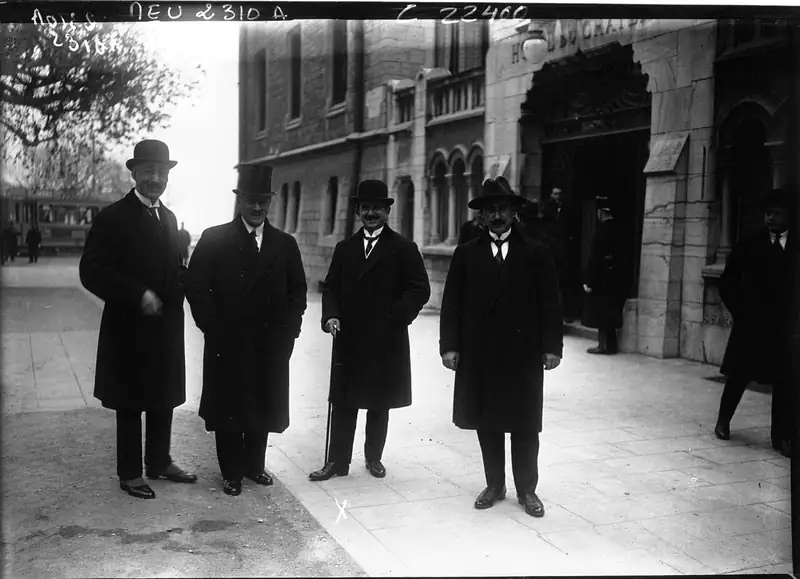
Greece was represented by Eleftherios Venizelos, formerly President of the Council of Ministers, and by Demetrios Caclamanos, Minister Plenipotentiary in London. Turkey was represented by the delegation of the Government of the Grand National Assembly, headed by Ismet Pasha, then Minister for Foreign Affairs.
The treaty was one instrument in a package. The final act listed a series of conventions signed the same day, among them the Straits convention, a convention on the Thracian frontier and a convention on the exchange of Greek and Turkish populations dated 30 January 1923.
What does the treaty say about the Greek-Turkish frontier?
Article 2 describes the frontier from the Black Sea to the Aegean. In the Greek sector it follows the course of the Maritza from its confluence with the Arda to the Aegean Sea. Article 5 created a Boundary Commission with one Greek and one Turkish representative and a president chosen from the nationals of a third power, to trace the line on the ground.
Article 6 adds a rule on islands: unless the treaty provides otherwise, “islands and islets lying within three miles of the coast are included within the frontier of the coastal State”. Article 12 repeats the principle for Turkey, stating that, except where the treaty provides otherwise, islands less than three miles from the Asiatic coast remain under Turkish sovereignty.
Who got the Aegean islands?
Three articles divide the islands. Article 12 confirms the 1914 decision of the Conference of London on Greek sovereignty over the islands of the Eastern Mediterranean other than Imbros, Tenedos and the Rabbit Islands, and names Lemnos, Samothrace, Mytilene, Chios, Samos and Nikaria. Article 14 leaves Imbros and Tenedos under Turkish sovereignty with a special administrative organisation “furnishing every guarantee for the native non-Moslem population”, and exempts their inhabitants from the population exchange.
Article 15 deals with the south-east Aegean. In it Turkey “renounces in favour of Italy all rights and title” over Astypalaia (written Stampalia), Rhodes, Chalki, Karpathos, Kasos, Tilos, Nisyros, Kalymnos, Leros, Patmos, Lipsi, Symi and Kos, and also over Kastellorizo. The treaty therefore did not place these islands under Greece; they are part of Greece today, but not through this article.
Article 16 is broader: Turkey renounces all rights over territories and islands outside the frontiers the treaty lays down, “the future of these territories and islands being settled or to be settled by the parties concerned”.
Does the treaty limit Greek forces on the islands?
Article 13 does, for four islands only. “With a view to ensuring the maintenance of peace”, Greece undertook that no naval base and no fortification would be established in Mytilene, Chios, Samos and Nikaria, that Greek military aircraft would not fly over the Anatolian coast (with Turkey reciprocally forbidding overflights of the islands), and that Greek forces there would be limited to the normal conscript contingent plus gendarmerie and police in proportion to those in Greece as a whole.
The article names these four islands. Lemnos and Samothrace, for example, are not among them, and the islands named in Article 15 were then occupied by Italy. Any wider reading of Article 13 is an interpretation, and should be attributed to the government or lawyer who makes it.
| Provision | What the text says |
|---|---|
| Article 2 | Fixes the Greek-Turkish land frontier along the Maritza (Evros) river, with a boundary commission under Article 5 |
| Article 12 | Confirms Greek sovereignty over the Eastern Mediterranean islands such as Lemnos, Samothrace, Mytilene, Chios, Samos and Nikaria, excluding Imbros, Tenedos and the Rabbit Islands |
| Article 13 | Restrictions on Greece in Mytilene, Chios, Samos and Nikaria: no naval base or fortification, limits on forces and on military overflights |
| Article 14 | Special administrative organisation for Imbros and Tenedos, which remain under Turkish sovereignty |
| Article 15 | Turkey renounces its rights to Rhodes, Kos, Leros, Patmos, Symi, Kastellorizo and other islands in favour of Italy |
| Article 20 | Turkey recognises the British annexation of Cyprus proclaimed on 5 November 1914 |
| Articles 37 to 45 | Protection of non-Moslem minorities in Turkey, with reciprocity for the Moslem minority in Greece |
What happened to Cyprus?
Article 20 is a single sentence: “Turkey hereby recognises the annexation of Cyprus proclaimed by the British Government on the 5th November, 1914.” Article 21 gave Turkish nationals ordinarily resident on the island on that date British nationality under local law, with a right to opt for Turkish nationality within two years provided they left Cyprus within twelve months. The treaty thus closed the Ottoman chapter of the island’s status.
What is the population exchange?
The exchange rests on a separate convention signed by the Government of the Grand National Assembly of Turkey and the Greek Government on 30 January 1923. Article 142 of the treaty gives that convention “the same force and effect as if it formed part of the present Treaty” between the two states.
Under Article 1 of the convention, from 1 May 1923 there would be “a compulsory exchange of Turkish nationals of the Greek Orthodox religion established in Turkish territory, and of Greek nationals of the Moslem religion established in Greek territory”, who could not return without authorisation. Article 2 excluded two groups: the Greek inhabitants of Constantinople and the Moslem inhabitants of Western Thrace. Article 3 counted as exchanged those who had already left since 18 October 1912. The text is published by the Turkish Ministry of Foreign Affairs.
The convention text itself contains no totals. Figures for the number of people moved should be taken from a named scholarly or official source, not from the treaty.
What does it say about minorities?
Articles 37 to 45 form the minorities section. In Article 38 Turkey promised “full and complete protection of life and liberty to all inhabitants of Turkey without distinction of birth, nationality, language, race or religion”. Article 40 gave non-Moslem minorities an equal right to establish and run charitable, religious and social institutions and schools “with the right to use their own language”. Article 41 provides for primary-school instruction in the minority language where a considerable proportion of non-Moslem nationals live.
Article 45 makes the arrangement reciprocal: the rights given to non-Moslem minorities in Turkey “will be similarly conferred by Greece on the Moslem minority in her territory”. The debate that reappears in the Thracian schools dispute turns on how these provisions apply today; see our report Daily Sabah revives the Thrace minority schools issue, citing Lausanne over the suspensions.
What about the Straits?
Article 23 recognised “the principle of freedom of transit and of navigation, by sea and by air, in time of peace as in time of war” in the Dardanelles, the Sea of Marmora and the Bosphorus, as set out in the separate Straits convention. For how passage works under the current regime, read Montreux Convention explained: who can pass the Bosphorus and the Dardanelles.
Why does Lausanne still matter?
Because it is the treaty both governments cite. It is the source of the Evros frontier, of the legal basis for Greek sovereignty over the Eastern Aegean islands in Article 12, and of the minority regime in Thrace. Specific disputes, such as the extent of any island restrictions, are matters on which Athens and Ankara take different positions, and each side’s reading should be quoted from its own official statements.
Sources: Treaty of Peace with Turkey signed at Lausanne, 24 July 1923 (World War I Document Archive, Brigham Young University); Convention Concerning the Exchange of Greek and Turkish Populations, 30 January 1923 (Turkish Ministry of Foreign Affairs).