Land Forces
AH-64E Apache clears final sea-transport test as U.S. Army validates folded-blade hoisting sling
The U.S. Army says a prototype sling lets cranes load and unload the AH-64E on cargo ships with its rotor blades folded, satisfying the last transportability requirement in the helicopter's production document.

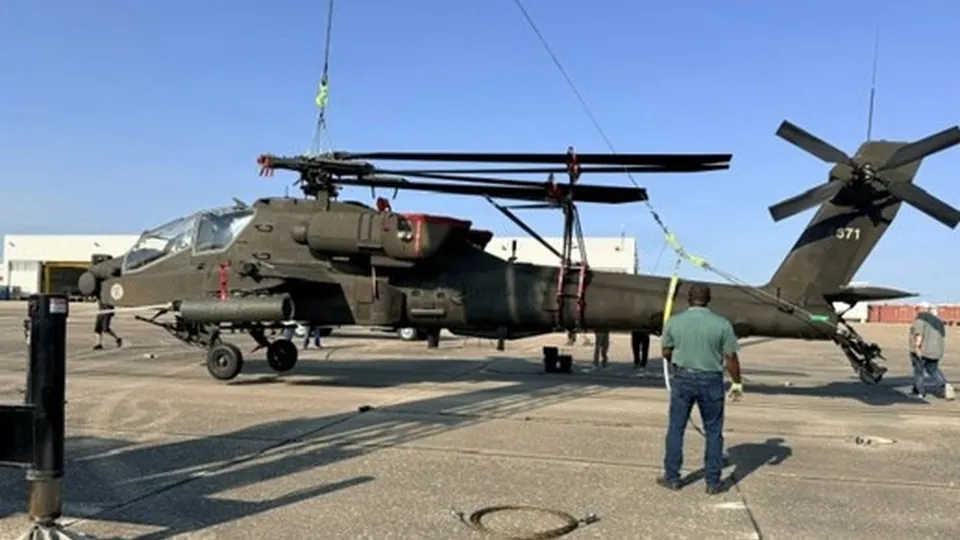
The U.S. Army has cleared the last sea-transport requirement for its AH-64E Apache attack helicopter, after its Apache project office validated a prototype lifting sling that allows the aircraft to be hoisted on and off cargo ships with its main rotor blades folded. The Army announced the milestone on 21 October, saying the test was carried out at Fort Hood, Texas.
What was tested
According to the Army, the Apache Project Management Transportability Team, based at Redstone Arsenal in Alabama, ran lift-on/lift-off (LOLO) trials with the sling, which was designed and built by the industry partner ASRC Federal. The team performed several load tests, balance assessments and rigging drills to show that crews can lift the helicopter with standard harbour and shipboard cranes without stressing the airframe or damaging sensitive avionics and blade components.
In the first trial the helicopter was lifted and held in the air for several minutes. The crane then moved it at an angle so that engineers could record movement loads before setting it back down. The Army says formal test results are still under review. One adjustment has already been identified: protective padding is needed to keep the hoisting cable away from the main rotor blades as it runs aft toward the tail.
Why it matters
The Army describes the sling as the final sea-deployment metric set out in the aircraft’s Capability Production Document, the paper that lays down benchmarks for moving the helicopter by land, air and sea. Until now, shipping the Apache by sea often depended on roll-on/roll-off vessels or on dock facilities with ramps able to take towed aircraft. A certified folded-blade hoisting procedure, the Army says, opens many more seaports around the world to Apache deployments and offers more entry routes in contested regions, with aircraft arriving closer to forward assembly areas.
The Army also points to savings. Hoisting the helicopter with its blades folded reduces the space it takes on deck and in the hold, so more aircraft or sustainment equipment can fit on a single ship, and the approach should ease vessel charter costs and availability.
Next steps
The project office will now validate the padding change and other adjustments before manufacturing and delivering five contracted production prototypes, which completes the contract. No delivery date was given in the Army’s account.
The Apache remains in demand beyond the U.S. Army. Geopolitiki has reported on Israel’s decision to move ahead with buying 12 AH-64E helicopters, in Israel moves ahead with the purchase of 12 AH-64E Apache helicopters from the US after the funding deadlock.