
Military & Defense
Boeing beats Northrop to win US Navy’s F/A-XX fighter contract
Boeing beat Northrop Grumman for the US Navy’s F/A-XX sixth-generation carrier fighter contract, its second advanced fighter win after the Air Force F-47.

Boeing has won the U.S. Navy’s F/A-XX competition, beating Northrop Grumman for the contract to develop a sixth-generation carrier fighter. The selection was announced on September 29, 2026. The development award is worth more than $20 billion and covers test aircraft as the Navy works toward a successor to its F/A-18E/F Super Hornet fleet.
Lockheed Martin had been eliminated earlier in the contest, leaving Boeing and Northrop Grumman as the final rivals. The decision gives Boeing a second major U.S. sixth-generation fighter programme after the Air Force chose it for the F-47 in 2025. Boeing’s September 29 announcement confirms the Navy selection but describes the award only as a multi-billion-dollar contract; the figure above comes from the Pentagon’s account of the development deal.
What the Navy expects from F/A-XX
The F/A-XX is the crewed fighter element of the Navy’s Next Generation Air Dominance effort. It is intended to extend the reach of a carrier air wing and eventually replace the Super Hornet. The Navy also plans for its future air wing to operate the F/A-XX alongside F-35C fighters and unmanned aircraft. Replacement of the EA-18G Growler is also part of the broader future-air-wing discussion, although the precise sequence has not been disclosed.
Range is central to the naval requirement. Carrier aircraft must be able to operate across large distances while warships face increasingly long-range anti-ship weapons. Navy planning has also stressed improved sensors, speed and cooperation between crewed and uncrewed systems. These are programme objectives, not verified performance figures for the aircraft. Boeing says F/A-XX will use an open mission-systems architecture and advanced mission systems, but says technical and programme details remain classified.
The newly released aircraft image is an artist’s rendering. It illustrates a proposed fighter on a carrier deck; it is not a photograph of a built aircraft or confirmation of the final design. The development contract is expected to fund design, integration and test aircraft before any decision on large-scale production. The Navy has not publicly provided a final fleet quantity or total programme cost.
Two fighter programmes for Boeing
Boeing is now responsible for the Navy’s F/A-XX and the Air Force’s separate F-47. The company says it had planned to develop both programmes at once and invested in facilities, technology and staff accordingly. Steve Parker, president and chief executive of Boeing Defense, Space & Security, said: “Delivering two advanced fighters in parallel was always our plan, and we invested accordingly.”
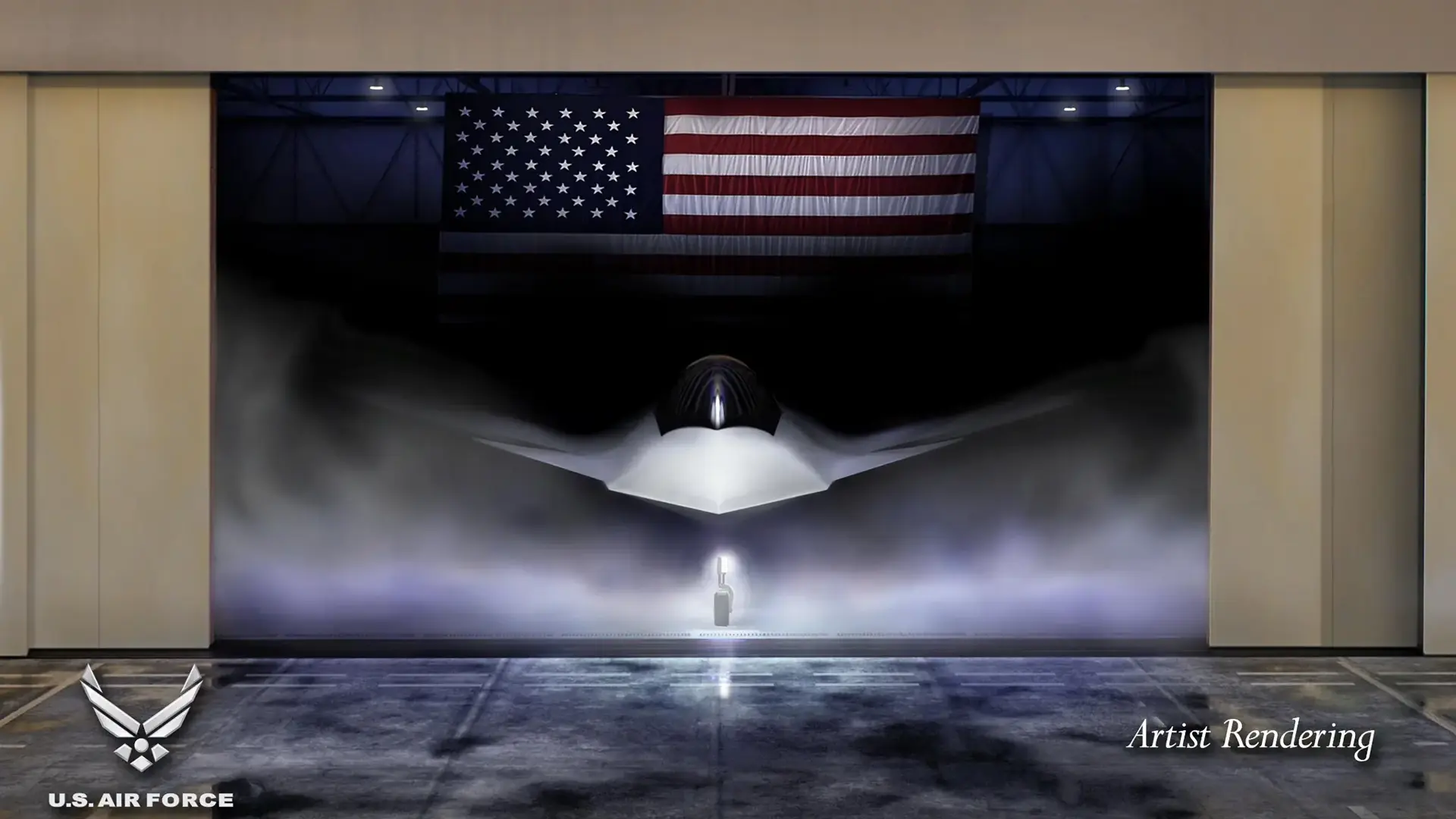
Construction is continuing on a secure Boeing manufacturing facility in St. Louis that the company says will support multiple future combat-aircraft programmes. The F-47 image above belongs to the Air Force project and shows a different aircraft concept from the Navy rendering.
The Navy award followed months of debate over funding and the capacity of the U.S. industrial base to pursue two advanced fighter programmes in parallel. Congress backed continued funding after postponement had been considered. Boeing’s next task is to turn classified Navy requirements into test aircraft and demonstrate that the design can meet carrier aviation needs.