Military & Defense
CBO: Trump-class battleships add billions to the cost of the US Navy’s new fleet
The Congressional Budget Office says the Navy's FY2027 shipbuilding plan would cost $53.8 billion a year, 18% more than the Navy estimates, with the 15 nuclear-powered Trump-class battleships the main driver.

The 15 nuclear-powered guided-missile battleships of the “Trump class” are the main reason the cost of the US Navy’s new fleet is rising by billions of dollars. That is the finding of an analysis by the Congressional Budget Office (CBO) of the fiscal 2027 shipbuilding plan, published on Thursday, November 19. About half of the plan’s extra cost compared with the 2025 plan is attributed to the decision to buy the battleships.
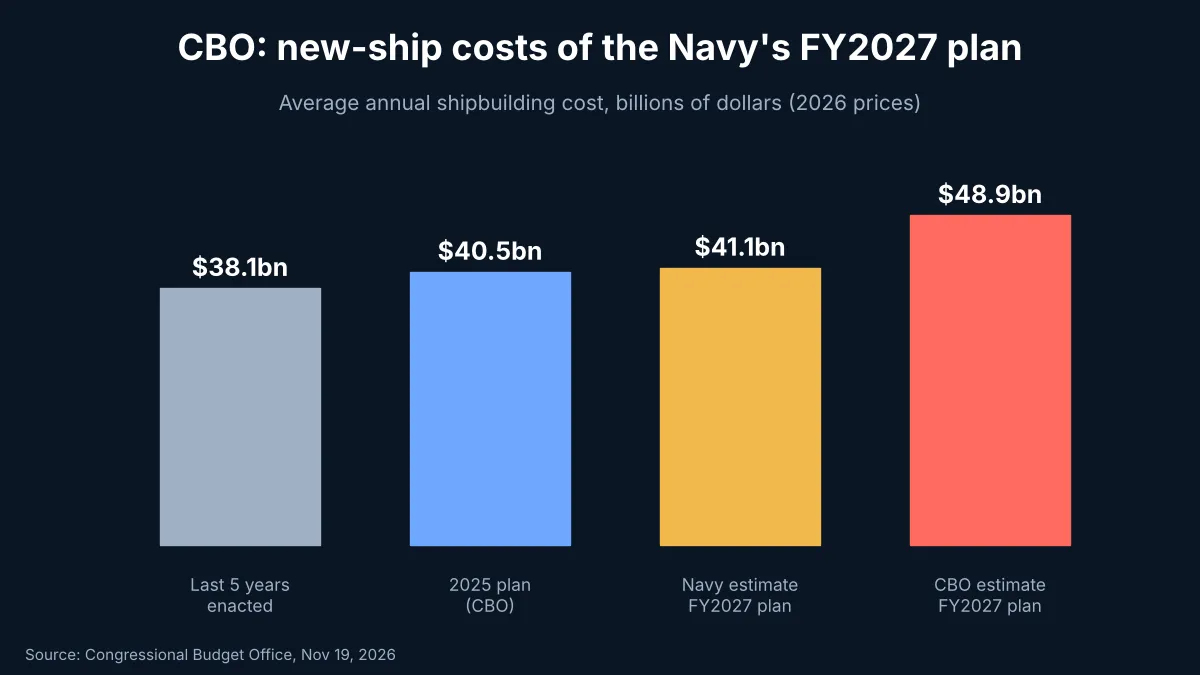
The CBO estimates that carrying out the plan, which covers 2027 to 2056, would cost an average of $53.8 billion a year (in 2026 dollars), of which $48.9 billion is for building new ships. That is about 18% above the Navy’s own estimate, which puts new-ship costs at $41.1 billion a year. Compared with the 2025 plan, new construction costs rise 21%, from $40.5 billion to $48.9 billion a year. The gap with recent funding is even larger: the plan would cost 41% more in real terms than the $38.1 billion average Congress approved over the past five years.
$18.3 billion per battleship
The analysis estimates each battleship at $18.3 billion. The ships would displace 35,000 tons or more, with the first to be bought in 2028 and the others about every two years until 2056. The CBO notes that the battleships would concentrate firepower in a few large ships, which runs against the Navy’s stated goal of spreading it across more ships and uncrewed vessels. The programme, headed by USS Defiant, is not the only cause. The report says per-ship costs are rising in nearly all major programmes, some ship designs proved more complex, and the cost of some ships was “unrealistically low” in earlier plans.
A fleet of 398 ships, and the limits
The plan would grow the fleet from 286 battle force ships on November 1, 2026 to 398 in 2056, above the 381 target. Of the current total, 15 logistics and support ships are laid up for lack of civilian crews, leaving 271 operational. The Navy wants to buy 371 new battle force, support and logistics ships, 58 new and 29 used auxiliaries, and 72 medium uncrewed surface vessels. The CBO says that even with funding equal to the last five years, the Navy “could not buy all the ships” in the plan. Unless it limits the maintenance delays that have plagued it for more than a decade, it will not be able to deploy as many ships as the target requires.
The report comes in a week of pressure on the Navy. Acting Navy Secretary Hung Cao acknowledged at his Senate hearing that the war with Iran is straining the fleet. The same week, members of the Senate Appropriations Committee proposed zeroing out the $1 billion the Navy asked for as advance procurement for the battleships, the Guardian reports.