Cyprus
EUNOMIA 7-26 concludes: Greece, Cyprus, France and Italy complete a quadripartite air-naval exercise
The seventh EUNOMIA exercise ran from October 16 to 22 in the Eastern Mediterranean, with Italy in overall coordination. Turkey disputed Greece’s competence to announce it from day one.

With anti-air and anti-submarine scenarios on the programme, and with Turkey disputing from the first day Greece’s competence to announce it, EUNOMIA 7-26 came to a close: the seventh quadripartite air-naval exercise of Greece, Cyprus, France and Italy in the Eastern Mediterranean. The Hellenic National Defence General Staff (HNDGS) announced its completion on Friday, October 23, a day after the corresponding release from Cyprus’s Ministry of Defence.
The drills lasted a week, from October 16 to 22, 2026, with Italy in overall coordination this year. According to Nicosia, the naval and air forces of the four countries trained in maritime interdiction operations, search and rescue, countering asymmetric threats, and anti-air and anti-submarine operations.
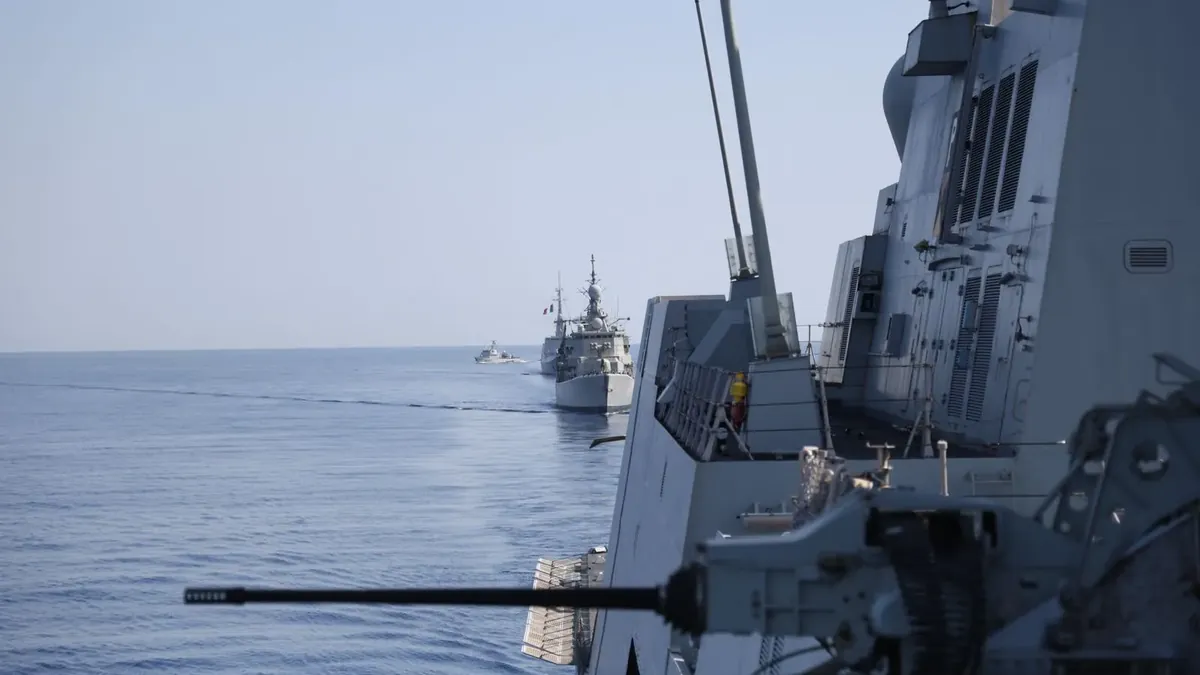
On the Cypriot side, National Guard personnel and assets and the Larnaca Joint Rescue Coordination Centre took part. Greece, France and Italy participated with their armed forces. The aim, the Cypriot ministry notes, was to improve mutual understanding, cooperation and the operational interoperability of the air-naval forces. The photographs released by the Cypriot Ministry of Defence show warships sailing in column, a boarding team approaching in a rigid inflatable boat and a helicopter flying over a frigate.
A yearly fixture of the Quadripartite Initiative
EUNOMIA takes place every year under the Quadripartite Initiative of the four states, with rotating organisation. The previous one, EUNOMIA 6-2025, was held from September 11 to 18, 2025, co-organised by Cyprus and France, and included maritime interdiction, search and rescue, asymmetric threats and cyber-warfare training. The initiative, according to the Cypriot ministry, expresses the four countries’ commitment to the UN Convention on the Law of the Sea (UNCLOS) and international law and aims at regional stability.
Ankara’s reaction
Once again this year the exercise provoked a reaction from Ankara. Turkey’s Antalya NAVTEX station rebroadcast the Greek Heraklion notice for the drills of October 19, describing itself as the “competent station” for the sea south of Kastellorizo and east of Kasos and Karpathos. The firing and air-naval exercise areas lie in the corridor between Crete and Cyprus, where the seabed surveys for the Great Sea Interconnector electricity cable are also planned.
In the Turkish media the tone rose. Türkiye Gazetesi spoke of a Greek “pirate NAVTEX”, while A Haber presented the exercise as a “two-scenario trap” by Athens involving France and Italy. The exercise was completed as planned, confirming for the seventh year the presence of the four countries at sea between Crete, Rhodes and Cyprus.