
Greece
Greece–France: the strategic alliance and the official offer of Blacksword Barracuda submarines
From Rafale jets and FDI frigates to crises in the Aegean and the Eastern Mediterranean, Greece and France have built a defence relationship that now extends to an official Naval Group offer of Blacksword Barracuda submarines.

From the Rafale and the FDI frigates to the crises in the Aegean and the Eastern Mediterranean, the defence relationship between Greece and France has now gone beyond the limits of a traditional bilateral relationship, with Athens and Paris operating together, developing industrial cooperation and shaping an ever closer strategic bond in the region.
The phrase “Greece–France–Alliance” carries historical weight. Today, however, it acquires very concrete military content.
The ties between the two countries run from French participation in the Battle of Navarino and the presence of the French Army of the Orient in Thessaloniki, to France’s support for Greece’s European course after the restoration of democracy. The modern strategic relationship, however, was built mainly through the crises of the past decade.
In the summer of 2020, during the crisis with the Turkish research vessel Oruç Reis in the Eastern Mediterranean, France chose to support Greece politically and militarily, deploying Rafale jets and naval units to the region. Shortly afterwards Athens announced the acquisition of its first Rafale.
In 2021 came the signing of the Greek–French Strategic Partnership Agreement on defence and security cooperation, with a mutual-assistance clause in case of armed attack. At the same time, the strategic convergence of the two countries shows operationally in the systematic joint training of Greek and French forces, through activities such as ARGO and HNIOCHOS.
Five years later, on April 25, 2026, the relationship was upgraded again. During the French President’s visit to Athens, an enhanced comprehensive strategic partnership between the two countries was signed, widening cooperation beyond defence into energy, the economy, technology and innovation. The strategic convergence was seen even more clearly in March, when, after the drone attacks on Cyprus, Greece immediately deployed F-16s and two frigates, among them the new FDI “Kimon”, to strengthen the island’s defence. France followed with the frigate Languedoc and then with the carrier air group of the Charles de Gaulle. The sight of Greek and French forces operating side by side to protect a third European state gave the Greek–French relationship far more substance than a simple bilateral defence agreement.
The French President was particularly clear on the mutual-security dimension, noting that the bilateral clause further strengthens European obligations of solidarity and telling Greece: “Whatever happens, we will be there, at your side.”
In parallel, Greece was included in 2026 in the first group of European states taking part in the new dialogue opened by Paris on so-called “enhanced deterrence”, the only country of Southern Europe in the initial group.
From the Rafale to the FDI
The defence cooperation is now reflected in the armed forces themselves. The Hellenic Air Force operates 24 Rafale, continuing a French tradition that began decades ago with the Mirage and was accompanied by French weapons such as the Exocet and MICA, for which an agreement with MBDA on support and upgrade was signed this year.
At sea, the Hellenic Navy has moved to acquire four FDI HN frigates, after the activation in 2025 of the contract for the fourth unit. The first frigate, “Kimon”, was delivered in December 2025, “Nearchos” is expected very soon, and the programme continues with the following units.
The FDIs bring the Navy capabilities such as the Sea Fire digital radar, Aster 30 missiles, advanced anti-submarine capabilities and a fully digital architecture designed for network-centric operations.
Most importantly, though, the cooperation is not limited to buying ready-made ships. At Salamis Shipyards, sections of the FDIs are being built for both Greek and French vessels. Naval Group has transferred relevant know-how to Greece and has brought dozens of Greek companies into its supply chain.
This is perhaps what sets today’s relationship apart most: Greece is not simply buying French systems. It already takes part in their production chain.
And now, the French Blacksword Barracuda submarines enter the equation
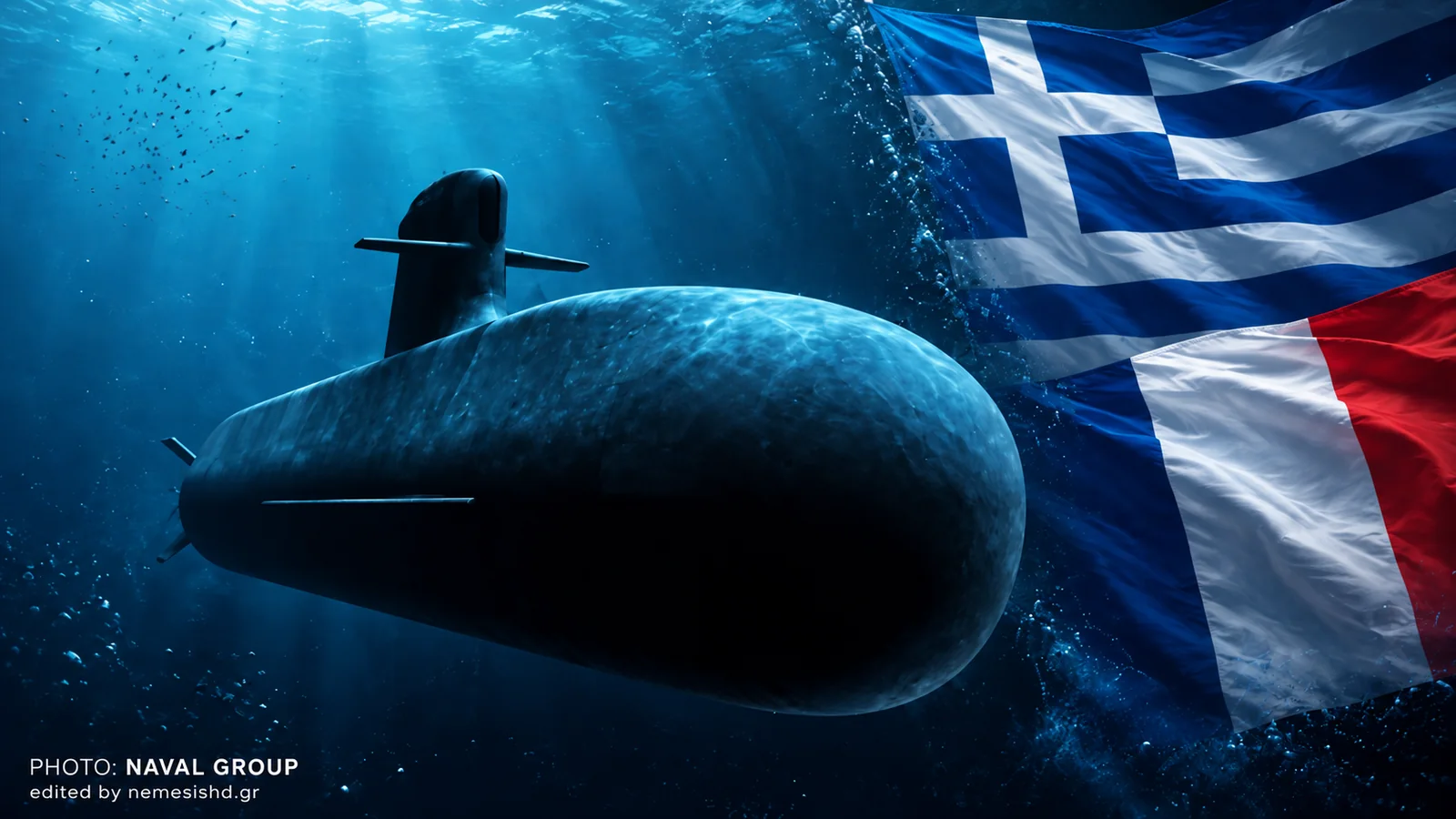
The next big programme that could give the cooperation a new dimension concerns submarines. The Navy is preparing to replace its older Type 209 boats, with the programme covering four new-generation submarines.
In this context, Naval Group is officially offering Greece the Blacksword Barracuda class of submarine, responding to the Greek request for information on the fleet’s future submarine. For more on the competing offers, see our report on Pistorius’s remarks to Dendias on the German U212 CD.
According to company officials, the choice of this design was made after studying the Navy’s operational and technical requirements, which were judged to be closer to the Barracuda family than to smaller French designs.
The Blacksword Barracuda derives from the Barracuda family and draws on technologies and design experience from the nuclear-powered Suffren class, with its combat system incorporating developments from the French nuclear submarine programme.
The Blacksword carries over, in conventional propulsion, part of the operational logic of a nuclear-powered SSN submarine: long range, a large energy reserve, a significant number of weapons, the ability to carry out different missions in the same deployment, and greater flexibility in operations far from base.
One of the most heavily promoted features of the Barracuda is its ability to carry almost 30 heavy weapons (missiles, torpedoes and mines). A large stock of weapons and systems gives the commander far more freedom in shaping a mission and reduces the need to return to base to rearm.
Even more significant is the ability to integrate cruise missiles for strikes on land targets. If such a capability were included in the Greek configuration, and the necessary approvals and an available weapon system existed, it would be a substantial change for the Greek submarine arm.
Until now, the main deterrent value of a Greek submarine has rested on its ability to remain extremely hard to detect and to threaten enemy ships or submarines. With such a strike capability, an adversary would also have to factor in the possibility that an undersea platform of unknown location could hit critical targets deep inland. That uncertainty alone strengthens deterrence.
Perhaps the most interesting technical element of the French offer lies in the energy architecture. Naval Group has chosen, for the Barracuda, a solution based on advanced lithium-ion batteries, rather than following the classic approach of a separate AIP system as found in several conventional designs. Large lithium-ion batteries, on the other hand, offer higher energy density and much more immediately available power, which allows more aggressive manoeuvres, higher underwater speed and faster changes of tactical position.
The French approach also comes with a practical support advantage, since the batteries are recharged at sea without needing the special refuelling infrastructure that accompanies some AIP architectures.
If selected, the Barracuda would join an already established French ecosystem in the armed forces, alongside the FDIs and French-origin weapons.
There is, however, an important precedent.
The choice of the same design family by the Royal Netherlands Navy for its Orka programme is undoubtedly a significant reference point. The Netherlands has long experience in long-range conventional submarine operations and traditionally sets strict requirements for ISR, endurance and long-range operations. That this design prevailed in a demanding European evaluation process shows that the Barracuda philosophy has already undergone serious technical and operational scrutiny.
Where the French offer could become particularly interesting for Greece is in the industrial dimension. The FDI experience has already shown that Greek shipyards can be integrated into Naval Group’s production chain, with Salamis Shipyards building sections for both Greek and French ships. In the submarine programme, Naval Group has also moved towards cooperation with Skaramangas Shipyards, opening the way for significant local participation.
That, in the end, is the main characteristic of today’s Greek–French relationship.
The Rafale, the FDIs and now the Blacksword Barracuda offer are the most visible elements of a cooperation that has evolved far beyond the purchase of defence equipment.
There is now joint operational activity, participation of Greek companies in the French shipbuilding chain, joint exercises and an institutionalised strategic relationship that was renewed and widened in 2026.