
Greece
Nemesis: what the ancient Greeks believed about the goddess who punishes hubris, and modern Greek deterrence
For the ancient Greeks nemesis meant not revenge but the restoration of measure when someone oversteps it. A look at Homer, Hesiod, Herodotus and Aeschylus, the sanctuary of Nemesis at Rhamnous, and why the word keeps returning in Greek deterrence.

To the ancient Greeks the word nemesis did not mean revenge, nor the “arch-enemy” that the English word has come to denote. It meant something stricter and more useful to anyone concerned with the security of a state: the restoration of measure when someone exceeds it. Nemesis is the answer to hubris, the moment when the arrogance of the powerful pays its price, and that is why the same word returns today in the language of Greek deterrence, from the speeches of Chiefs of the Hellenic National Defence General Staff to exercise names in Cyprus. It is worth explaining what our ancestors actually believed, on the evidence of the ancient texts themselves and the goddess’s sanctuary at Rhamnous in Attica.
What the word means: from “nemo” to righteous indignation
Nemesis comes from the verb nemo, to distribute, to allot to each what is due. At the root of the word lies the idea of a fair share: the world has an order, everyone has a place, and whoever seizes more than he is owed provokes a reaction that restores the balance. In Homer the word is not yet a goddess but a feeling, the righteous indignation one feels at what is improper. In Book 13 of the Iliad, when the Achaeans give ground and Hector fights beside the ships, Poseidon urges each man to put into his heart “aidos and nemesis” (Iliad 13.121-122), shame before himself and indignation at the situation, the two feelings that keep an army in its place.
In Hesiod Nemesis becomes a person. In the Theogony she is a daughter of Night, “a woe to mortal men” (lines 223-224), not because she is evil but because she finds them when they overstep their limits. In Works and Days the poet describes what will happen when people are utterly corrupted: Aidos and Nemesis, wrapped in white robes, will leave the earth for Olympus, and then “there will be no defence against evil” (lines 197-200). The image matters for understanding ancient thought: Nemesis is not a threat to society but a precondition for society to exist, and her absence means that the powerful can do as they please at no cost.
Hubris and Nemesis: how Herodotus and Aeschylus explained the defeat of the Persians
Nemesis takes on its full meaning only beside hubris, the arrogance of one who believes his power places him above men and gods. Herodotus builds the whole narrative of his Histories on this pair. Croesus of Lydia, after sending away Solon, who had warned him to call no man happy before seeing his end, is struck at once: “a great nemesis from god fell upon Croesus” (1.34), because he thought himself the happiest of all men. His son’s death follows and, soon after, the collapse of his kingdom before the Persians.
The most military formulation of the idea is in Book 7, when Xerxes gathers the Persian nobles to decide on the campaign against Greece. His uncle Artabanus is the only one who dares to contradict him, and tells him something every staff officer should remember: the god strikes with his thunderbolts the tallest animals, the largest houses and the highest trees, “for the god loves to cut down everything that stands out”, and in the same way (Herodotus 7.10e) “a great army is destroyed by a small one” (7.10e), when the god, jealous of it, sends panic or thunder. The warning was ignored, and after Salamis Themistocles gave the same explanation to the Athenians: it was not we who won, he said, but the gods and heroes, who would not tolerate an impious and arrogant man ruling over Asia and Europe, a man who even lashed the sea (8.109).
Aeschylus, who himself fought at Marathon, put the same idea in the mouth of the dead Darius in The Persians, the oldest surviving tragedy. The king’s ghost explains to the Persians why his son’s army was lost with one of the best-known lines in Greek literature:
“For hubris, flowering, bears the ear of ate, and from it reaps a harvest all of tears.” (Aeschylus, Persians 821-822)
Hubris blossoms, bears the fruit of ate (the blindness that leads to disaster) and reaps a harvest full of lamentation. The chain hubris, ate, nemesis is how the Greeks of the fifth century understood their victory against an empire many times greater in population and resources. It is not fatalism: Herodotus does not say the Athenians sat waiting for the gods, but that they fought, and that the enemy had already undermined himself through his arrogance. In modern terms, it is an observation about how overestimating one’s power breeds strategic errors, and deterrence is the mechanism that makes those errors costly.
Rhamnous: the sanctuary of Nemesis and the fortress on the Euboean Gulf
Nemesis was worshipped in many places, but her most important sanctuary in Greece was at Rhamnous, on the north-eastern edge of Attica above the Euboean Gulf and a few kilometres from Marathon. Pausanias, who visited it in the second century AD, calls her the god “most implacable towards insolent men” and tells the story that made the sanctuary famous. The Persians who landed at Marathon in 490 BC were so sure that nothing would stop them taking Athens that they brought with them a block of Parian marble to set up a trophy of victory. The victory never came, and from that marble, according to Pausanias (1.33.2-8), the statue of Nemesis was carved.
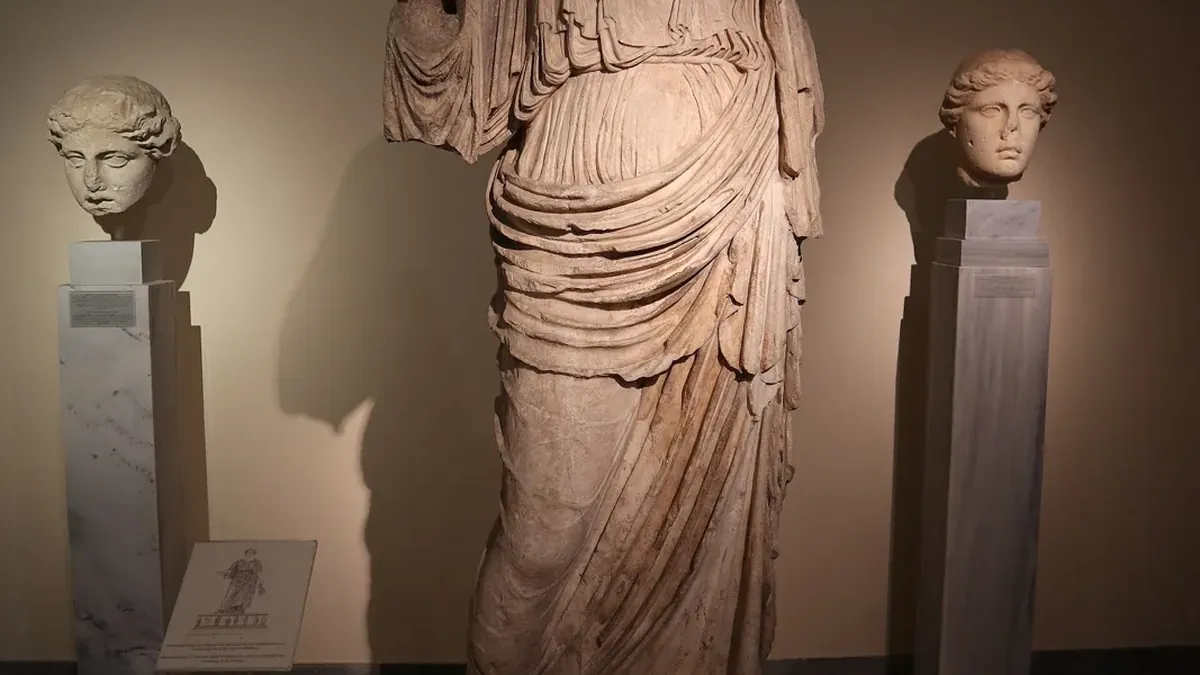
Pausanias attributes the statue to Pheidias, but Pliny and modern scholarship regard it as the work of his pupil Agorakritos of Paros, and that is how the Greek Ministry of Culture presents it presents it. The goddess held an apple branch in one hand and a phiale in the other, and wore a crown decorated with deer and small figures of Victory. The relief base, restored from many fragments and dated to about 420 BC, showed Leda leading Helen to Nemesis, because in one version of the myth Nemesis was the true mother of fair Helen: Zeus pursued her in the form of a swan, she took the form of a goose, and the egg she laid was raised by Leda. The choice is no accident, since Helen was the cause of the Trojan War, the first great punishment of hubris in the Greeks’ memory. The classical temple, a Doric peripteral building with six columns on the short sides and twelve on the long, measuring 21.40 x 10.05 metres, was built after the middle of the fifth century BC beside an older temple destroyed by the Persians in 480 BC.
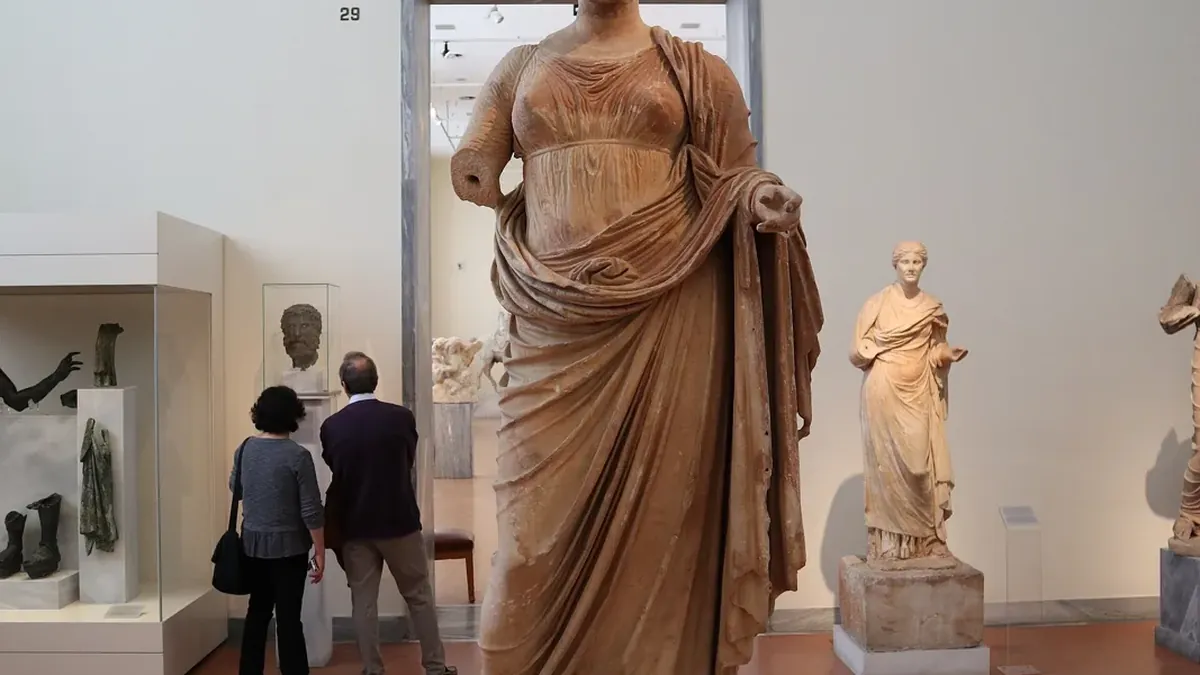
Next to the great temple stands the smaller one, measuring 10 x 6 metres, where the statue of Themis, goddess of just order, was found; it is now in the National Archaeological Museum. The pairing says a good deal: Themis defines what is right, Nemesis sees to it that whoever violates it pays. What makes Rhamnous unique for a defence publication, however, is what lies a little lower, above the sea. There survives a fortress with an outer wall of 800 metres, rectangular towers and military installations on the hilltop, while two small harbours, according to the Ministry of Culture, served the ships that controlled the passage of the Euboean Gulf and protected the grain cargoes bound for Athens. In 322 BC the Macedonian admiral Cleitus landed troops there and Phocion drove them off, and in 296 BC Demetrius Poliorcetes took the fortress. On the same hill, in other words, the Athenians had placed the goddess who punishes hubris and the garrison that protected a vital sea route, a coincidence that would be hard to find more eloquent about the relationship between moral law and military power.
Nemesis in modern Greek deterrence
The word did not stay in museums. In January 2023 the then Chief of the Hellenic National Defence General Staff, General Konstantinos Floros, warned that Greek weapons, which are weapons of peace and deterrence, would turn into “weapons of Nemesis and Tisis (retribution)” for those who dared to commit “the fatal error of hubris”, using almost verbatim the vocabulary of Herodotus. In August 2020, at the height of the Oruç Reis crisis, Greece’s then foreign minister Nikos Dendias told Parliament that national unity would bring “Nemesis in the face of Turkish hubris”. And the Cypriot National Guard gave the name “Nemesis 2021” to an exercise that, as the then Cypriot defence minister said, concerned dangerous situations stemming from Turkey’s energy programme in the Cypriot EEZ, annoying Ankara.

The reappearance of the word is not a rhetorical ornament. The ancient Nemesis describes precisely the logic of deterrence: it is not an aggressive threat or revenge, but the credible certainty that overstepping the measure will cost more than it gains. Artabanus’s remark that a large army can be lost to a small one is arguably the oldest argument for quality over quantity, the same one that runs through every discussion of the balance of power in the Aegean today. A country smaller than its adversary does not deter by numbers, but through technology, training, knowledge of the terrain and the ability to make the price of hubris visible, a price Greece and Cyprus have had every reason to point out since Turkey’s invasion and continuing occupation of northern Cyprus in 1974.
The Nemesis of the ancients was not blind rage but the delivery of justice, and that is the standard worth applying to defence reporting too: measure accurately, do not exaggerate, and remember that arrogance always pays.