
Opinion Greece
Proposal: the Dutch AEV 3 Kodiak engineer vehicles on a Leopard 2 hull could fill a long-standing gap in the Hellenic Army
The Netherlands will replace its ten AEV 3 Kodiak armoured engineer vehicles. Opinion: acquiring them at surplus prices could give the Hellenic Army’s Leopard 2 armoured brigades the breaching and engineering support they lack, after the 2024 tender for 12 used vehicles was cancelled over price.

The Netherlands’ decision to replace its AEV 3 Kodiak armoured engineer vehicles creates an excellent opportunity for the Hellenic Army. Deputy Defence Minister Derk Boswijk told the Dutch parliament on October 22, in a letter on the projects “Replacement and expansion of obstacle-breaching capability” and “Expansion of bridge-laying tanks”, that the Netherlands will buy new breaching vehicles in place of its ten Kodiaks.
Acquiring the Kodiaks could fill a chronic operational gap in the support of Greece’s armoured and mechanised formations, since the existing engineer assets rely on older platforms such as the Leopard 1. The Leopard 2A4 and 2A6 HEL tanks of the Armoured Brigades move with a speed and armour their current engineer vehicles lack, and in a conflict the tank stops where its engineer stops: at a minefield, a canal, an embankment or a roadblock that someone must cross or open under fire.
What the AEV 3 Kodiak is and what it can do
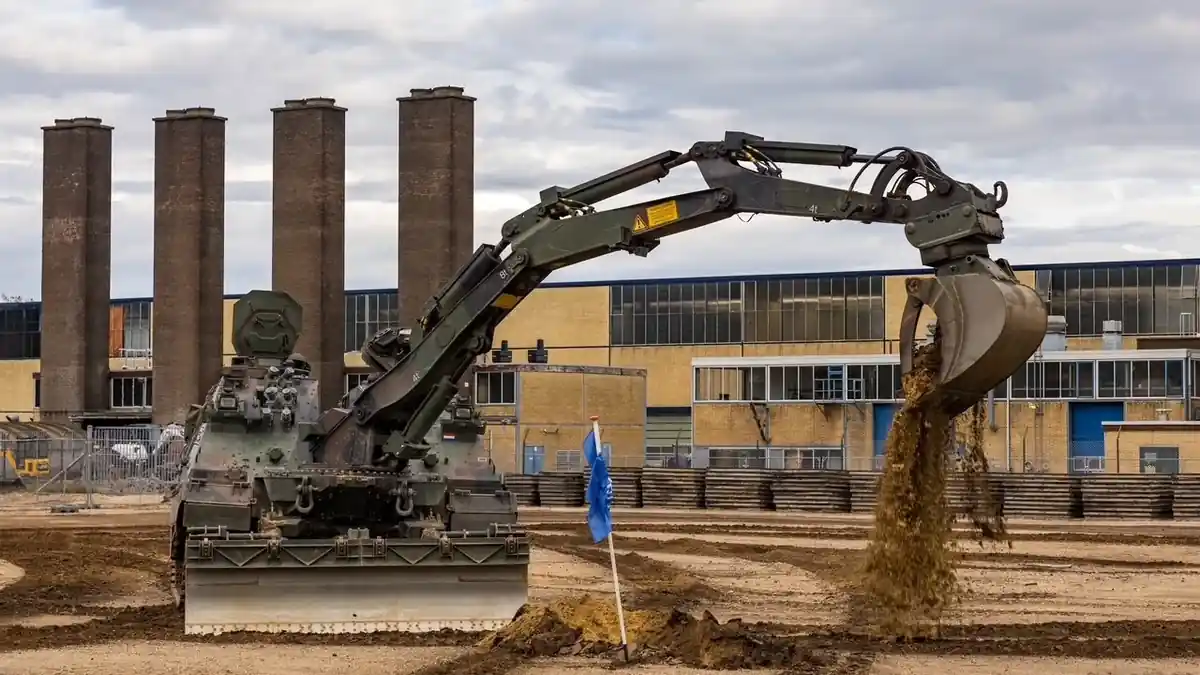
The Kodiak, or Pionierpanzer 3 in German, is a Rheinmetall armoured engineer vehicle that uses the hull and drive train of the Leopard 2. According to Rheinmetall, it has at the centre of its front an articulated excavator arm with a 160-degree swing, a horizontal reach of up to 9 metres, a one-cubic-metre bucket and a lifting capacity of up to 3.5 tonnes at maximum reach. The excavator’s tools, such as grabs, hydraulic hammers and concrete crushers, change through a hydraulic quick coupler without the crew leaving the armoured cabin, with two more tools carried at the rear. At the front is an adjustable dozer blade 3.42 metres wide, or 4.30 metres with side extensions, for digging positions, building embankments and clearing roads of rubble.
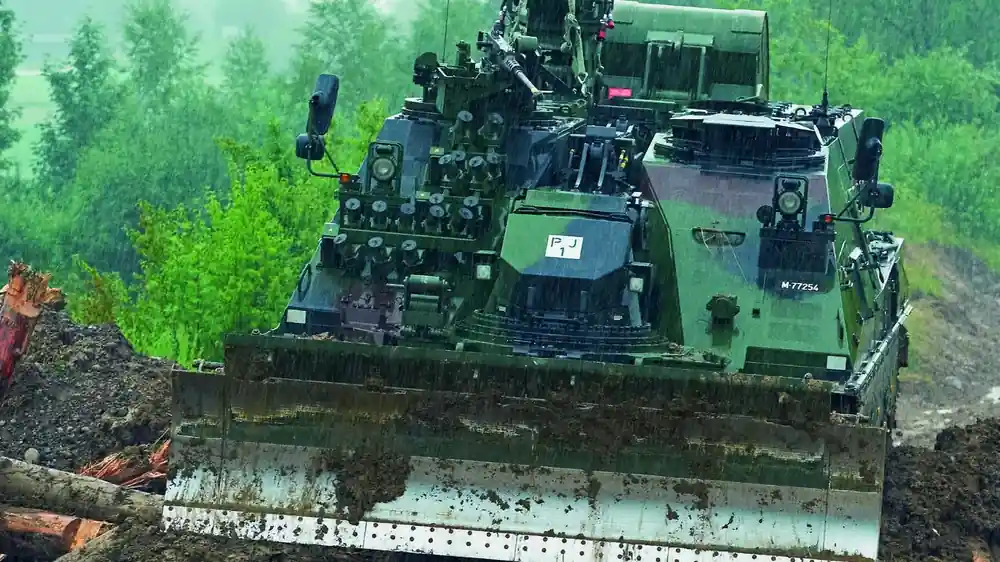
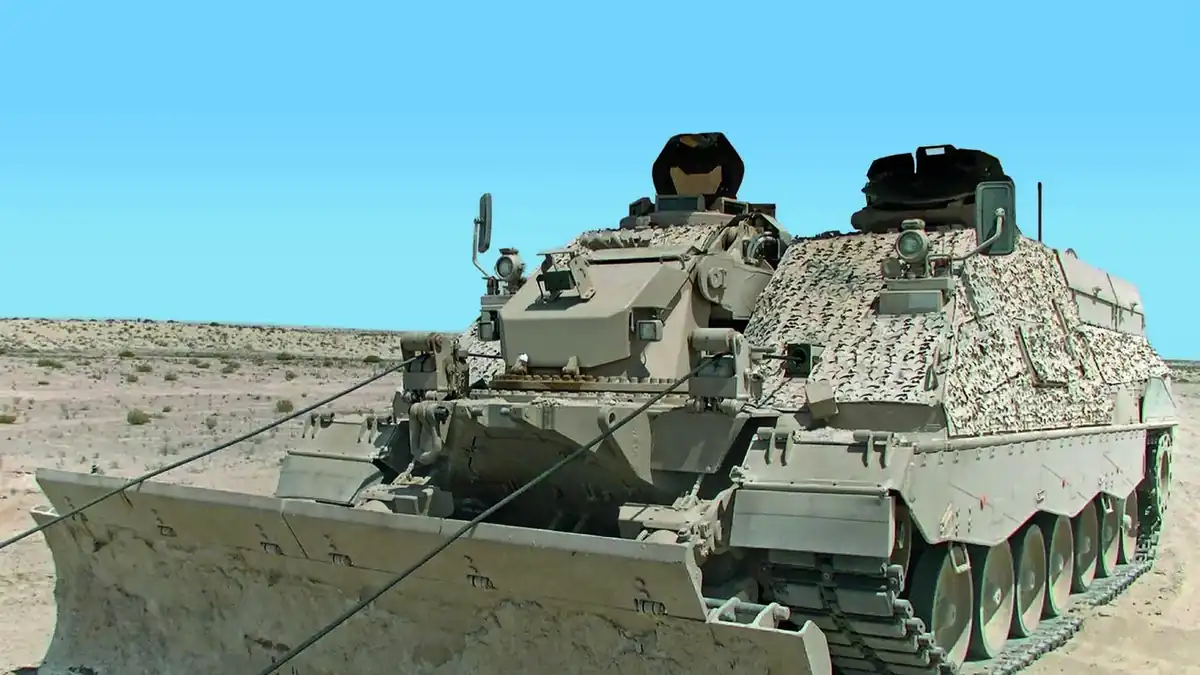
The vehicle also has two 9-tonne winches that work together or independently, pull down obstacles and, with a multi-pulley arrangement, reach a pulling force of up to 620 kN for recovering heavy vehicles. With the breaching kit the crew quickly converts it into a minefield-clearing system, with a full-width mine plough, an electromagnetic signature simulator that triggers magnetic mines before the vehicle passes, and a lane-marking system so following forces can pass safely. Rheinmetall notes that with optional equipment the Kodiak can be driven and operated by remote control from a safe distance, precisely for the most dangerous breaching missions. The crew of two or three works under full protection, with ballistic armour, protection against mines and improvised explosive devices, NBC protection and, with an additional armour package, protection of the cabin against shaped-charge rounds such as the RPG-7.
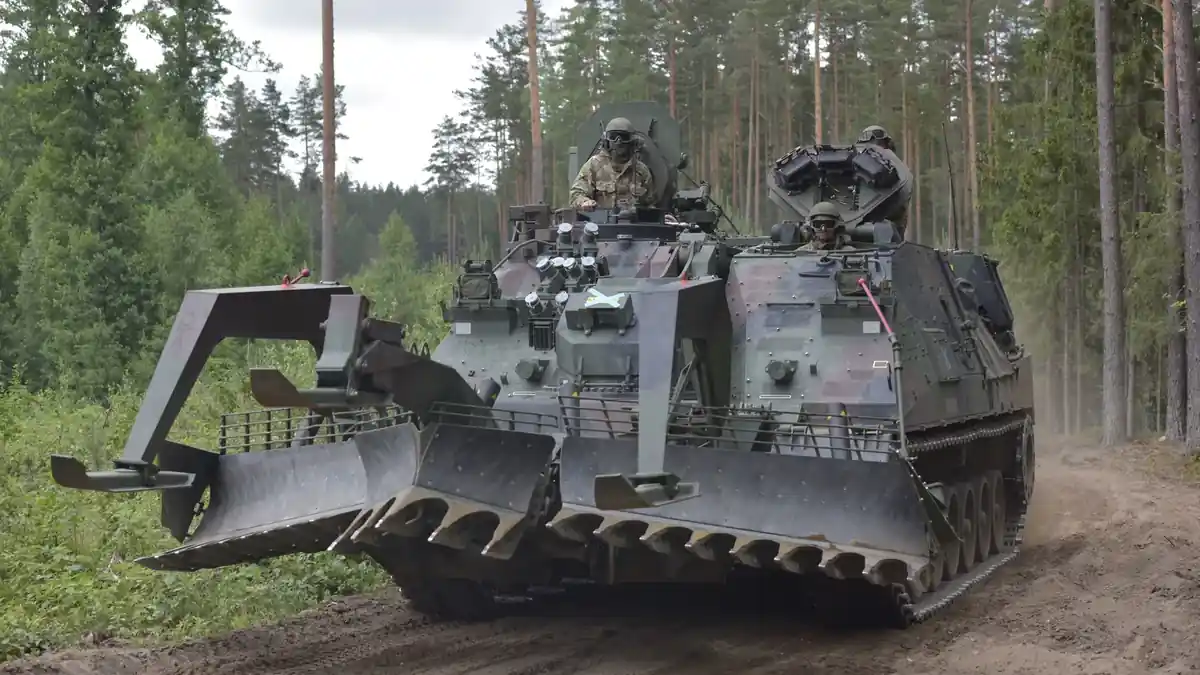
The Netherlands ordered ten Kodiaks in January 2008, together with six for Sweden, and according to the Dutch Ministry of Defence they have been in service since 2014. According to Rheinmetall, more than 40 Kodiaks now serve in Switzerland, Sweden, the Netherlands and Singapore, while the Bundeswehr has ordered newly built vehicles of its own. That matters for a Greek used-vehicle purchase: the Kodiak support line is alive and will remain so for many years, so it would not have the spare parts problems of an “orphan” system.
Why it suits the Hellenic Army
The biggest advantage is commonality with Greek main battle tanks. The Kodiak is powered by the 1,100 kW MTU MB 873 engine, the same type that drives the Hellenic Army’s Leopard 2A4 and 2A6 HEL, and is based on the Leopard 2 hull. The workshops, engineers and spare parts stocks that already exist for the Leopard 2 can cover most of the vehicle’s maintenance, which sharply simplifies the supply chain compared with introducing an entirely new type. With a top speed of 60 kilometres an hour and the same off-road ability as the Leopard 2, the Kodiak keeps up with the tanks instead of slowing them down, something a vehicle on a Leopard 1 hull can no longer guarantee.
The terrain of Evros makes the need more specific. The river, canals, embankments and the plain’s farm ditches are natural and man-made obstacles that must be crossed, opened or reinforced quickly, and in a crisis minefields will be the first thing the Armoured Brigades meet, whether as an obstacle to advance or to open a lane for a counter-attack. The war in Ukraine showed that without enough well-armoured breaching assets even modern tanks are immobilised in front of dense minefields. A vehicle that opens a lane under Leopard 2 armour, shapes firing positions for the tanks and recovers immobilised vehicles from the field improves the manoeuvrability of the whole brigade, not only of the Engineer unit.
What the Netherlands says about its Kodiaks
The Dutch letter does not flatter the vehicle, which is exactly why Athens should read it carefully. The ministry writes that the Kodiak was designed as a multi-purpose system for general engineer work, minefield breaching and laying a bundle of pipes to fill ditches, but that it “is now obsolete”, lacks adequate protection against present and future battlefield threats and has low technical availability because of breakdowns and failures of its subsystems. The ministry considered a mid-life upgrade, judged it too technically complex and time-consuming for its urgent need, and preferred new vehicles designed specifically for breaching, which will also cover the expansion of the Medium Infantry Brigade. The project budget ranges between €250 million and €1 billion, and the study and procurement preparation phase is expected to be completed in the first half of 2028.
For Greece this means two things. First, the Kodiaks will logically be released once the new Dutch vehicles arrive, so the discussion with The Hague can start now, putting Greece first in line when the vehicles become available. Second, the Dutch reservations are the best argument for a low price. A vehicle that no longer meets the Dutch army’s requirements for a major war in central Europe remains far more modern and better protected than the Leopard 1-hull engineer assets in Greek units today. The availability problems, however, must be measured vehicle by vehicle before anyone signs.
The conditions: technical state, price and support package
The need is already officially recorded. The Hellenic Army requested 12 used Armoured Engineer Combat Vehicles under a 2022 programme activation decision, and the General Directorate for Defence Investments and Armaments (GDDIA) launched Tender 01/2024. On September 3, 2025, however, the defence minister signed its cancellation, since the only bidder, Germany’s FFG, submitted a financial offer judged unacceptable. The Army’s requirement remains open and the obstacle was price. That is why a direct agreement with The Hague for the Kodiaks, at a used price, may succeed where the tender failed.
The basic precondition for such a purchase is its technical and financial viability. The vehicles, if put up for sale, must be thoroughly inspected by a technical team of the Army General Staff to establish that they are in excellent condition, with no structural wear in their hydraulic and mechanical parts. The first checkpoint is the subsystem failures the Dutch ministry itself cites. The excavator, winches and blade work at high hydraulic pressures and are stressed more than a tank, so the team should examine their operating hours, maintenance history and the upgrades made since entering service in 2014. It must also be confirmed what exactly is included in the sale: mine ploughs, marking systems, the excavator’s extra tools and remote-control equipment are not a given on every vehicle, and without them the Kodiak loses part of its value.
The purchase makes sense only if the total cost of acquisition and return to service stays at surplus-price levels and includes an initial package of spares and support. That package should cover training of crews and technicians, ideally with the Dutch engineer units that operate the vehicles, as well as manuals and special tools. Participation of Greek industry in returning the vehicles to service, with Rheinmetall supporting the special subsystems, would keep part of the expenditure in the country. Provided good technical condition and an attractive price are secured, bringing the AEV 3 Kodiak into the Engineer units would sharply improve the manoeuvrability and operational power of the Armoured Brigades in Evros.
Useful in natural disasters too
The Kodiak’s value is not limited to the battlefield. According to Rheinmetall, in early summer 2020 the Dutch armed forces used Kodiaks with Büffel recovery vehicles to fight forest fires on the Dutch-German border, and the countries that use it have sent it several times to floods and snowfalls. The vehicle can also supply electrical and hydraulic power to external tools such as floodlights, welders and hand hydraulic tools. For a country that lives with big fires every summer and has seen floods like those in Thessaly, an armoured machine that opens firebreaks and roads through debris is a civil protection tool too.
Quick answers
What is the AEV 3 Kodiak? It is a Rheinmetall armoured engineer vehicle on a Leopard 2 hull, with an articulated excavator, a dozer blade, two 9-tonne winches and an optional minefield breaching kit with a plough and lane marking. It can also be operated by remote control as an option.
Why is the Netherlands replacing its Kodiaks? According to the Dutch Ministry of Defence’s letter of October 22, 2026, the Kodiak has been in service since 2014, is now obsolete, lacks adequate protection against today’s threats and has low technical availability. A modernisation was judged too complex, so the Netherlands will buy new breaching vehicles.
Who uses the Kodiak? According to Rheinmetall, more than 40 Kodiaks serve in Switzerland, Sweden, the Netherlands and Singapore, and Germany has ordered newly built vehicles. The Netherlands has ten, ordered in 2008.
Why does commonality with Greek Leopard 2s matter? The Kodiak uses the MTU MB 873 engine and the drive train of the Leopard 2, like the Greek Leopard 2A4 and 2A6 HEL, so maintenance and spares can rely on existing infrastructure.