
Air Force
Portugal approves the purchase of three KC-390 aircraft with electronic warfare for the Hellenic Air Force, at a cost of €590 million
Portugal’s Council of Ministers approved the procurement of three Embraer KC-390 Millennium aircraft for Greece under Resolution 207/2026. Greece pays the full €589.98 million, and the aircraft will give the Hellenic Air Force its first tanker and a jet-powered airlifter.

Portugal’s Council of Ministers approved the procurement of three Embraer KC-390 Millennium aircraft for Greece. Under Resolution 207/2026, signed on October 14 and published on October 22 in the Diário da República, Portugal buys the aircraft from Embraer and will transfer them to Greece through a government-to-government contract, which is expected to be signed. Greece pays the full cost: the resolution states explicitly that the expenditure is financed solely by the revenue from the contract with the Hellenic Republic.
The resolution sets two budget lines. The three aircraft, with a logistics support package for entry into service, cost €532.9 million and will be contracted with the Embraer S.A. and Embraer Portugal consortium. The second line, €57.1 million, is managed by the Portuguese Air Force and is not only for electronic warfare: it covers the electronic warfare suite, training, logistics support, technical support teams based in Greece and programme management. The total reaches €589.98 million before VAT, with payments spread from 2026 to 2031 and the largest sums for the aircraft in 2029 and 2030.
Electronic warfare
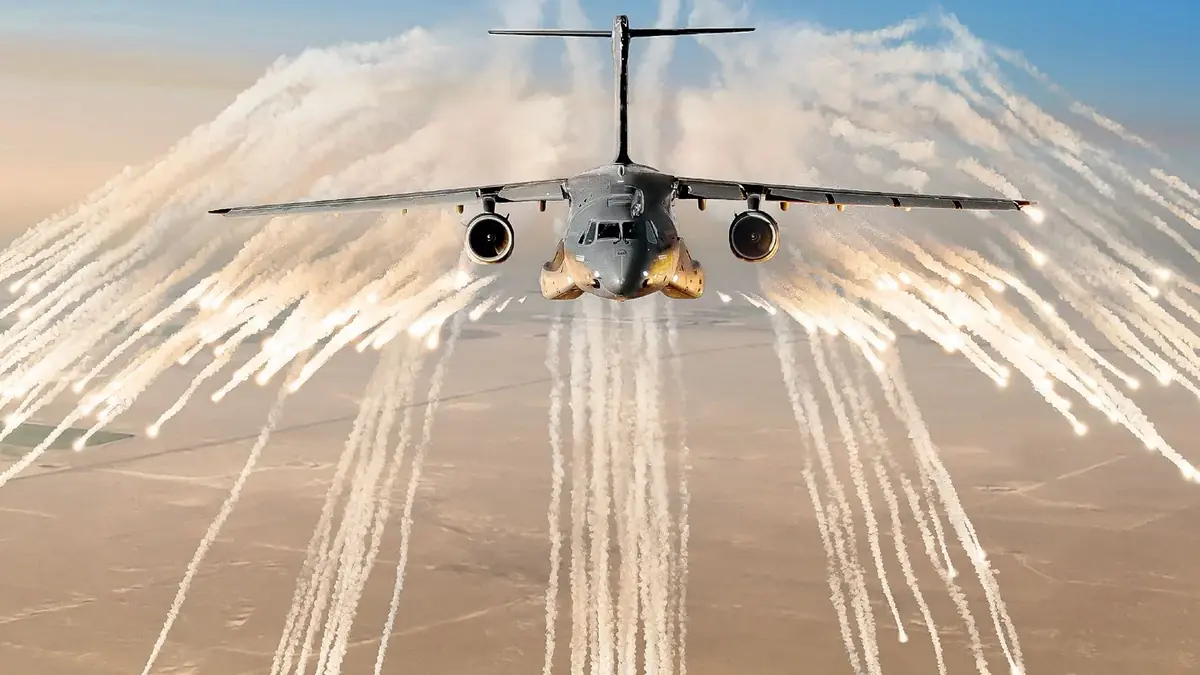
Portuguese Air Force KC-390s carry a suite from Israel’s Elbit Systems. The company announced in October 2019 a contract of about $50 million with Portugal’s Ministry of Defence for a complete electronic warfare suite and logistics support lasting five years. It includes radar and laser warning receivers, a missile warning system, countermeasure dispensers, a directed infrared countermeasures system (DIRCM) and an active electronic countermeasures pod. The Greek aircraft will get the same configuration, since they are bought through the Portuguese programme, and the resolution notes that the Portuguese Air Force developed the aircraft’s NATO configuration, tested it at Air Base 11 and certified it.
How the programme got here
According to the Portuguese resolution, Greece signed a letter of intent on June 16, 2025 for strategic cooperation with Portugal in military airlift. On May 7, 2026 Defence Minister Nikos Dendias visited Lisbon and the 506 Squadron, which flies the Portuguese KC-390s from Air Base 11 at Beja. On May 22 the Hellenic Aerospace Industry (EAB) and Embraer signed a memorandum on maintaining the aircraft in Greece, and on July 23 the purchase was approved by the Government Council for National Security (KYSEA), in the same package as Israeli air-defence systems, with the first delivery placed in 2027. An Athens–Lisbon memorandum of understanding and an official Greek request to the mission monitoring the KC-390 programme in the Portuguese defence ministry followed.
Portugal bought five KC-390s in 2019 and exercised an option for a sixth in a decision published on August 4, 2025. The same decision secured an option for up to ten more aircraft, so that European or NATO countries can buy them through the Portuguese state under government-to-government contracts. The Greek aircraft come from that mechanism. According to the Portuguese government, ten other countries have now bought the KC-390, five of them NATO members.
The first flying tanker of the Hellenic Air Force
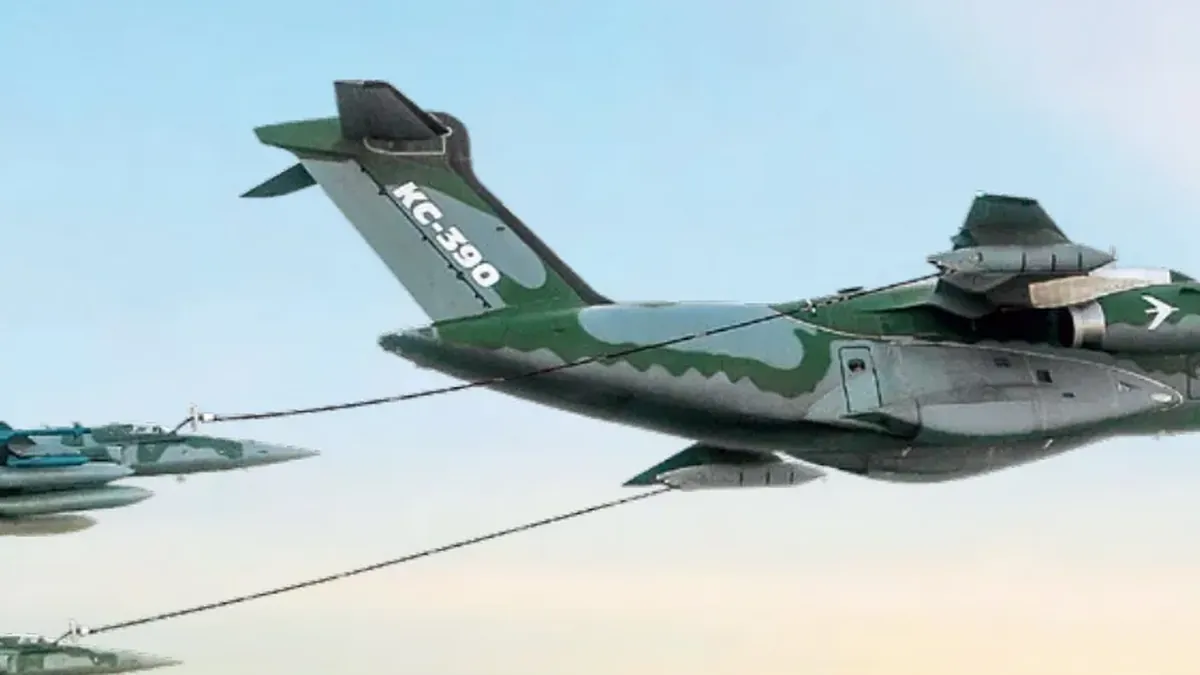
The biggest change the KC-390 brings is not transport but aerial refuelling. The Hellenic Air Force has never had a flying tanker of its own. On every long-range mission and every exercise far from the country it has relied on allied tankers, assets it does not control and that would not necessarily be available in a Greek–Turkish crisis. The KC-390 can carry two Cobham 912E refuelling pods under its wings with a hose and drogue (probe-and-drogue system). According to Embraer it refuels day and night, with cameras and observation windows for the crew, and transfers up to 400 gallons of fuel a minute.
There is one limitation that must be stated clearly. The system serves aircraft with a probe, that is the Rafale and the Mirage 2000-5, the aircraft mentioned in the briefing on the KYSEA approval. F-16s and future F-35s refuel with the rigid boom of the US standard and cannot take fuel from a KC-390 in its present form. Embraer and Northrop Grumman announced in February 2026 a collaboration on a boom that could also be fitted to existing aircraft, but it is a programme under way with no Greek commitment.
Even so, the difference is large. A Rafale from Tanagra refuelled over the southern Aegean stays longer on patrol, reaches deeper into the Eastern Mediterranean and covers Cyprus with a fuel margin it does not have today. For an air force whose area of responsibility runs from Evros to Kastellorizo, time in the air is power. The KC-390 itself also has a probe, so it can take fuel from another tanker and extend its own missions.
Jet speed and 26 tonnes of cargo
The C-130s are turboprops. The KC-390 flies with two IAE V2500 engines and, according to Embraer, cruises at Mach 0.80, about 870 kilometres an hour, at up to 36,000 feet. The US Air Force gives the C-130H a speed of about 590 kilometres an hour. In practice the Elefsina–Paphos route, about 880 kilometres, takes around one hour instead of an hour and a half, and the difference multiplies when an aircraft has to make many trips on the same day.
Payload rises too. The KC-390 lifts up to 26 tonnes of concentrated cargo (23 tonnes distributed), while the US Air Force gives the C-130H a maximum payload of about 19 tonnes. The cargo hold is 18.5 metres long including the ramp, 3.45 metres wide and 2.95 metres high, and takes 80 soldiers or 64 paratroopers, an armoured vehicle or a helicopter the size of a Black Hawk. With 23 tonnes the range, according to Embraer, is 1,470 nautical miles, about 2,700 kilometres.
Islands, crises and damaged runways
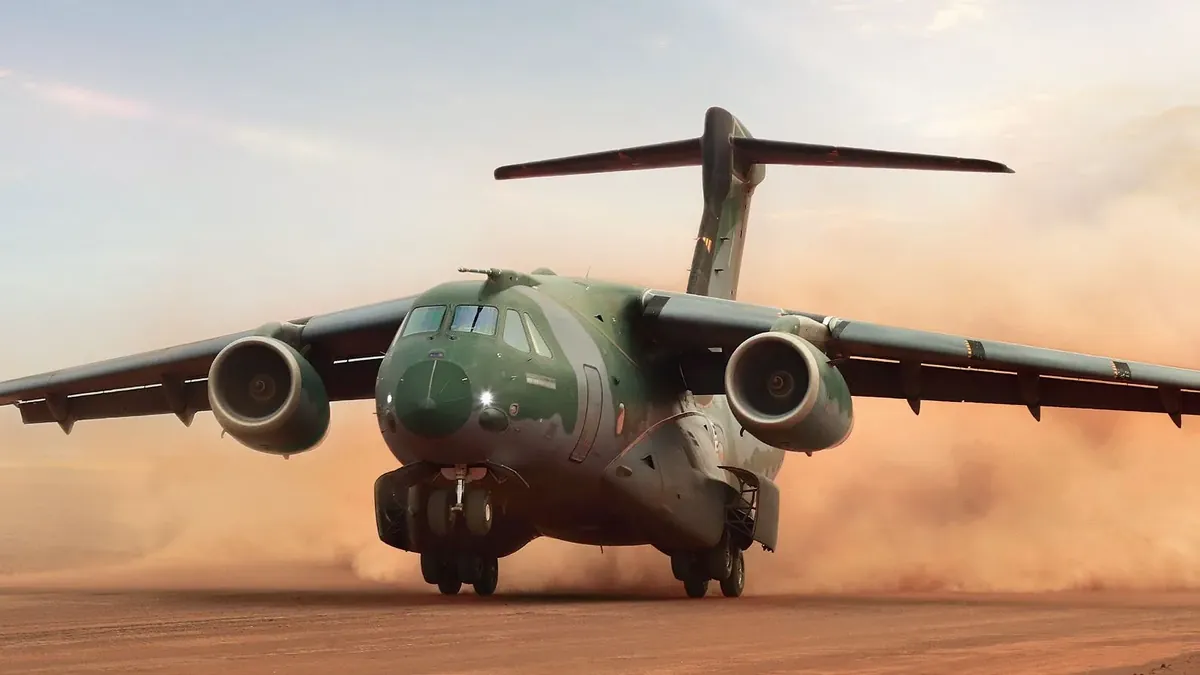
Embraer gives a landing distance of about 1,000 metres with 26 tonnes of cargo in normal sea-level conditions and says the aircraft operates from dirt or damaged runways. For Greece that means rapid reinforcement of the islands with personnel, munitions and spare parts, even if a runway has been hit, faster than current assets allow. The same speed matters in crises far from the country. In an evacuation of civilians or an earthquake the KC-390 carries up to 74 stretchers with medical staff, arrives faster and flies more sorties with fewer aircraft.
Firefighting: a capability that depends on equipment
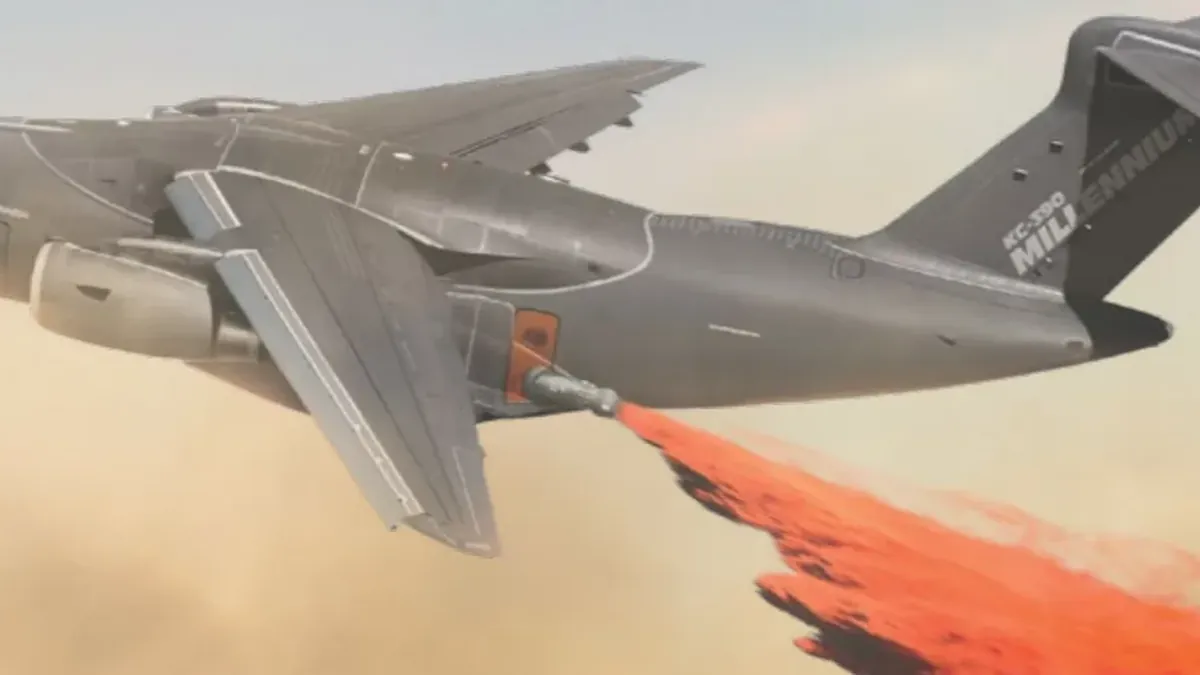
Embraer offers the KC-390 a removable firefighting system loaded in the cargo hold that drops up to 3,000 gallons, about 11,300 litres, of retardant. That is almost double the tank of a Canadair CL-415, with the difference that the KC-390 does not scoop water from the sea and must return to an airfield to refill. Resolution 207/2026 does not mention a firefighting system in the Greek package. If bought, it would give the country a fast tool for the big summer fires, complementary to the Canadairs and not a replacement.
Survivability and support in Greece
The electronic warfare suite is not a luxury. A transport landing in a crisis zone is vulnerable to shoulder-fired anti-aircraft missiles, and DIRCM diverts the infrared missile before it reaches the aircraft. The package also provides for technical support teams in Greece, while the EAB–Embraer memorandum opens the way to maintaining the aircraft and their engines in the country. The Hellenic Air Force thus joins a common European fleet with Portugal, the Netherlands, Austria, Hungary, the Czech Republic and Sweden, with a training centre for the KC-390 that Portugal is building at Air Base 11 in Beja.
Next steps
The government-to-government contract with Portugal is the next step. It will finalise the payment terms and the delivery schedule to the Hellenic Air Force.
Quick answers
How much do the three KC-390s cost Greece? According to Portuguese Resolution 207/2026, the total is €589.98 million before VAT: €532.9 million for the aircraft and the entry-into-service support package and €57.1 million for the electronic warfare suite, training, support and programme management. Greece covers the amount through a government-to-government contract.
Can the KC-390 refuel Greek F-16s? Not in its present form. It refuels with hose and drogue, so it serves Rafale and Mirage 2000-5. F-16s and F-35s need a boom, which Embraer is developing with Northrop Grumman.
Why does Greece buy the KC-390 through Portugal? Portugal has secured from Embraer an option for up to ten more aircraft so that European and NATO countries can buy them through the Portuguese state under government-to-government contracts. Greece signed a letter of intent in June 2025.