Middle East & North Africa
Saudi Arabia expands its ballistic-missile plant at al-Duwadimi; study sees larger missiles with Chinese technology
Satellite imagery analysed by the Foreign Policy Research Institute shows two new buildings at the solid-fuel missile plant near al-Duwadimi, about 200 km west of Riyadh, suggesting the kingdom is preparing larger missiles.

Saudi Arabia is expanding its solid-fuel ballistic missile factory near al-Duwadimi, about 200 kilometres west of Riyadh, and the new facilities suggest the kingdom is probably preparing to build larger missiles, with longer range or a heavier payload. That is the conclusion of researchers Sam Lair and Michael Duitsman of the Foreign Policy Research Institute (FPRI), who studied Planet Labs satellite images from April 2025 to September 2026 and published their analysis on October 23.
Two new buildings are going up at the complex. The first, in the researchers’ assessment, is meant for casting solid-propellant motors: in this process the fuel mixture is poured into the motor casing in deep pits and left to solidify. The pits are roughly 5 to 6 metres on a side, and the building is larger than any other probable casting building at the facility. In an image of September 18 both buildings are nearly complete, and heavy blast-deflection walls are being erected on either side of the first, somewhat similar to those at a US motor plant in Utah and a propellant plant at Parchin in Iran. The second building, with lightning rods around it, will probably store raw materials such as ammonium perchlorate or finished components.
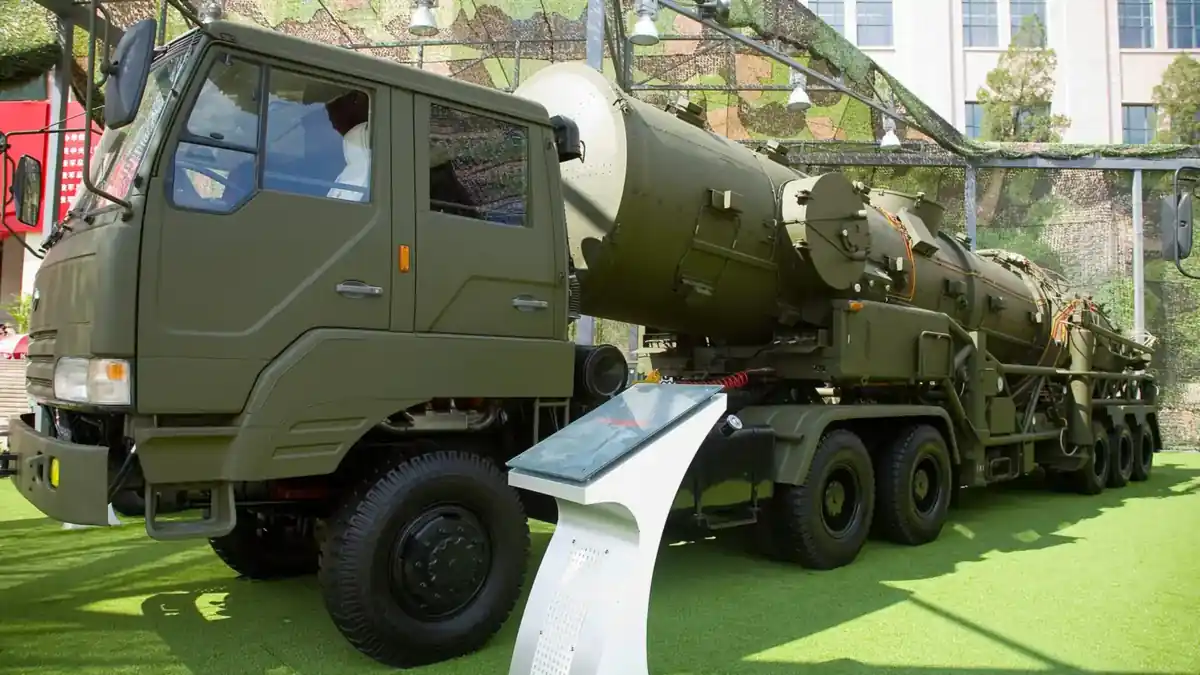
The pit size is the main constraint on a missile’s diameter, so the researchers believe the expansion concerns a new, larger missile or, alternatively, an increase in production. Lair told Reuters that the kingdom may already be producing the Chinese-designed DF-15 and that the expansion most likely concerns the longer-range DF-21 or a similar system. FPRI recently identified in videos and photos the debris of DF-15A missiles in Yemen, the first indication that Riyadh used missiles it has been importing from China for decades in the war with the Houthis.
Background
The plant was publicly identified in 2019, confirmed in 2021 to be operating with Chinese assistance, and according to FPRI has been producing ballistic missiles since late 2021. As early as 1987 Saudi Arabia had secretly acquired about 40 liquid-fuel DF-3 missiles from China, according to a declassified 1991 CIA assessment, and first showed them in a parade in April 2014. Riyadh is believed to have turned to Beijing because Washington has for years restricted exports of long-range missiles.
IISS researcher Sasha Bruchmann explains that longer-range missiles would allow the kingdom to strike Iran without risking its F-15s against Iranian air defences. “Iran has the advantage, because its missiles and drones can hit Saudi Arabia wherever it wants. The Saudis could close that gap a little,” he said. Janes notes that the buildings “may indicate an effort to increase production or support the development of longer-range missiles”, while CNA’s Decker Eveleth observes that “the exact same thing is happening in the UAE and Turkey”.
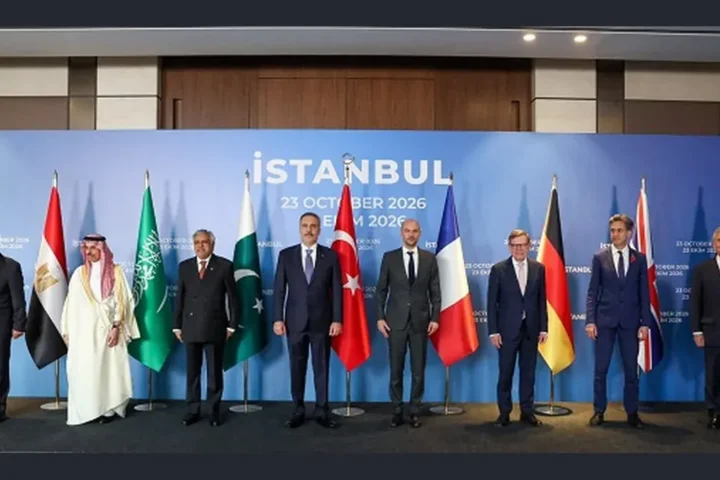
The development comes as the kingdom faces continuing attacks, most recently Houthi ballistic missiles toward Riyadh, and has committed to the Mecca Agreement with Turkey and Pakistan. It also carries a political cost in Washington. FPRI’s researchers link the expansion to the US–Saudi agreement on civil nuclear cooperation, which may allow the kingdom to enrich uranium. Longer-range, heavier-payload missiles would, in their view, heighten proliferation concerns, and bipartisan opposition in Congress to the agreement may harden.