
Air Force
Shield AI and GEK TERNA eye the X-BAT unmanned fighter: agreement on an industrial and support base in Greece
US company Shield AI and Greece’s GEK TERNA signed a strategic agreement in Athens to pursue parts production, aircraft integration and long-term support of the X-BAT in Greece. It is a memorandum of understanding, not an aircraft order.

US company Shield AI and Greece’s GEK TERNA signed a strategic agreement in Athens to jointly pursue parts production, aircraft integration and long-term support of the X-BAT in Greece, Shield AI announced on Thursday, October 8. It is a memorandum of understanding: roles, workshare and facilities will be set in definitive agreements, which the two companies are already negotiating.
What each company would do
Under the memorandum, Shield AI would lead the X-BAT programme and supply the aircraft’s autonomy software and mission systems. GEK TERNA, which Shield AI describes as Greece’s largest investor in critical infrastructure assets, would act as its strategic partner in Greece: managing and developing a network of Greek suppliers, including small and medium-sized enterprises, and running a local programme office.
Greek industrial participation is expected to include parts manufacturing and assembly, ground equipment, operating bases and launch sites, training centres, maintenance and repair, and research with Greek universities. The two companies are looking at Greece as a regional hub for X-BAT training, logistics and maintenance, serving Cyprus, the Balkans and Southeastern Europe.
Why Shield AI sees the X-BAT in the Aegean
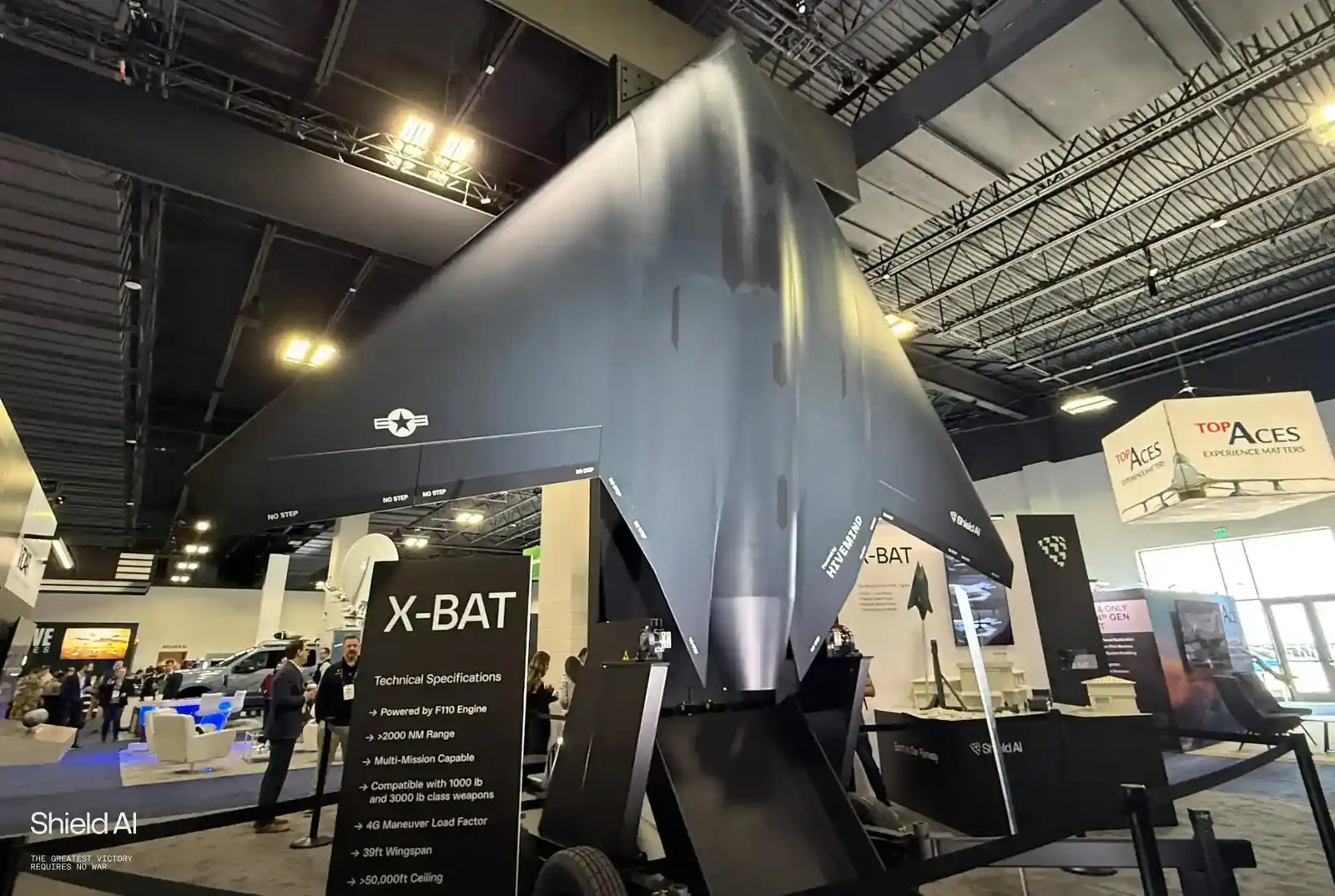
The company ties the aircraft directly to Greek geography: runways are among the first targets in a conflict, while island airstrips are few and exposed. The X-BAT is designed as a long-range, survivable, AI-piloted strike fighter that takes off and lands vertically, so it can operate from ships, islands or remote sites without a runway.
According to Shield AI, it will carry weapons up to the 2,000-pound class in internal bays comparable in size to the F-35’s, with an objective combat radius of 1,000 nautical miles, and will support power-intensive electronic warfare and intelligence, surveillance and reconnaissance payloads. It is powered by GE Aerospace’s F110 engine and will fly on Shield AI’s Hivemind autonomy software, which enables operations without GPS or communications. Flight testing is due to begin later this year. For more on its potential, see Geopolitiki’s analysis of the Greek Air Force’s interest in unmanned combat aircraft: Greek Air Force eyes CCA drones, but what about missiles and F-16 targeting pods?
The statements
“Greece already flies our aircraft over the Aegean and Greek engineers are already building on our software, so X-BAT is the next step in that relationship,” said James Lythgoe, Shield AI’s Regional Director for Eastern and Southeast Europe. “An aircraft that doesn’t need a runway fits a country that defends hundreds of inhabited islands,” he added.
“With Shield AI, we want Greek companies to assemble, integrate and support X-BAT here, aiming for Greece to become the place where operators in the region train and maintain it,” said George Kouladis, Investments Monitoring Head of GEK TERNA. He said this means long-term, highly skilled local engineering jobs, a strong Greek supplier base and an aircraft the Hellenic Armed Forces can sustain at home.
Shield AI’s presence in Greece
The company’s activity in Greece expanded this year. In June the Hellenic Army signed an agreement to expand its V-BAT fleet for maritime surveillance across the Aegean, and Shield AI announced a new office in Athens. In July a V-BAT flew the live demonstration at the opening of Greece’s Joint UAS Tactics Training Centre in Tripoli.
The agreement is not an order for aircraft by Greece. It concerns the creation of an industrial base and support infrastructure, if the definitive contracts go ahead.