Europe
Eight foreign ministers meet in Istanbul: no new attack on Iran, “unimpeded passage” through Hormuz
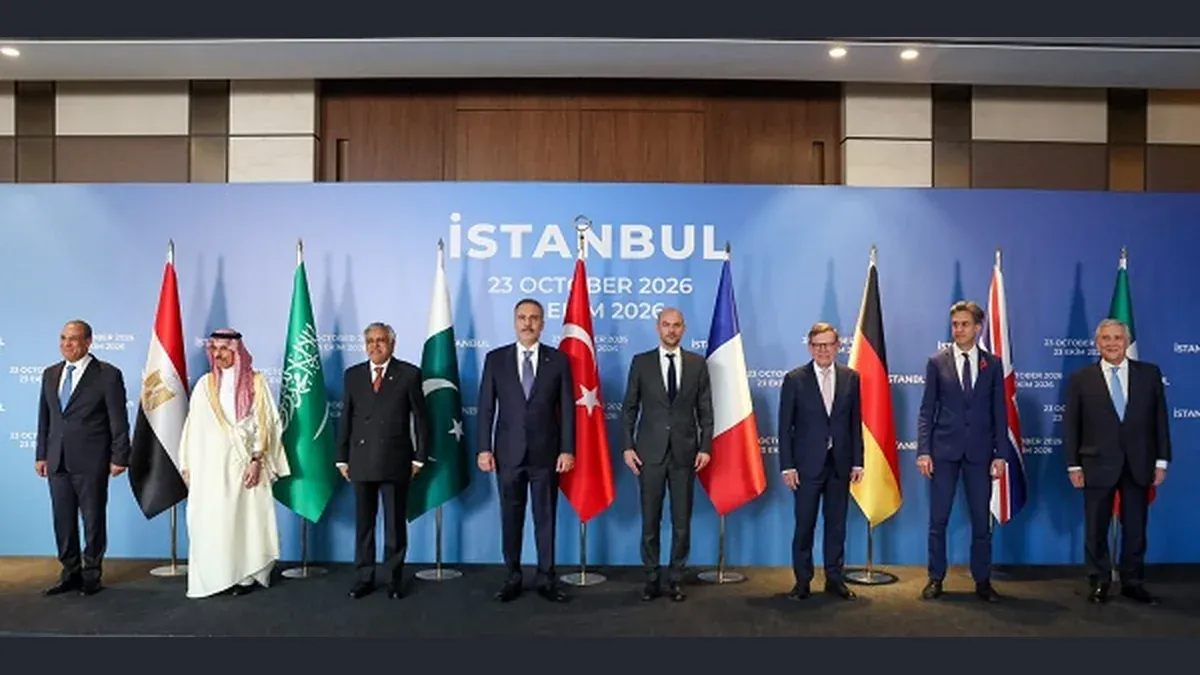
Foreign ministers of Saudi Arabia, Egypt, Pakistan, Turkey, Germany, France, the UK and Italy met in Istanbul and called for dialogue, restraint and the restoration of safe, unimpeded passage through the Strait of Hormuz.

Eight foreign ministers from Europe and the Middle East gathered in Istanbul on Friday, October 23, and sent a joint message on the war around Iran: no new military attack, dialogue only, and the restoration of unimpeded passage through the Strait of Hormuz. Turkish Foreign Minister Hakan Fidan hosted his counterparts from Saudi Arabia, Egypt and Pakistan, the group known as R4, and from Germany, France, the UK and Italy, in a double meeting held on the initiative of Berlin and Ankara.
After the meeting Fidan said none of the participating countries endorses a new military intervention or attack on Iran, because it would heighten tension and widen the conflict. French Foreign Minister Jean-Noël Barrot warned that a new escalation between Iran and the United States “would produce only losers” and would have serious consequences for hydrocarbon prices, which is why the first move of the group of eight is to ask both sides for “maximum restraint”. Italy’s Antonio Tajani said, as Al Jazeera reported, that the problem cannot be solved “from a purely military point of view” and that opening Hormuz requires dialogue.
The warnings came the same day US ambassador to Turkey Tom Barrack called a US strike on Iran over the weekend “absolutely” possible.
What the joint statement says
The joint statement of the four regional countries, published by the Turkish Foreign Ministry, calls for the US/Israel–Iran military confrontation and the crisis around the Strait to be addressed “only through dialogue and diplomacy”, and for civilians and civilian infrastructure, including ships, not to be targeted. The ministers back the Islamabad Memorandum of Understanding and efforts to prevent further escalation, reject any measure that obstructs legitimate navigation, and call for the “swift and full restoration of safe and unimpeded passage” through the Strait of Hormuz. They note that disruption of sea lanes hurts energy, fertiliser and food supplies and burdens the most vulnerable populations.
On Yemen, the four condemn “in the strongest terms” the Houthi escalation, the strikes against Saudi Arabia, especially those targeting civilians and civilian infrastructure, and the attacks on merchant ships in the Red Sea and Bab el-Mandeb. They express full solidarity with Riyadh and the Yemeni government and call on the militia to halt all military action and return to the political process. A few hours after the meeting, Saudi air defences intercepted new Houthi ballistic missiles fired toward Riyadh. The text also describes the Israeli occupation as a “fundamental source of instability” in the region and calls for a two-state solution based on the 1967 borders.
Berlin’s message and the Black Sea
German Foreign Minister Johann Wadephul had set the tone before leaving for Istanbul. “We, eight countries together, are sending a message: we do not accept Iran and the Houthi militia blackmailing global trade,” he said, calling for attacks on shipping and on neighbouring countries to stop.
The Black Sea was also on the agenda, where, as the German ministry notes, Russian attacks since July have almost halted Ukrainian grain exports. About 12% of global seaborne trade passes through Bab el-Mandeb and roughly one fifth of the oil consumed worldwide through Hormuz.