Middle East & North Africa
Hormuz: Revolutionary Guards say a supertanker exploded on a mine on an “unapproved” route – UKMTO: traffic 70% down
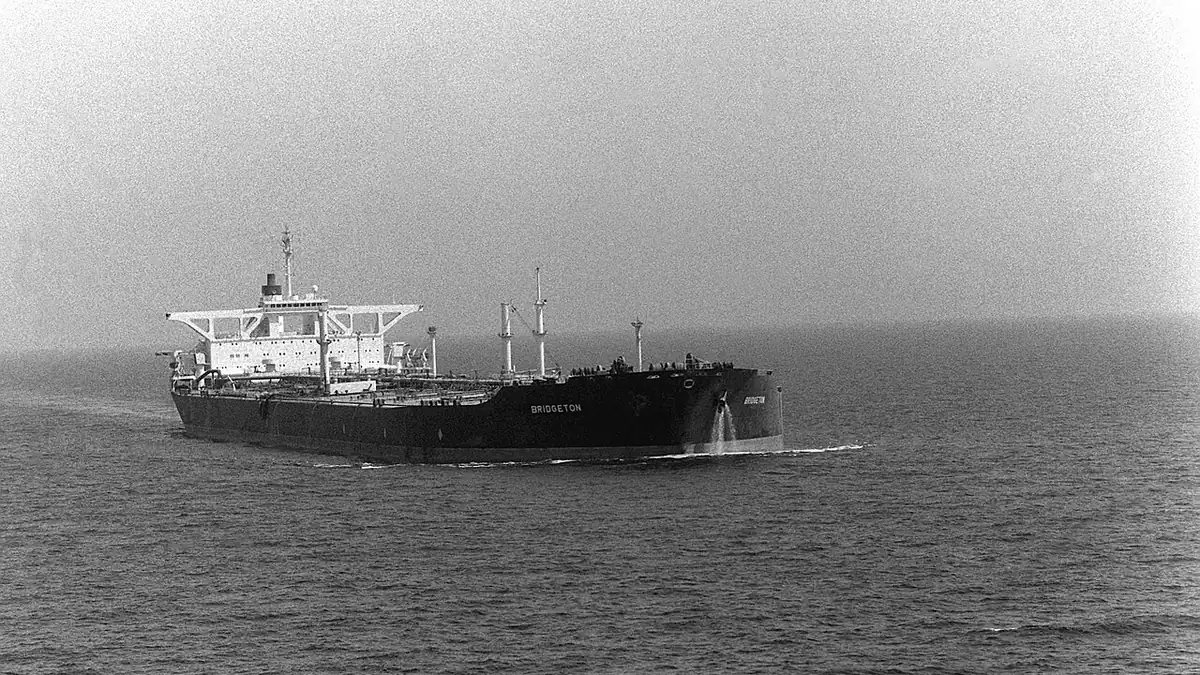
The IRGC Navy claims a supertanker carrying more than 2 million barrels of crude hit a sea mine in the Strait of Hormuz on a route Iran has not approved. The claim is unverified, and UKMTO says traffic is still about 70% below pre-war levels.

The Navy of the Islamic Revolutionary Guard Corps (IRGC) claims that a supertanker carrying more than 2 million barrels of crude oil hit a sea mine in the Strait of Hormuz while trying to pass along a route Iran has not approved. According to a statement released by Iranian state broadcaster Press TV in the early hours of Saturday, October 17, the impact caused a “powerful explosion and a fierce fire”. The statement does not name the ship, its flag or its owner, gives no exact location and says nothing about the crew or casualties. The information has not been independently confirmed.
The IRGC say the tanker had switched off all its position-tracking systems and radar to “deceive” the Iranian naval authorities and that it was passing with the support and protection of the US military, which they call a “smuggler and terrorist”. “The Strait of Hormuz is closed,” the statement says, adding that the fate of ships that do not follow Iranian rules is “to burn in the flames of their trust in the American military”. Press TV showed a video attributed to the IRGC, which has also not been verified.
This is a different claim from Friday’s, when Iran’s regular Navy spoke of a tanker on fire east of the Strait. Its content, however, is almost identical to the IRGC announcement of October 10, which also spoke of a supertanker of about 2 million barrels on an “unapproved southern route”. On October 12 the Guards had already announced that three tankers hit mines in the Strait.
There was no comment from the US side on this particular incident. CENTCOM had already rejected as “false” Iran’s accusations that it threatens seafarers. A few hours earlier, CENTCOM commander Adm. Brad Cooper had said the Strait is “controlled by the United States and our regional partners, not by Iran, and remains open”, with about 400 merchant ships passing in the past week.
According to the weekly briefing of the British UKMTO to October 14, traffic remains about 70% below pre-war levels, with 125 outbound and 129 inbound transits. That week 12 attacks were recorded, 10 of them inside the Strait, one ship was lost and two were immobilised, while since the end of February there have been 84 incidents. UKMTO notes that most ships that come under attack do not report it, which makes claims such as the IRGC’s difficult to confirm.