Middle East & North Africa
Rewards for Justice: up to $20 million for information on Iran’s nuclear programme – whom Washington is looking for
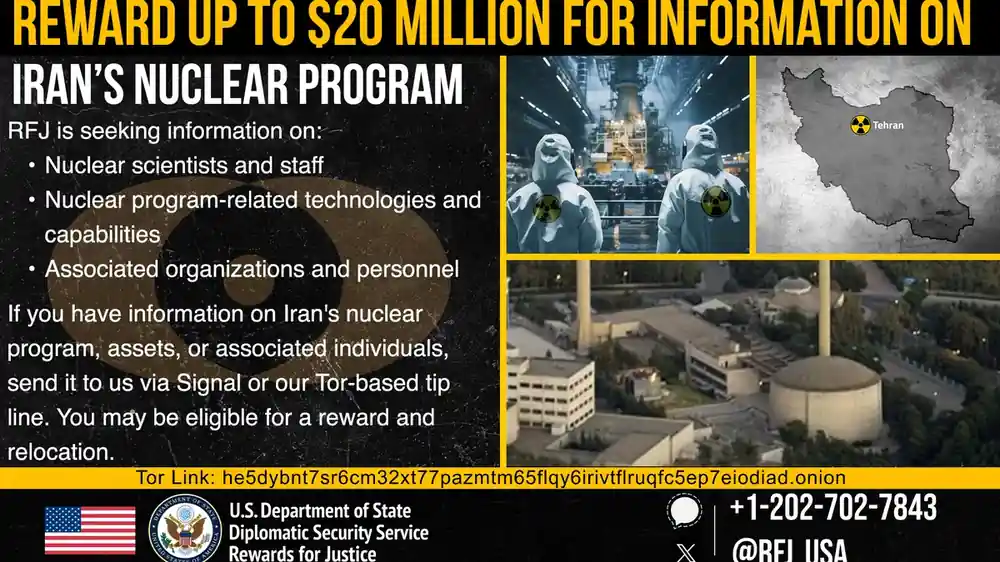
The US State Department’s Rewards for Justice programme offers up to $20 million, and possible relocation, for information on the facilities, equipment and people of Iran’s nuclear programme.

The State Department is putting a price on information about Iran’s nuclear programme. The Rewards for Justice (RFJ) programme of American diplomacy announced on Friday, November 6 that it offers a reward of up to $20 million, as well as possible relocation, to anyone who provides information on the facilities, equipment and people working for the Iranian programme.
This is a new offer, not a repeat of an older one. RFJ’s dedicated page on the Iranian nuclear programme was created the same day, followed at 17:01 UTC by a post of the programme on X. A little after midnight UTC, US Central Command (CENTCOM) reposted the message. Until now RFJ’s Iran-related offers had other targets. Rewards of up to $15 million concerned the financial networks of the Revolutionary Guards, the latest in September for the Guards’ Aerospace Force, while up to $10 million was offered for Iranian hackers.
“The U.S. government remains determined to counter any Iranian effort to develop a nuclear weapons programme,” RFJ writes, calling on anyone with information on the programme’s personnel or technologies to send it in.
Scientists, technologies and relocations
Washington’s interest spreads across three fields, as the campaign’s graphic shows. The first is nuclear scientists and the programme’s personnel. The second is the programme’s technologies and capabilities. The third is the organisations and officials linked to it. The RFJ page explicitly asks also for information on the relocation of facilities, equipment or people, which matters after the American strikes on Fordow, Natanz and Isfahan in June 2025. Information is sent via Signal or through a line on the Tor network, to protect the identity of the informant.
In the rationale for the offer the State Department recalls that during 2025 the International Atomic Energy Agency (IAEA) recorded uranium enrichment at 60%. From there, the distance to the 90% required for a nuclear weapon is, in the American view, a small technical step. No other non-nuclear-weapon state enriches to such a level, and experts estimate that the quantity Tehran holds would suffice for several bombs if further enriched. In addition, because Iran does not comply with its IAEA safeguards obligations, the Agency has lost “continuity of knowledge” over the production and stockpile of critical components, such as centrifuges.
The offer comes at a time of military pressure on Iran, with the naval blockade of its ports in force and the recent American strikes on Qeshm, which we covered in our report on the night of the strikes. RFJ operates under the State Department’s Diplomatic Security Service. The new offer is the first by RFJ that concerns specifically the Iranian nuclear programme.