Middle East & North Africa
UN First Committee welcomes Syria chemical weapons progress as Russia, Iran and Sudan face new allegations
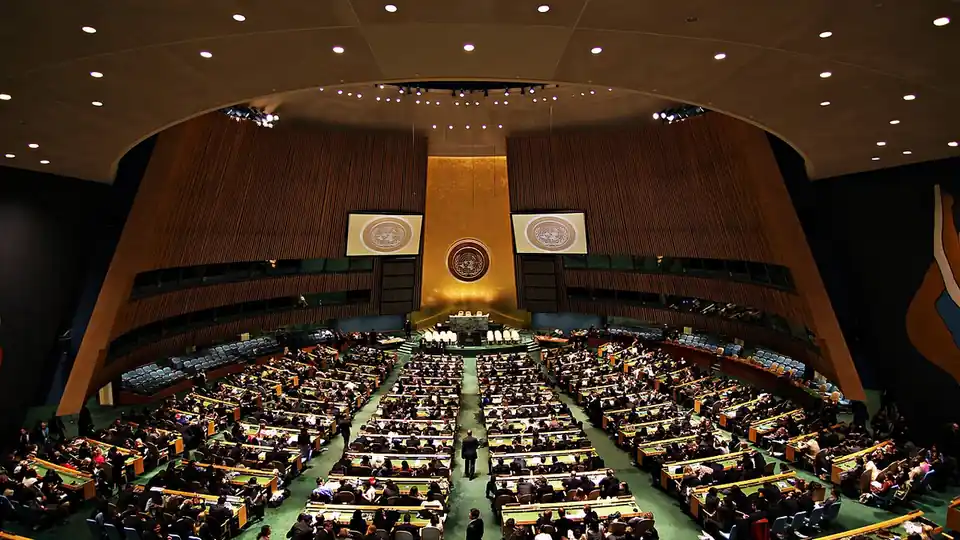
Delegates at the UN First Committee on 20 October welcomed verified destruction of Syrian chemical munitions, while the US, Lithuania for the EU and Israel made allegations against Russia, Iran and Sudan.

The UN General Assembly’s First Committee, which handles disarmament and international security, spent its 14th and 15th meetings on 20 October on non-nuclear weapons of mass destruction. Delegates welcomed concrete progress on Syria’s chemical weapons file, while Russia, Iran, Israel and Sudan were named in new allegations, according to the UN’s official summary of the debate.
Syria: verified destruction under way
A representative of the Organisation for the Prohibition of Chemical Weapons (OPCW) told the committee that 42 aerial bombs were destroyed under verification in August, and that both the OPCW and Syria are committed to building on that momentum with the aim of closing the file. Syria’s delegate said cooperation with the OPCW had advanced significantly over the past year and described a chemical-destruction process launched in September as the first of its kind since the “liberation of Syria”, in the delegate’s words. Indonesia also welcomed the first verified destruction of chemical weapons in August.
Allegations over Ukraine
Lithuania, speaking for 48 countries and the European Union, said Ukraine has documented more than 14,000 cases of munitions containing hazardous chemicals, including chloropicrin, used by Russian forces since February 2023. It also cited reports of the riot-control agent CS in samples from the Dnipropetrovsk region and said that using such an agent as a method of warfare would breach Article 1 of the Chemical Weapons Convention. The United States separately accused Russia of repeated use of chloropicrin and riot-control agents in Ukraine and referred to findings on the poisoning of Alexei Navalny. The UN summary records that the countries named rejected the allegations.
Middle East and Africa
The United States also accused Iran of developing pharmaceutical-based agents and said the Government of Sudan used chemical weapons in 2024. Israel’s representative alleged that Iran has secretly developed a chemical weapons programme using weaponised pharmaceutical agents, including fentanyl-based munitions, and that such capabilities were passed to regional partners including the Houthis and Hizbullah. These are claims by the delegations concerned; the UN record does not present independent confirmation.
Iran’s representative, for his part, condemned alleged US and Israeli attacks on Iran’s peaceful chemical and biological facilities and accused Israel of using white phosphorus and depleted uranium against Palestinian and Lebanese civilians. Libya, speaking for the Arab Group, urged the OPCW to act impartially and without politicisation, including by examining alleged Israeli use of prohibited chemicals in Gaza. Myanmar’s representative alleged that its military has used tear gas, white phosphorus and aluminium phosphate since the 2021 coup.
Other points raised
Jamaica, speaking for the 14 member states of CARICOM, called the Chemical Weapons Convention and the Biological Weapons Convention crucial to the disarmament regime and described any use of toxic chemicals as weapons of mass destruction as unjustifiable and contrary to international law. Several delegations said the lack of a formal verification regime is a major shortcoming of the Biological Weapons Convention and called for progress through its Working Group. Several also warned that advances in artificial intelligence, biotechnology and synthetic biology could raise biosecurity risks without adequate safeguards.
The debate continues the committee’s session, which Geopolitiki has followed from the start. Earlier reports covered how UN First Committee turns to confidence-building on nuclear risk as US, China, Iran and Israel trade positions and how the EU tells UN First Committee the NPT is the ‘cornerstone’ of non-proliferation, warns on New START expiry and Russian nuclear rhetoric.
Source: UN Meetings Coverage and Press Releases, GA/DIS/3773, 20 October 2026.