Politics & Diplomacy
UN First Committee turns to confidence-building on nuclear risk as US, China, Iran and Israel trade positions
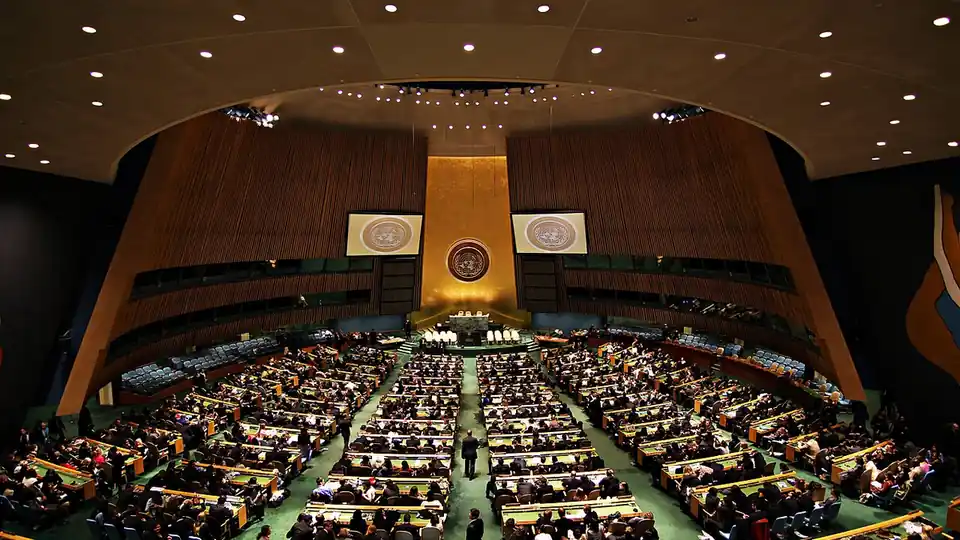
On 16 October the UN General Assembly’s First Committee heard proposals to revive confidence-building measures, while the US, China, France, Iran, Israel and North Korea set out opposing nuclear positions.

The UN General Assembly’s First Committee, which handles disarmament and international security, continued its nuclear weapons debate on 16 October with transparency and confidence-building measures at the centre. According to the UN’s official meetings coverage (GA/DIS/3771), delegations from the United States, China, France, Iran, Israel, North Korea and others set out sharply different views on how to reduce nuclear risk.
The UN proposal and calls for talks
Adedeji Ebo, Deputy to the High Representative for Disarmament Affairs, said such measures were developed during the Cold War to prevent large-scale direct confrontation. He proposed reviving existing measures and considering new ones to close what he called the trust deficit, through options such as codes of conduct, political commitments and technical steps. The UN Secretary-General’s Advisory Board on Disarmament Matters has made the subject its focus for 2026-27.
Viet Nam, speaking for ASEAN, urged the United States and Russia to resume negotiations on a new, legally binding arms-reduction framework. The Republic of Korea said the five permanent Security Council members should agree concrete risk-reduction steps, including crisis communication channels, pre-launch notifications and military-to-military engagement. Finland called for more dialogue and confidence-building.
Washington, Beijing and Paris
The United States called for “the next era of arms control”, recognised Russia and China as nuclear peers and said it continues to invite both to engage on nuclear-risk reduction, nuclear testing and mutual transparency.
China said Cold War mentality, double standards and unilateralism are the main obstacles to nuclear governance. It urged nuclear-weapon states to abandon deterrence policies built on winning a nuclear war and on first use, called for negotiations on a mutual no-first-use treaty and a legal instrument on negative security assurances, criticised NATO nuclear sharing and rejected a resumption of nuclear testing. France said it had taken “unprecedented” unilateral steps under Article VI of the Non-Proliferation Treaty, backed a moratorium on fissile material production for weapons, and urged Iran to cooperate with the IAEA and North Korea to abandon its nuclear programme.
Middle East and the Korean Peninsula
Israel said, in its own account, that Iran’s military nuclear programme continues to deceive the international community, citing more than nine tonnes of nuclear material including 440 kilograms of highly enriched uranium, and said Tehran had not provided necessary information. It rejected the UN conference on a Middle East zone free of nuclear weapons.
Iran condemned US and Israeli attacks on its peaceful nuclear facilities as violations of the UN Charter and the NPT, said NATO nuclear sharing breaches the treaty, and blamed Israel’s refusal to join the NPT as the main obstacle to a regional zone. North Korea described itself as a responsible nuclear state and argued that US extended deterrence, nuclear sharing and nuclear-submarine technology transfers undermine the NPT. Egypt said only total, verifiable and irreversible elimination of nuclear weapons can guarantee against their use.
The UN summary says several speakers condemned Russia’s war against Ukraine and its nuclear posture, and that Russia rejected this and referred delegations to its online statement. For the opening of the debate, see UN First Committee opens debate with Ukraine, Iran, Japan and others split over nuclear deterrence. The full account is on the UN meetings coverage page.