Europe
Hera: first close-up of the asteroid Didymos shows the side DART never photographed
ESA’s Hera planetary-defence spacecraft has sent its first close-up image of Didymos from 60 km, showing a side the DART camera never captured before the 2022 impact.

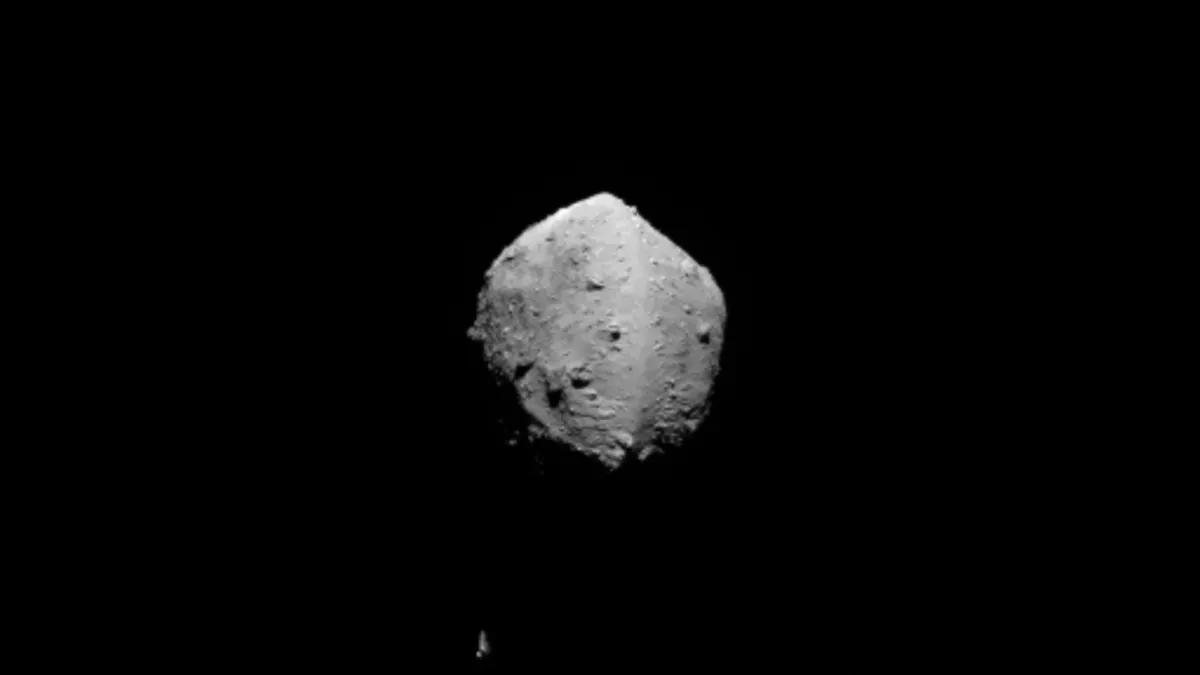
Hera, the European Space Agency (ESA) planetary-defence spacecraft, has sent its first close-up picture of the double asteroid system that NASA’s DART deliberately struck in 2022. In the image, which ESA released on Thursday, November 5, the larger asteroid, Didymos, is clearly visible, from a side that DART’s camera had no time to record before the collision.
The shot was taken by the spacecraft’s monochrome Asteroid Framing Camera from a distance of 60 kilometres. Didymos is 780 metres across. Its small moon Dimorphos, 151 metres across, hides almost entirely in shadow. The pair is currently 196.8 million kilometres from Earth, after two years of travel for the spacecraft.
“Our first reaction was a ‘wow’!” said the mission’s principal investigator Patrick Michel, research director at France’s CNRS and the Côte d’Azur Observatory. “It is the other side of Didymos from the one the DART camera showed us just before the impact, so it is like seeing a completely new world.” The new side has the same central ridge along the equator seen before, but otherwise looks very different, with many boulders, craters and grooved or ridged patterns.
Mission scientist Michael Kueppers offered a first interpretation. Scientists expect that a large amount of material ejected by the impact crossed the distance of about one kilometre from Dimorphos to Didymos, so some of the surface features may be due to that transfer of material. “We have exciting work ahead to sort this out,” he added, explaining that the team will systematically map every change it finds.
Two earlier announcements
The new shot follows two earlier announcements by the mission. On October 27 ESA published the first image showing the two asteroids separately, taken on October 18 from 1,280 kilometres, with Dimorphos occupying about one pixel. On Tuesday, November 3, ESA presented the ten open questions about Dimorphos that the mission wants to answer. The distance has now fallen to 60 kilometres and the surface of Didymos is gaining detail.
Why Dimorphos matters
The interest in Dimorphos has a specific cause. On September 26, 2022, NASA’s DART spacecraft, with a mass of about 580 kilograms at impact, hit Dimorphos at about 6.1 km/s in the first asteroid kinetic-deflection experiment. Dimorphos’s orbital period around Didymos shortened by 33 minutes (±1 minute), far more than had been predicted. Dimorphos is the first Solar System body whose orbit has been measurably changed by human action.
The next stop is an “on-site autopsy of the collision”. Hera will examine up close what DART left behind, so that kinetic deflection can be turned from a single experiment into a well-understood and potentially repeatable technique, should Earth ever be threatened. “Seeing this image is an extremely exciting moment for the whole Hera family,” said mission manager Ian Carnelli. “It took years of hard work and dedication to get here, but it gives us a boost to know that the adventure is only just beginning!”
ESA announced that detailed images of both asteroids will be revealed on November 25.