Technology
ESA’s Hera: the ten mysteries of Dimorphos that the spacecraft will try to solve
Shortly before reaching the Didymos system in November, ESA’s Hera mission faces ten open questions about Dimorphos, from the DART crater to the asteroid’s interior and the “beta factor” of deflection.

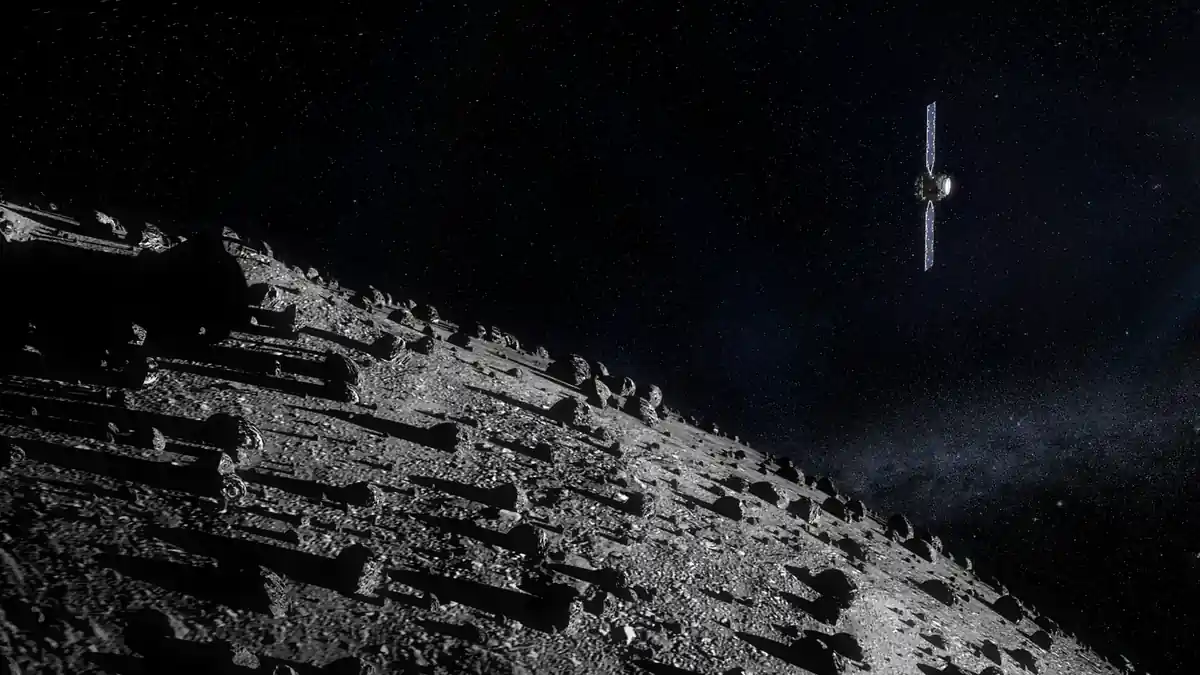
Shortly before it reaches its target, the European Space Agency’s Hera spacecraft faces ten open questions about the asteroid Dimorphos. On Tuesday, November 3, ESA published a seven-minute video and an accompanying text on the mysteries that Europe’s first planetary defence mission is expected to investigate. It reaches the system of Didymos and Dimorphos in November.
The spacecraft is the size of a small car. Dimorphos is 151 metres across and orbits the larger Didymos, 780 metres in diameter. On September 26, 2022, NASA’s 550-kilogram DART spacecraft hit Dimorphos at 6.1 km/s and shortened its orbital period by 33 minutes, far more than simulations predicted. Hera will examine the impact site up close, so that the experiment becomes a documented method for deflecting dangerous asteroids. We reported earlier on Hera’s first views of the pair as two separate asteroids.
The crater, the debris and the spin
The first question will be answered by the first images: did the impact leave a crater? About 16 million kilograms of dust, fragments and boulders are estimated to have been ejected, around 0.5% of the asteroid’s estimated mass. Mission principal investigator Patrick Michel explains that gravity is so weak that the outcome depends mainly on the cohesion of the material. In 2019 Japan’s Hayabusa2 fired a copper projectile at 2.1 km/s at the asteroid Ryugu and opened a crater about 15 metres across, much larger than expected. Some simulations suggest the DART crater could have spread across the whole surface of Dimorphos and reshaped it completely. The second question concerns the debris around the two asteroids, which is a collision hazard for the spacecraft itself.
The third question is how chaotically Dimorphos now rotates. Before DART it was thought to be tidally locked, always showing the same face to Didymos, like the Moon to Earth. Because the hit was off-centre, its rotation axis may keep shifting, like a rugby ball thrown crooked. This could also affect Hera’s autonomous navigation later, since it will rely on tracking surface features that move in a complex way.
Origin, cohesion and interior
The fourth question is whether Dimorphos was born from the fast rotation of Didymos. About 15% of asteroids are estimated to have one or more small moons. According to the prevailing theory, sunlight gradually spins up the parent asteroid through the YORP effect, because its irregular shape heats unevenly. Didymos rotates in a little over two hours and has a pronounced equatorial bulge, like a spinning top. Hera will check whether the two asteroids are made of the same materials and, from the effect of the space environment on the surface, may allow the age of Dimorphos to be estimated; it could be only a few thousand years.
The next three questions concern cohesion. On Dimorphos gravity is a tiny fraction of Earth’s, and other properties, chiefly cohesion, play a comparable role; the lower the cohesion, the larger the DART crater. The fifth is what holds the asteroid together and whether its surface will withstand the landing of a CubeSat, or whether it will sink like into quicksand. The sixth is where the dust between the boulders is: DART’s camera did not see it, although the impact released large amounts. The seventh is how strong the boulders are, from car-sized to house-sized, with angular shapes and rough, apparently cracked surfaces, probably from collisions and thermal stress.
The eighth question is whether there are voids inside. The CubeSat Juventas, carrying the smallest radar ever flown in space, will make the first radar probing of an asteroid’s interior, at a resolution of about 10 metres. Dimorphos may be a single body of very porous material, like pumice, or a collection of boulders with large gaps between them, like a bunch of grapes.
Mass and the “magic formula” of deflection
The ninth question is the exact mass of Dimorphos, whose uncertainty reaches tens of percentage points. Hera will track the motion of surface points on both bodies to detect the slight wobble that Dimorphos induces in Didymos. Towards the end of the six-month mission, when the spacecraft orbits very close to Dimorphos, small Doppler shifts in its radio signal will help determine the pull of its gravity and, through it, its mass.
The tenth is the “magic formula” of deflection. The orbit of Dimorphos shrank by 33 minutes, much more than predicted, because of an extra element, the “beta factor”: the momentum boost from the recoil of the ejected material, a push similar to a rocket’s. Dimorphos is currently estimated to have received about 2.1 times the spacecraft’s momentum, possibly because of low cohesion. Hera’s measurements will refine that number and help clarify how asteroids of any size and composition can be deflected.