Technology
Hubble: NASA asks private industry for a mission to raise the telescope’s orbit and service it
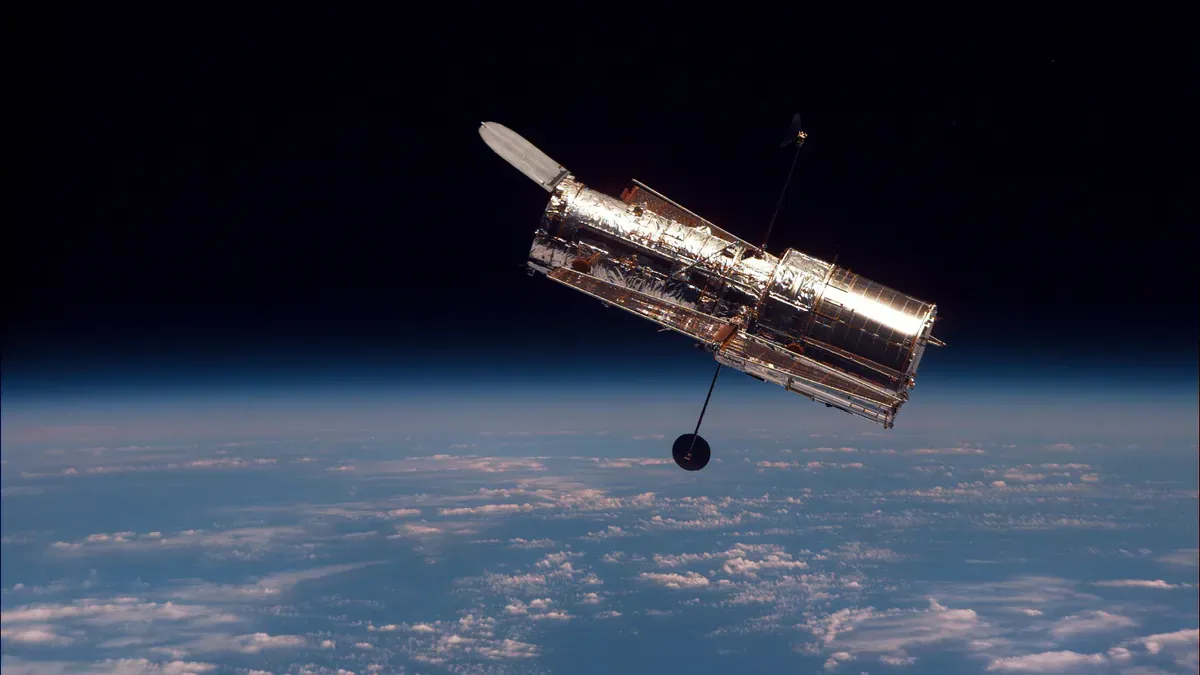
NASA issued a Request for Information on October 29 asking companies what they could offer to boost, repair or safely deorbit the Hubble Space Telescope, which is expected to re-enter the atmosphere around 2033-2034.

The Hubble Space Telescope has no propulsion system to maintain its orbit on its own, and its altitude is falling slowly but steadily. To keep it in the sky as long as possible, NASA is turning to the private sector: on Thursday, October 29 it issued a Request for Information, an invitation to companies to describe what they can offer before any formal solicitation is announced.
The request covers three possibilities. The first is a mission that would raise Hubble to a higher altitude and extend the life of its science observations. The second is repair and upgrade of the telescope so that it gains new capabilities. The third concerns the end of the mission: a safe controlled re-entry into Earth’s atmosphere or placement of the telescope in a disposal orbit. Interested companies may respond until 3:00 p.m. US Eastern time on Monday, November 30.
Time is pressing for purely physical reasons. Like any satellite in low Earth orbit, Hubble loses altitude because of drag from the thin gases of the upper atmosphere. NASA analyses estimate it will most likely re-enter in 2033-2034, which is why the agency considers that a mission would have to take place by 2032. The telescope is currently about 483 km (300 miles) above the Earth’s surface.
NASA Administrator Jared Isaacman linked the move to the obligation to the taxpayer. “Hubble still has significant scientific work ahead of it, and we should look at every reasonable opportunity for it to keep producing results for as long as possible,” he said. He added that if there are innovative and cost-effective ways to extend the life of a space system already in orbit, the agency must explore them for the American taxpayer and the scientific community.
Nicky Fox, associate administrator of NASA’s Science Mission Directorate, noted that the sector has changed rapidly: the commercial space industry now has the ability to capture and service satellites in space. With the time left before Hubble’s expected re-entry, NASA wants to examine the full range of options for moving it to a higher orbit, while the flagship mission that will succeed it is under development.
A history of servicing
Hubble was launched on April 24, 1990 aboard the space shuttle Discovery and was the first astronomical observatory in Earth orbit able to observe from ultraviolet to near-infrared light. Between 1993 and 2009 astronauts serviced it five times, replacing batteries, gyroscopes and solar arrays and installing newer instruments. NASA is now exploring whether companies can take on similar work. The telescope keeps making discoveries; Fox stressed that it is a “national symbol” that has fundamentally changed how humanity sees the universe for more than 35 years.
The programme is an international collaboration between NASA and the European Space Agency (ESA). NASA’s Goddard Space Flight Center in Greenbelt, Maryland manages the telescope and mission operations, supported by Lockheed Martin Space in Denver. The Space Telescope Science Institute (STScI) in Baltimore, operated by the Association of Universities for Research in Astronomy (AURA), conducts science operations for NASA.