Technology
NASA: Artemis III will test Blue Origin and SpaceX lunar landers in Earth orbit in 2027, with a Moon landing targeted for 2028
Artemis III will not reach the Moon but will be a major rehearsal: NASA says the 2027 mission will test the Blue Origin and SpaceX lunar landers in low Earth orbit, so American astronauts can return to the lunar surface in 2028.

Artemis III will not reach the Moon, but it will be a major rehearsal before a landing. NASA announced on Friday, October 23 that the mission, launching in 2027, will test the lunar landers of Blue Origin and SpaceX in low Earth orbit, so that American astronauts can return to the lunar surface in 2028. A lander, formally the Human Landing System, is the vehicle that takes astronauts from lunar orbit to the ground. The agency simultaneously published the revised development plan of the two vehicles and the description of Artemis III.
The flight matters because NASA will see in practice for the first time how the Orion spacecraft works with commercial landers before entrusting them with a crew on the Moon. “We are launching three spacecraft on three different rockets and testing how they work together, something NASA has never attempted,” said Jeremy Parsons, Artemis programme manager.
Orion will carry NASA astronauts Randy Bresnik, Frank Rubio and Andre Douglas and ESA’s Luca Parmitano. The flight is planned to last 14 days, and the crew will rendezvous and dock with test articles of the two landers.
The new role of Artemis III stems from updates to the contracts with the two companies earlier this year. In the original contracts Starship had been assigned to Artemis III and IV and Blue Moon Mark 2 to Artemis V. Now both take part in Artemis III and neither is committed to a specific landing mission. SpaceX adds two demonstrations of its crew cabin, Cabin 1, and Blue Origin new test milestones. “NASA does not intend to wait with folded arms,” said NASA Administrator Jared Isaacman.
To speed up development ahead of 2028, the way the vehicles meet on real missions also changes. Orion and the landers will no longer meet in the near-rectilinear halo orbit (NRHO) around the Moon, but in a different orbit for each company. Each time, two crew members will descend to the Moon and two will stay in Orion.
How the 2027 flight will work
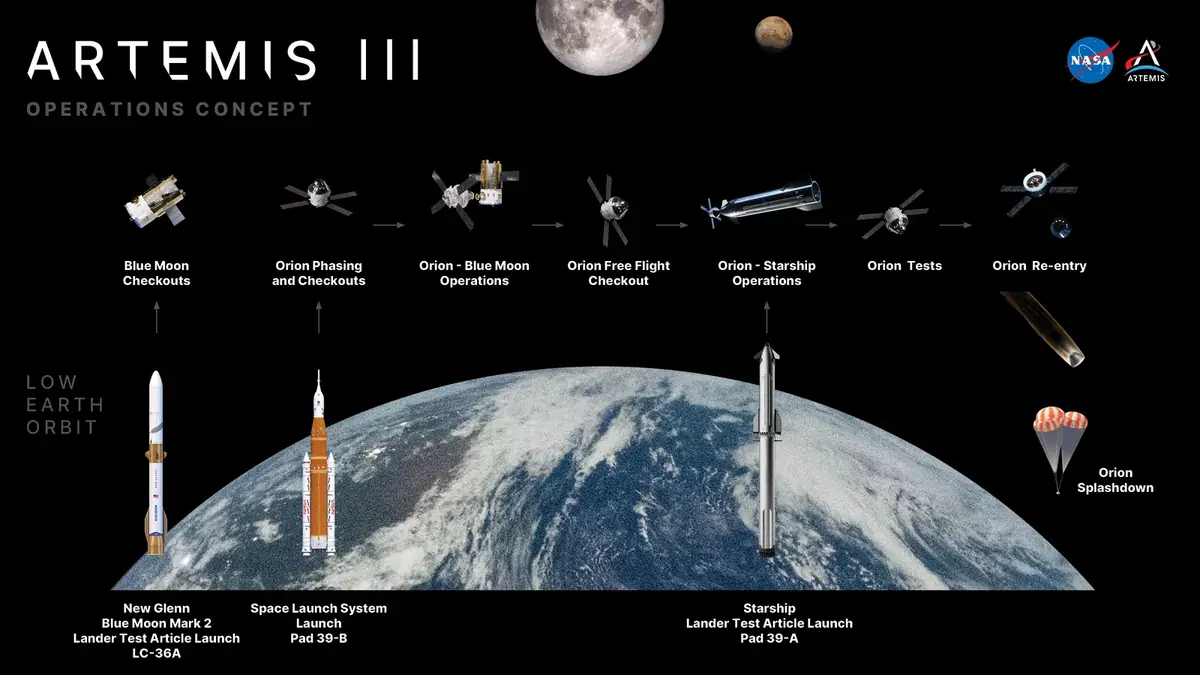
The flight of 2027 will begin with a test Blue Moon Mark 2, placed in a circular orbit about 273 miles (439 km) above Earth, where it can stay up to 30 days. A few days later Orion will launch on the Space Launch System (SLS) from Kennedy Space Center in Florida and gradually approach the craft. After docking, the astronauts will spend about two days inside it: they will open the hatch and evaluate the cabin, the controls, life-support systems, atmosphere and pressure.
The second rendezvous follows. Orion will undock and SpaceX will launch from Florida a test Starship Version 3 into a 206 nautical mile (about 381 km) orbit, with an additional docking system on its nose. The docking will last up to two hours and the crew will not enter Starship. Here the handling of the docked stack, communications and software are tested. The two dockings also differ in geometry, since Orion will connect to a port beside the Blue Moon cabin and to the front system of Starship.
Once the Starship test is over, Orion will have up to five days for additional tests, such as evaluating survival suits, testing docking sensors and a cell-biology experiment. The return will be a splashdown in the Pacific off California, where Orion will be recovered by NASA and the US Navy.
In the SpaceX plan, refuelling Starships will carry cryogenic propellants, fuels liquefied at very low temperatures, to low Earth orbit to a Starship that will act as a fuel depot and refuel the lander. The lander will wait for Orion in Earth orbit and, after docking, send the stack to low lunar orbit. Blue Origin defers propellant transfer and will send Blue Moon Mark 2 Alpha with three transfer stages to an elliptical polar orbit around the Moon, descending to the south pole.
Before crewed missions, each company must carry out an uncrewed demonstration flight, and NASA will certify the landers. Which company will first carry astronauts to the surface in 2028 will be decided by the readiness of the vehicles, with a second landing opportunity to follow. On the first surface missions the goal is two lunar walks of about two hours, in Axiom Space suits.