Greece
Athens Polytechnic uprising explained: 14-17 November 1973
What was the Athens Polytechnic uprising? A student revolt against the Greek junta from 14 to 17 November 1973, crushed by tanks, and how it led to the Cyprus coup of 1974.

The Athens Polytechnic uprising was a student-led revolt against the Greek military dictatorship that began on 14 November 1973 and ended on 17 November, when army tanks broke into the campus of the National Technical University of Athens (NTUA) on Patission Street. It was the largest blow to the junta from inside Greece, and Greeks mark it every year on 17 November.
Key points
- The dictatorship of the Colonels ruled Greece from 1967 to 1974.
- Student protests in February and March 1973 were met with force; the November uprising followed.
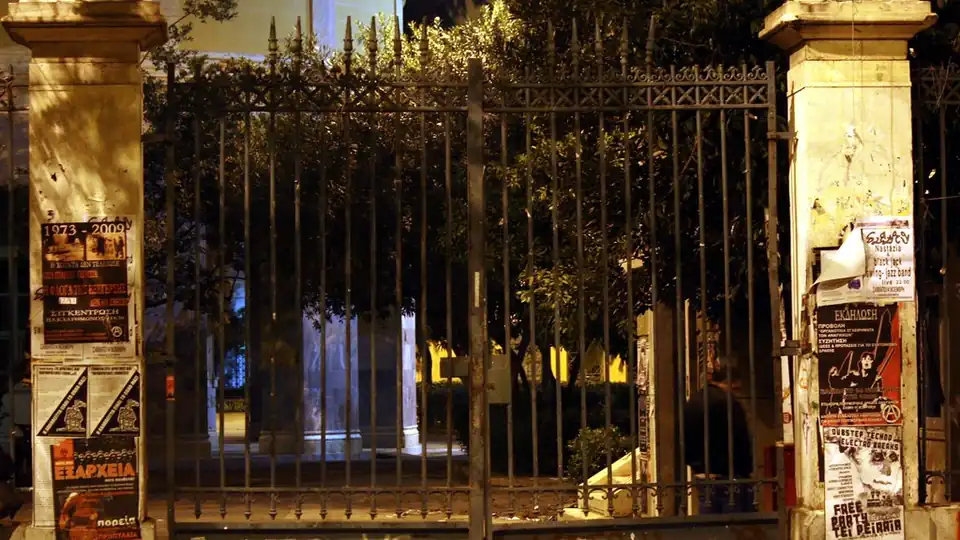
- The uprising ended when tanks demolished the campus gate and the army and police attacked those inside and outside.
- Eight days later Brigadier General Dimitrios Ioannides, chief of the Military Police, removed Georgios Papadopoulos in a new coup.
- A U.S. Embassy report of 15 July 1974 saw evidence implicating Ioannides in the coup against Makarios in Cyprus, which preceded the Turkish invasion.
What was the Athens Polytechnic uprising?
The NTUA describes the events as the culmination of struggles against the 1967-1974 military dictatorship. They began on Wednesday 14 November 1973 and grew into what the university calls “an impressive popular uprising centered at NTUA”, with the people of Greece and its youth rallying around the ideals of freedom, democracy, independence, education and social progress. The slogan that became its shorthand was bread, education, freedom.
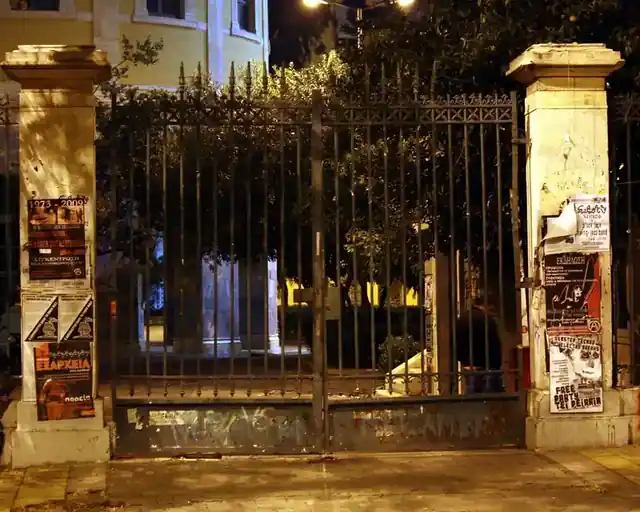
The end came on 17 November 1973, with what the NTUA calls “the unprovoked intervention of army tanks” and an attack by the army and police on those besieged inside the campus and on supporters demonstrating outside in Patission Street. According to the university, several demonstrators were killed and many more were arrested by the military police and tortured for months in military prisons. In this article we do not give a casualty figure, because the official source we rely on does not state one.
What led up to November 1973?
The NTUA traces the escalation to 14 February 1973, when a student gathering at its Patission campus was followed by what it calls an “unprecedented brutal attack” by police inside the campus and the arrest of several students. Demonstrations followed, including the occupation of the Law School of the University of Athens on 23 February and again on 20 March, and each was met by force.
Washington was watching. In an April 1973 telegram, published in the State Department’s Foreign Relations of the United States series, the U.S. Embassy in Athens listed the regime’s unresolved problems: university and student unrest, seven lawyers detained without charge and the arrest of Professor Tsatsos of Bonn University. It concluded that criticism of the government was rising. The embassy also noted that the return of classes in the autumn brought back student dissidence, “sparked by academic and intra-professional woes as well as political unhappiness” with the Papadopoulos and Markezinis era.

How did the regime respond?
Martial law was declared. In a telegram of 18 November 1973, U.S. Ambassador Henry Tasca recorded that Prime Minister Spyros Markezinis told him martial law had been necessary because a “subversive plot” had developed, and that he hoped it would be brief. Tasca replied that he regretted martial law had been considered necessary. A footnote by the State Department historians adds that in telegram 8037 of 17 November the embassy had called the early-morning crackdown a “setback to ongoing GOG efforts to return Greece to more normal pattern of political life”, GOG meaning the Greek government.
The crackdown did not save the Papadopoulos-Markezinis experiment. A February 1974 embassy assessment says that discontent inside the armed forces had been growing for months, and that “the student disturbances, accompanied by bloodshed, forced the military to the front” in the role of saviours of a regime that, in the eyes of hardliners, had abandoned the “revolution”.
Who took power on 25 November 1973?
On 25 November the army ousted Papadopoulos in what the embassy described as a bloodless coup. In a telegram of 26 November, Tasca wrote that Ioannides had “masterminded the entire new coup” and remained “the dominant figure”, with General Phaidon Gizikis as the new President and Adamantios Androutsopoulos as Prime Minister, both likely to be subject to Ioannides.
The ambassador also described Ioannides as the chief of the Military Police, “reputed to have been largely responsible for maltreatment of political prisoners”. His verdict on the new strongman’s politics was blunt: “There is no reason to think he believes in democracy.” The NTUA, for its part, says that the military police tortured arrested demonstrators for months.
How does 17 November connect to Cyprus in 1974?
The junta that emerged from the November coup soon turned its attention to Cyprus. On 15 July 1974 the U.S. Embassy in Athens reported that “the evidence to date seems clearly to implicate Ioannides with the coup in Cyprus”, noting that the operation against Archbishop Makarios was carefully planned, as the declaration of a “Government of National Salvation” showed.
The coup was followed by the Turkish invasion of the island in July and August 1974. That invasion and the occupation of the north are Turkey’s crimes, not a “peace operation”. In its Grand Chamber judgment of 10 May 2001 in Cyprus v. Turkey, the European Court of Human Rights found numerous violations of the Convention by Turkey arising from its military operations in northern Cyprus in July and August 1974 and the continuing division of the island. In 2014 the Court ordered Turkey to pay EUR 30 million for the relatives of the missing persons and EUR 60 million for the enclaved Greek Cypriot residents of the Karpas peninsula, a ruling set out in the Court’s press release. For the wider story see our Cyprus 1974 timeline: coup, Turkish invasion and UN resolutions and Cyprus problem explained: 1960, 1974 and the UN buffer zone.
How did the dictatorship end?
The NTUA says the junta fell “a few months” after the uprising. A U.S. National Security Council paper in the same State Department volume records that on 14 August 1974 the new government of Prime Minister Constantine Karamanlis announced Greece’s withdrawal from NATO’s integrated military structure. Greece returned to it in 1980; we explain why in Greece and NATO: why Athens left in 1974 and came back in 1980.
How is 17 November remembered today?
According to the NTUA, the uprising is commemorated every year on 17 November by students, school pupils, the university senate, democratic authorities, political parties, the Greek Parliament and the people of Greece. The university has also built a monument to the victims in its courtyard, opposite the gate that the dictatorship’s tanks demolished that night, next to the column commemorating the National Resistance.
Sources: National Technical University of Athens, history of NTUA; U.S. Department of State, Office of the Historian, Foreign Relations of the United States 1969-1976, Volume XXX, Greece; Cyprus; Turkey, Greece chapter; European Court of Human Rights, press release on Cyprus v. Turkey, 12 May 2014.