Europe
Holodomor explained: Ukraine’s 1932-33 famine and the genocide debate
The Holodomor was the 1932-33 famine in Soviet Ukraine that parliaments including the European Parliament and the Bundestag classify as genocide. What the official records say, and why it is back in the news.

The Holodomor was the famine of 1932-1933 in Soviet Ukraine, in which millions of people starved after Soviet authorities seized grain and sealed off affected regions. Parliaments including the European Parliament and the German Bundestag have since classified it as genocide, while the Soviet Union itself denied the famine for decades. The UK marked the 93rd anniversary with a statement to the OSCE on 26 November 2026, ahead of Ukraine’s remembrance day.
Key points
- The name comes from the Ukrainian words for hunger and to kill by starvation; the German Bundestag’s 2022 motion puts the toll in Ukraine in the winter of 1932/33 alone at 3 to 3.5 million deaths.
- Both the Bundestag and the European Parliament trace the famine to Soviet policy: forced grain requisitions, punishment by hunger and sealed regions, not crop failure.
- The European Parliament recognised the Holodomor as genocide on 15 December 2022 by 507 votes to 12, with 17 abstentions.
- The Soviet authorities suppressed the record for decades; Soviet representatives were still denying it at the UN General Assembly in the early 1980s, according to the Bundestag motion.
- In 2026 the UK linked the anniversary to Russia’s present-day attacks on Ukraine’s farmland, ports and food infrastructure.
What was the Holodomor?
The term Holodomor combines the Ukrainian words for hunger (holod) and to kill by inflicting starvation (moryty). The Bundestag motion of November 2022 uses it for the deliberate, mass killing by hunger that claimed millions of lives in what was then Soviet Ukraine, and states that the mass starvation was not the result of poor harvests but was the responsibility of the Soviet leadership under Joseph Stalin.
The European Parliament, in the resolution it adopted on 15 December 2022, describes the famine of 1932-1933 as the result of a deliberate policy of the Soviet regime, one aimed at forcing through collectivisation of agriculture and at suppressing the Ukrainian people and their national identity.
How did the famine happen?
According to the Bundestag motion, the hunger was in the first place the direct result of forced collectivisation, the imposition of the Soviet economic model from the top down to the villages. From 1928, it says, the harvest was taken from millions of peasants to supply cities and factories, and grain was also exported to obtain foreign currency and Western machinery. Peasants branded as wealthy “kulaks” were persecuted and deported, and the requisitions became harsher each year.
The motion states that hundreds of thousands already died of malnutrition in the countryside in the winter of 1931/32, yet the forced requisitions continued. Hunger was used as a punishment: where delivery quotas were not met, a multiple of grain and other food was demanded and confiscated. The affected regions were sealed off to stop starving people fleeing to the cities and to stop food reaching them. In the winter of 1932/33 alone, the motion says, between 3 and 3.5 million people starved in Ukraine, and hundreds of thousands more in the largely Ukrainian-populated Kuban region.
The European Parliament’s resolution makes the same two points in its own words: the regime deliberately confiscated grain harvests and sealed the borders to prevent Ukrainians from escaping starvation.
Why Ukraine, and why is it called more than a famine?
The Bundestag motion gives two reasons why it treats the Holodomor as more than a grain-collection disaster. First, Ukraine mattered to Moscow: together with the Kuban, it produced more than half of the Soviet Union’s grain, and the leadership wanted it under strict central control. Second, the motion says the mass killing also aimed at suppressing Ukrainian national consciousness. After a short phase of tolerated local language and culture in the early Soviet years, it says, Stalin ended that policy; members of the Ukrainian elite from church, culture, science and politics were persecuted, imprisoned and murdered, and peasants resisting requisitions were brutally suppressed.
The motion also records that hunger and repression affected the whole of Ukraine, not only its grain-producing regions, and that later reductions in the grain quotas were not applied to Ukraine. It adds that millions died in other parts of the Soviet Union in politically induced famines, including an estimated up to two million in Kazakhstan and hundreds of thousands along the Volga and Don rivers. The Holodomor, in other words, sits inside a wider Soviet catastrophe, but the Bundestag singles out the Ukrainian dimension.
What does the genocide label mean in law?
The Convention on the Prevention and Punishment of the Crime of Genocide was adopted by the UN General Assembly on 9 December 1948 and entered into force on 12 January 1951, according to the UN Audiovisual Library of International Law. Its Article II defines genocide as certain acts “committed with intent to destroy, in whole or in part, a national, ethnical, racial or religious group, as such”. One of the listed acts is “Deliberately inflicting on the group conditions of life calculated to bring about its physical destruction in whole or in part”. The full text is in the UN Treaty Series, volume 78.
The European Parliament relied on this wording. Its resolution recognises the Holodomor as genocide against the Ukrainian people because it was committed with the intent to destroy a group, by “deliberately inflicting conditions of life calculated to bring about its physical destruction”, as the Parliament’s own summary of the resolution puts it.
Not every parliament uses the same words. The Bundestag motion says that, from today’s perspective, a historical-political classification as genocide is evident (“nahe” in the German original) and that the Bundestag shares it. It is a parliamentary and political finding, adopted by the coalition parties together with the CDU/CSU on 30 November 2022 with the AfD and Die Linke abstaining, according to the motion tabled in the Bundestag (Drucksache 20/4681).
How did the Soviet Union deal with the memory?
The Bundestag motion says the Holodomor was systematically denied and made taboo in the Soviet Union, and that mentioning it was punishable. The suppression of information began while the famine was still under way: death registers were destroyed, critical officials removed, regions sealed and journalists barred from travelling to the affected areas. Some European states had diplomatic reports and occasional press accounts of widespread hunger, the motion adds, but looked away, in part because they profited from cheap Soviet grain imports.
As late as the early 1980s, Soviet representatives denied the Holodomor before the UN General Assembly, the motion states. It took decades before Soviet leader Mikhail Gorbachev, under glasnost, allowed that a “famine” had occurred in Ukraine, archives were opened and accounts could circulate openly.

Who has recognised it?
The European Parliament adopted its resolution on 15 December 2022 by 507 votes to 12, with 17 abstentions. It also called on all countries and organisations that had not yet done so to recognise the Holodomor as genocide, and on Russia, as the primary successor of the Soviet Union, to apologise and to open its archives on the famine, according to the European Parliament’s press release as carried by the EU delegation to Ukraine.
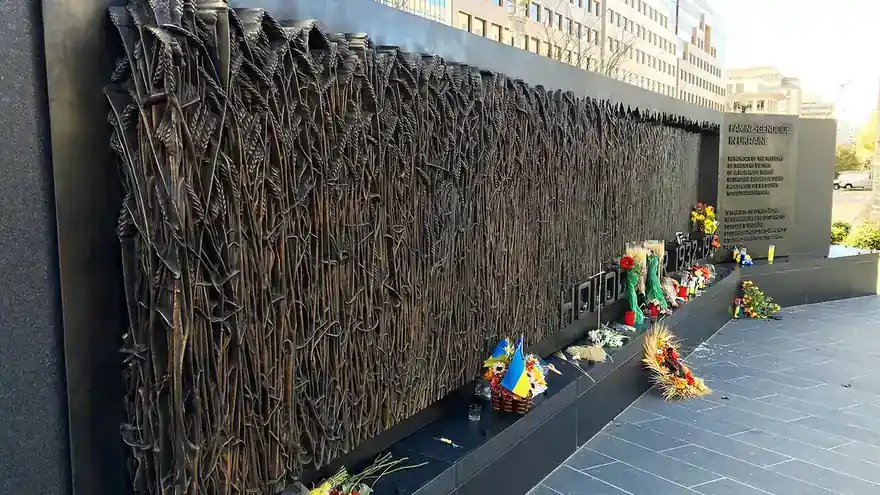
In the United States, Public Law 109-340, signed on 13 October 2006, authorised the Government of Ukraine to establish a memorial in Washington, D.C. “to honor the victims of the Ukrainian famine-genocide of 1932-1933”, with no cost to the US Government. The memorial there was dedicated on 7 November 2015, according to the photo description on Wikimedia Commons. The text of the law is published by the US Government Publishing Office.
The National Museum of the Holodomor-Genocide in Kyiv, a Ukrainian state museum, keeps a list of national and international recognitions. It records, among others, the Parliamentary Assembly of the Council of Europe (resolution of 12 October 2023), the German Bundestag (30 November 2022) and the House of Commons of the UK Parliament (25 May 2023) as having recognised the Holodomor as genocide. The list also shows that wording differs: it records the Austrian National Council as describing the Holodomor as a “horrific crime” committed by the Stalinist regime. These entries rest on the museum’s own summary and should be read as its account.
Why the Holodomor is back in the news
In its statement to the OSCE on 26 November 2026, the UK said it joined Ukrainians and people around the world in remembering the millions who died in a “man-made famine, caused by the brutal policies of Stalin’s regime”. It said the history remains relevant because the Russian state “continues to distort the past to justify its war against Ukraine”, and that Russia’s attacks have damaged Ukraine’s agricultural land, ports and food infrastructure, disrupting food supplies within Ukraine and around the world. The full speech is on GOV.UK.
The European Parliament drew the same line in 2022, condemning what it called Russia’s manipulation of historical memory and the global food crisis caused by the war. Geopolitiki has reported on the present-day side of the argument, including the UK’s case at the UN Security Council that Russia is weaponising food and energy (UK tells UN Security Council that Russia is weaponising food and energy, citing 116 attacks on Ukraine’s power grid in a week) and the attack on two foreign grain ships near Odesa (Russia attacks two foreign grain ships near Odesa; Zelensky warns of a new massive strike).
For readers who want a short visual introduction, the following video tells the story of the famine.
Frequently asked questions
How many people died in the Holodomor? Sources differ in scope and method. The Bundestag motion gives 3 to 3.5 million deaths in Ukraine in the winter of 1932/33, plus hundreds of thousands in the Kuban region; the European Parliament speaks of millions of Ukrainians.
Was the Holodomor caused by a bad harvest? The Bundestag motion states the opposite: the mass starvation was not the result of poor harvests but of Soviet policy, through forced requisitions, punitive demands and sealed regions.
Sources
This article rests on the Bundestag motion 20/4681 and the European Parliament summary of its 15 December 2022 resolution, the text of the Genocide Convention, the US Public Law 109-340 and the UK statement to the OSCE of 26 November 2026, together with the press release of the European Parliament carried by the EEAS delegation to Ukraine and the recognition list of the National Museum of the Holodomor-Genocide, both attributed in the text.