
Greece
Smyrna 1922 explained: what US diplomatic records show
US diplomatic telegrams from September 1922 record the fall of Smyrna, the fire, the shooting of refugees and the evacuation of 262,587 people. Here is what the primary record says.

The Great Fire of Smyrna in September 1922 destroyed the Greek and Armenian city on the Aegean coast. Telegrams of the US High Commissioner and of the US naval officers on the spot, printed in the State Department series Foreign Relations of the United States, record Turkish forces entering the city, the burning of its European and Armenian quarters, the shooting of refugees, the separation of men aged 18 to 45, and a Turkish commander’s statement that the refugees must leave the country.
Key points
- Kemal’s forces occupied Smyrna by 10 September 1922; the fire began on 13 September in the Armenian quarter and destroyed almost the entire European section.
- US officers reported irregulars shooting refugees, the capture of men aged 18 to 45, deportations to the interior and a Turkish commander’s statement that safety of life “could not be assured”.
- US naval records count 262,587 people evacuated from Smyrna and nearby ports by 20 October 1922, most of them on Greek ships under American control.
- In 2007 the International Association of Genocide Scholars resolved that the Ottoman campaign against Christians in 1914–1923 was a genocide that included Pontian and Anatolian Greeks; Turkey rejects the term.
What happened in Smyrna in September 1922?
By 8 September 1922 the Greek front in Asia Minor had collapsed. That evening the American Consul General, Horton, cabled that Turkish forces were expected “tomorrow night or morning after” and asked what his dealings with the Kemalist authorities should be (document 328). On 9 September the US High Commissioner in Constantinople, Bristol, reported that Greek troops were pouring into the city in panic, that the Greek administration had ceased at 10 p.m. the previous day and that the Allied consuls would go to meet Mustafa Kemal to arrange the surrender of the city (document 330). One day later he wired: “Smyrna occupied by Mustafa Kemal” (document 331).
On 10 September American relief workers counted about 150,000 refugees and warned that without imports by sea the “entire population of 700,000 face starvation”.
How did the fire unfold?
A message from the senior US naval officer, Captain A. J. Hepburn, relayed on 14 September, gives the first official outline: the fire “started 1 p.m. 13th in Armenian quarter”, the European section of the town was “almost completely destroyed”, the American consulate was gone and every warship in the harbour was loaded with refugees. The destroyers Edsall and Winona sailed that day for Salonika and Piraeus with several hundred people each (document 338).
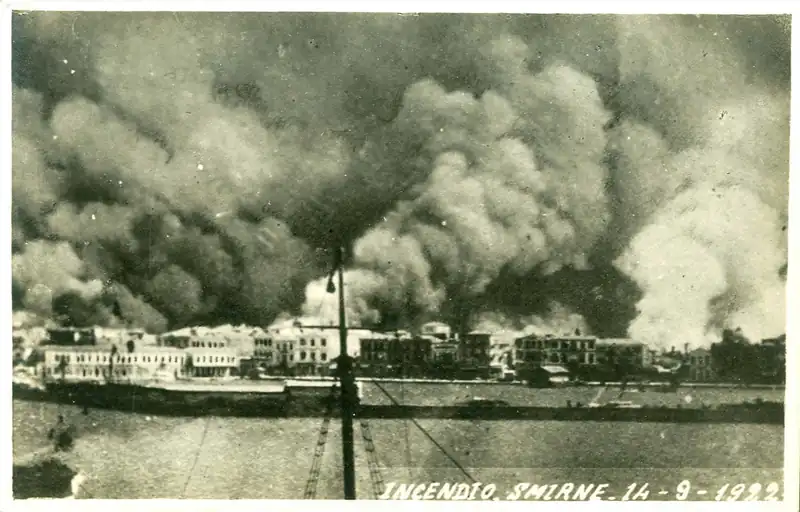
The telegrams record where the fire began and what it destroyed, not who lit it. What they do document, in the words of Americans who were there, is what happened to the people of the city while it burned.
What do US records say about the killing and the refugees?
The relief committee’s representative, Major Davis, wrote on 14 September of refugees “hidden in institutions or huddled here, there, moving, panic stricken, when irregulars begin shooting them”. The Turkish authorities, he reported, said they would protect and camp the refugees, but “animosity of troops so great” it was difficult, and he urged that foreign governments be asked to take the people away (document 337).
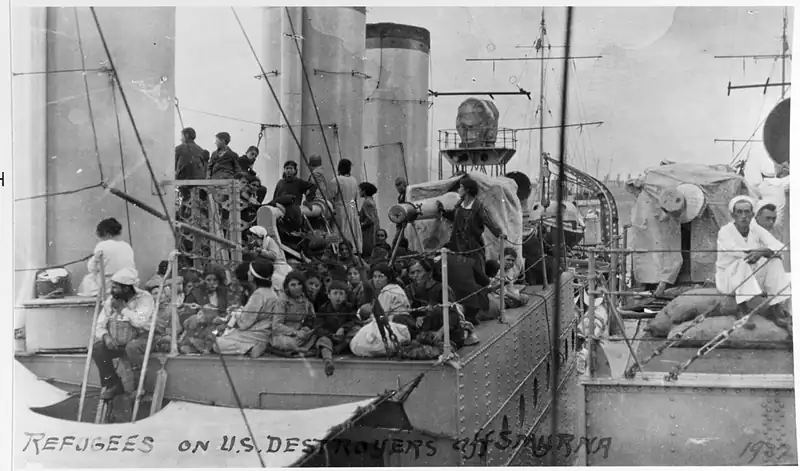
The same day Davis reported his interview with Noureddin Pasha, the Turkish commander at Smyrna. Asked to allow the refugees to return home under protection, the commander replied that they “must leave country or be taken away, frankly stating safety of life could not be assured”. Davis added his belief that this was “the final decision Nationalist Government as solution of race problem” (document 336). Bristol had already told Washington that the destitute could not go back to their villages, adding: “All reports agree that to send refugees back would be sheer murder” (document 334).
By 19 September a Turkish proclamation had set the terms. A telegram from the destroyer Edsall quotes it: “Refugee men from 18 to 45 prisoners of war. All others may be evacuated up to October 1st. Deportations continuing. Disorder still prevalent” (document 343). On 28 September Bristol reported that all men of that age had been separated from the other refugees, that some were put to work cleaning debris and repairing the railway, and that it was “impossible to obtain reliable information as to disposition of majority”. Other refugees, he added, had been deported to the interior in numbers that could not be estimated (document 352).
Taken together, these first-hand American reports describe the shooting of civilians, the detention and deportation of men of military age, and a policy that the refugees could not stay. This is the core of the Greek position that the destruction of Smyrna was not an accident of war but part of the expulsion of the Greeks from their ancestral homeland in Asia Minor.
Who rescued the refugees, and how many?
The rescue was slow and, according to Bristol, mostly improvised. On 18 September he wrote that it “began to appear that attitude of Allied navies present was to take no action to meet the emergency”, and he found the same disposition in the British High Commissioner (document 341). Two days later he reported that the British High Commissioner had told the Greek Patriarch he could do nothing for 50,000 refugees at Rodosto, citing the lack of provisions and the need for economy (document 345). It was American destroyers, American relief committees and Greek ships that carried most of the load.
The conditions for the Greek vessels were strict. On 22 September the Turkish authorities allowed them into Smyrna only if they did not fly the Greek flag, did not come alongside the quay and put no officers or men ashore. Seven arrived on 24 September and took off 15,000 people; on 26 September 43,000 reached Mytilene (document 352). By 25 September Bristol counted 80,000 refugees on Mytilene alone, and Britain announced 15 ships (document 350).
The final tally comes from a report by Commander Halsey Powell, the senior US naval officer at Smyrna, dated 20 October 1922 and forwarded by the US mission in Constantinople. It lists 213,480 people evacuated from Smyrna itself and 49,107 more from ports in its vicinity, a grand total of 262,587. Of the Smyrna figure, 140,046 left on Greek ships under US control and 40,954 on ships under British control; Italian and French vessels carried their own nationals, and US destroyers a further 2,080 (document 364).
| Evacuated, to 20 October 1922 | People |
|---|---|
| Greek ships under US control | 140,046 |
| Ships under British control | 40,954 |
| Total from Smyrna | 213,480 |
| Total from nearby ports | 49,107 |
| Grand total | 262,587 |
The refugees became Greece’s problem overnight. On 20 September the US chargé in Athens reported that destitute people were being landed daily on Greek territory and that the task was “much too big” for the Greek Government and the organisations helping, and he urged American relief agencies to send money and food (document 346). The diplomatic settlement that followed, including the compulsory population exchange, is covered in Treaty of Lausanne explained: borders, islands and minorities.
Ankara’s case
Turkey does not accept the word genocide for these events. The American telegrams show the argument Turkish officers used at the time: Noureddin Pasha said that the “complete destruction of country by retreating Greek Army” made return impossible (document 336), and Bristol himself wrote that refugees would face a hostile Turkish population “which witnessed devastations of Greek army” (document 334). Hepburn likewise wrote that the conduct of Greek troops during the retreat made settling refugees in Asia Minor impossible (document 339). Those claims point to the retreat, but they do not explain the shooting of civilians, the capture of men aged 18 to 45 or the order that a whole community leave, all of which the same telegrams record.
How is Smyrna classified today?
In December 2007 the International Association of Genocide Scholars passed a resolution, published in a press release, declaring that “the Ottoman campaign against Christian minorities of the Empire between 1914 and 1923 constituted a genocide against Armenians, Assyrians, and Pontian and Anatolian Greeks”, and calling on Turkey to acknowledge it, apologise and make restitution (text as published by the Armenian Genocide Museum-Institute). For the later Turkish invasion and the displacement of Greek Cypriots in 1974, see Cyprus problem explained: 1960, 1974 and the UN buffer zone.
Sources
Foreign Relations of the United States, 1922, Volume II, documents 328 to 364 (telegrams of Consul General Horton, High Commissioner Bristol and the US naval officers at Smyrna, Office of the Historian, US Department of State); International Association of Genocide Scholars resolution of December 2007, as published by the Armenian Genocide Museum-Institute. Photographs: US Navy collection (NH 85298) and a contemporary postcard, both public domain.