
Drones
A900: the Hellenic Navy’s small unmanned helicopter that flies from any ship
The Spanish-designed A900, under 25 kg and up to four hours in the air, flies from the deck of a ship. How the Hellenic Navy’s small unmanned helicopter works and how it differs from the Camcopter S-100.

The A900 is a small but valuable “eye” of the Hellenic Navy: an unmanned helicopter of under 25 kilograms, set up in less than twenty minutes, that lifts off from a ship’s deck and stays in the air for up to four hours to see beyond the horizon of the ship’s radars. At the military parade of October 28, 2026 in Thessaloniki it passed on a white pickup truck, in the same segment as the much larger Camcopter S-100 “PN 201” of the FDI frigates. The picture of the two together says a lot about the road the Navy is taking: vertical-takeoff helicopters without a crew are no longer an experiment but a tool in different sizes for different ships.

Spanish design, Greek support
The A900 is designed and built by Spain’s Alpha Unmanned Systems. It was brought to Greece by ALTUS LSA, the Chania-based company also known for its own Atlas-8H “Kerverus”. As ALTUS announced in November 2021, the contract with the Hellenic Navy provided for five A900s for naval surveillance, together with the training of Navy and Hellenic Civil Aviation Authority staff in operation and maintenance, the integration of the systems on the warships and post-delivery support. The Greek company, in other words, is not the manufacturer but the link that makes the foreign product work inside the Navy, which for a small system with parts, spares and software counts as much as the platform itself.
The civil aviation authority’s involvement in the training is not a detail. An unmanned helicopter flying from a ship near the coast shares airspace with civil aircraft and helicopters, and integrating it requires rules and certified operators. The Navy had also tested the Austrian Camcopter before the selection, which finally came later with the Belharra frigates.
What a 25-kilogram helicopter can do
According to Alpha Unmanned Systems’ official data, the A900 has a maximum takeoff weight under 25 kilograms, endurance of up to 4 hours and can hover for 2.5 hours. It carries 4 kilograms of sensors, usually an electro-optical and thermal (EO/IR) sight with automatic target tracking, and its data link reaches up to 200 kilometres. Its engine burns heavy fuel, Jet A1, JP5 or JP8, and this is perhaps its most practical feature for a warship: JP5 is the same fuel as the fleet’s helicopters, so the ship does not need to carry petrol, with all the risks that has at sea. The manufacturer also states automatic autorotation in case of engine failure, redundant critical systems and compliance with NATO’s STANAG 4738 standard.
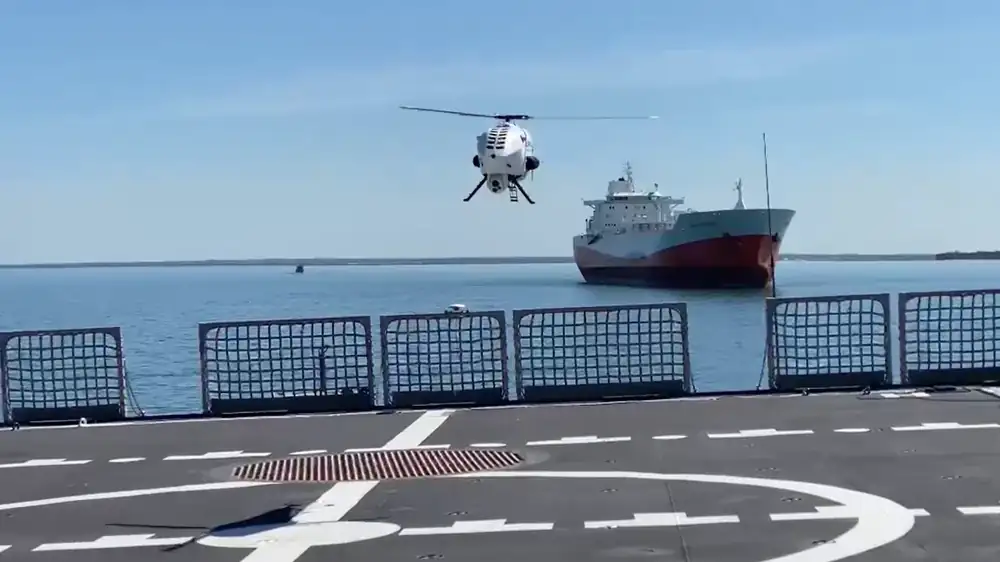
The system, with its control station and tracking antenna, sets up in under twenty minutes and takes off and lands on a ship under way. That is where its value for the Aegean lies. A surface ship sees with its radar as far as the horizon, and a small boat, a dinghy with migrants or an unmanned surface vessel is easily lost in sea clutter or behind an island. A helicopter of a few kilograms that climbs a few hundred metres and sends real-time imagery does the reconnaissance without risking the ship’s crewed helicopter, which stays available for anti-submarine warfare or search and rescue. Alpha proposes it for surveillance, reconnaissance, border control, search and rescue, cooperation with crewed assets and infrastructure inspection, that is, for all the everyday work of a ship in the Aegean.
Alongside the Camcopter, and the problem of fleet diversity
The A900 and the Camcopter S-100 are not competitors. The S-100 weighs up to 200 kilograms, carries tens of kilograms of payload, from wide-area cameras to a sonobuoy dispenser, and is built into the FDI frigates from the design stage. The A900 is a light system for ships of all sizes, as its manufacturer describes it, with a small footprint in space and in the supply chain. The right question, therefore, is not which is better, but how they will be tied into a single system with common control stations, common training and a common video feed to the General Staff. The problem of fleet diversity among the armed forces’ unmanned systems is real, and the Navy’s unmanned helicopters are one of the places where standardisation can happen early, before the types multiply.
The A900’s appearance at the parade, together with the S-100, the “Pyrpolitis”, the PLUTO vehicles and the SeaHake torpedoes, showed a Navy investing in unmanned assets in the air, on the surface and under the sea. The small Spanish helicopter does not impress as much as the rest, but it is built exactly for the job the Navy does every day in the Aegean: to see far without risking a crew.