
Drones
Camcopter S-100 “PN 201”: the eyes of the FDI frigates that fly ten hours over the Aegean
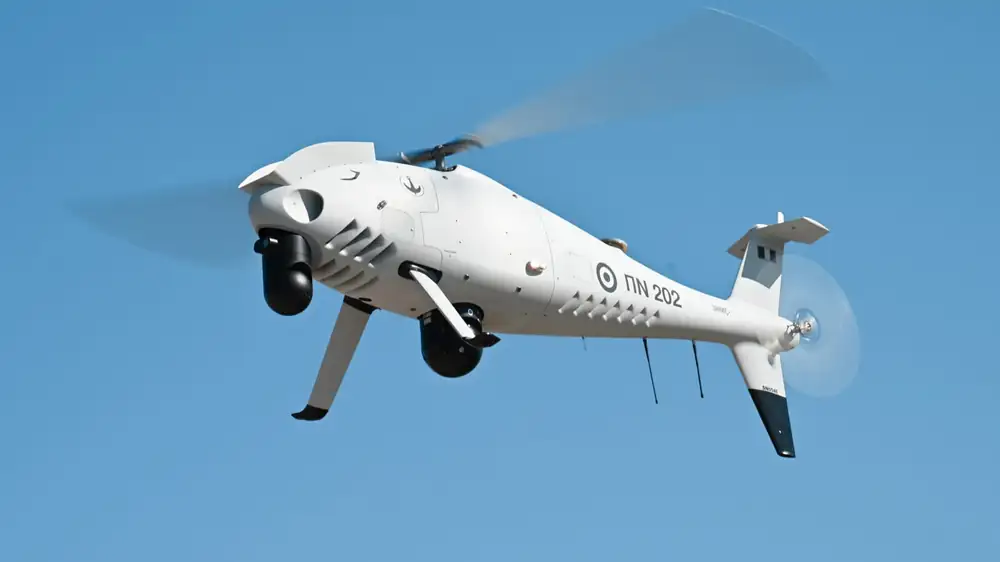
The Camcopter S-100 “PN 201”, the 200 kg unmanned helicopter of the Hellenic Navy’s FDI frigates, passed in the October 28 parade. Its contract, sensors, anti-submarine fit and why the Navy also flies the small A900.

An FDI frigate sees far into the air with its Sea Fire radar, but a small boat low on the sea, behind an Aegean island, can slip past it. That gap is what the Camcopter S-100 fills: a 200-kilogram unmanned helicopter that flies up to ten hours and sends live imagery from up to 200 kilometres away. At the military parade of October 28, 2026 in Thessaloniki the public saw it up close, with the number “PN 201” and Hellenic Navy markings, while the frigate KIMON was open to visitors in the city’s port.
The contract and the timetable
A press release by Austria’s Schiebel on February 13, 2026 said the Hellenic Navy had signed a contract for S-100 systems that will operate from the three FDI (Belharra) frigates: KIMON, NEARCHOS and FORMION. KIMON, which arrived in Greece in January 2026, was to be equipped first in the spring of 2026. NEARCHOS is expected at the end of 2026 and FORMION in early 2027, both already pre-fitted by Naval Group for the S-100 so that installation can be done quickly. One more system operates from land, for training and keeping operators ready. A “system” in Schiebel’s language usually means two aircraft, a two-seat control station and an encrypted data link.
The first acceptance milestone was completed in April 2026: at the Naval Helicopter Base in Kotroni, within a week, the first two of the four systems were checked, with four aircraft in total. The Greek story of the S-100 begins earlier, however. In the summer of 2021 the Navy tested it for a week aboard the frigate AIGAION, west of Crete, in day and night scenarios for coastal surveillance and tracking of maritime traffic. Almost five years passed before it reached the fleet, and it came together with the ships designed to host it.
What it sees and what it carries
According to Schiebel, the Greek S-100s carry L3Harris’s Wescam MX-10 electro-optical and thermal sight and Overwatch Imaging’s PT-8 Oceanwatch, a wide-area camera that “combs” large stretches of sea and uses algorithms to detect small objects, castaways or boats that the human eye would miss on a screen. The first does identification, the second search. The missions the company names for Greece are maritime security, search and rescue, environmental monitoring, EEZ control and anti-submarine warfare.
Schiebel’s technical data explain why the S-100 is far more than a drone with a camera. It has a maximum takeoff weight of 200 kilograms, a length of 3.11 metres and a rotor diameter of 3.4 metres. In its typical configuration it lifts 34 kilograms of payload for ten hours, reaches 18,000 feet, cruises at 55 knots and dashes at 120 knots. It burns aviation gasoline or JP-5, the fuel of naval helicopters, and can operate without GPS, which in the Eastern Mediterranean, where GPS interference is a known problem for ships and aircraft, is not a luxury. The company reports operational use on more than 50 different ships worldwide.
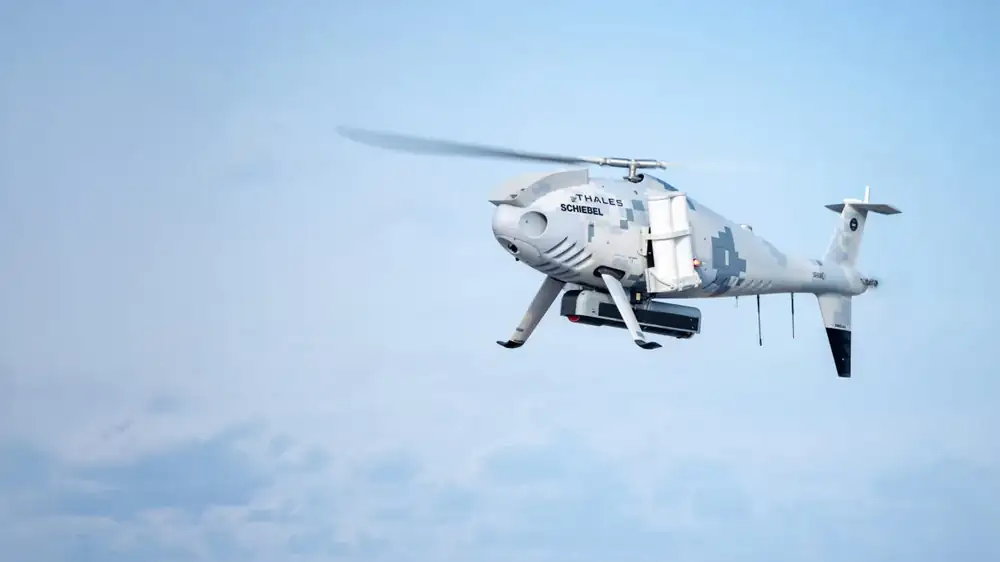
Most interesting for the Hellenic Navy is the anti-submarine configuration. Schiebel has developed a dispenser that drops NATO A- and G-size sonobuoys and relays their data in real time to the ship. An FDI frigate with an MH-60R helicopter and an S-100 can thus lay a sonobuoy barrier without tying up the crewed helicopter, which stays free for the chase and a torpedo shot. In an Aegean where the Turkish submarine fleet is being renewed with the Reis class, an asset that extends the frigate’s “ears” counts. The manufacturer also offers configurations with radar or a wide-area camera for search and rescue, life-raft drops, mine detection with LiDAR, and operation as a “loyal wingman” to a crewed helicopter, with control passing to the helicopter itself.
Why two kinds of unmanned helicopter
The much smaller A900 from Spain’s Alpha Unmanned Systems, under 25 kilograms, also passed in the same parade, as we cover in our separate piece on the Navy’s small unmanned helicopter. The two do not conflict: the S-100 is the heavy asset built into the frigate’s combat system, with payloads that change with the mission, while the A900 is a light surveillance system for ships of any size. The challenge for the Navy is to tie them into a common picture and common training, so that the video the commanding officer sees in the Aegean also reaches the General Staff. With the “PN 201” on the streets of Thessaloniki, that is no longer a forecast.