
Defense Industry
“Anemogiannis”: the Greek kamikaze drone boat with a 50 kg warhead that appeared at the parade, and what it changes in the Aegean
The Greek one-way-attack unmanned surface vessel “Anemogiannis”, based on Delian Alliance Industries’ Interceptigon-N, was shown at the October 28 parade in Thessaloniki. Capabilities, origins and what it means for the Aegean.

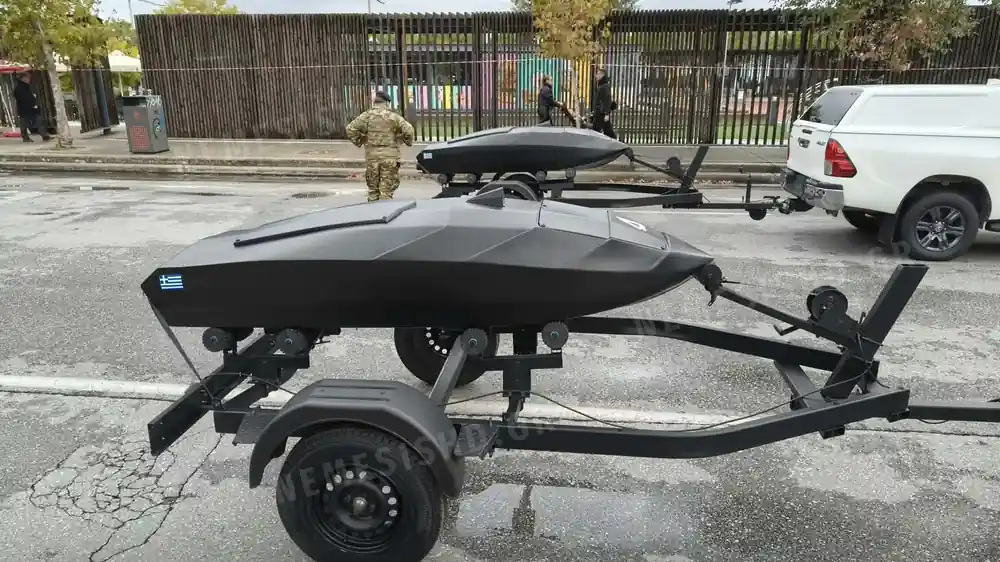
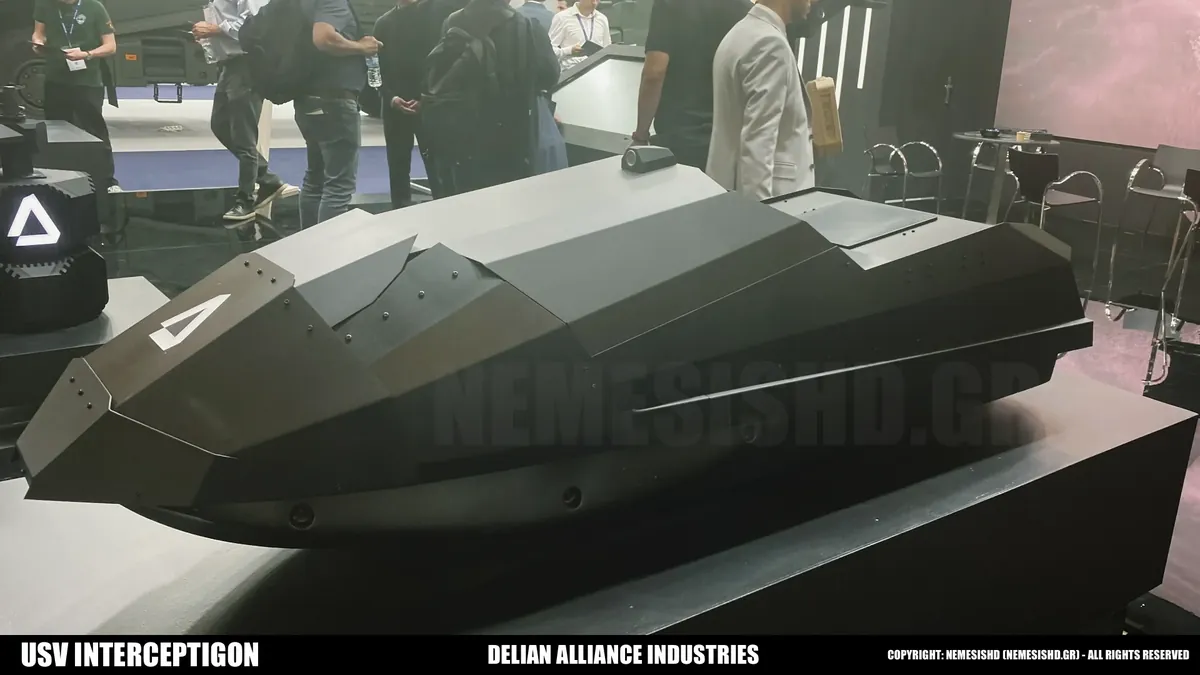
“Anemogiannis” is a Greek unmanned surface vessel (USV) designed from the start as a one-way weapon: a small, low, black craft that does not patrol or merely gather intelligence but rams its target with a warhead. It was shown under its Greek name at the military parade of October 28, 2026 in Thessaloniki, on a simple single-axle trailer behind a pickup truck, and that image says most about its philosophy: it needs no port, crane or mother ship, only a launch ramp on any shore of the Aegean. Behind the Navy’s name is the Interceptigon-N of the Greek company Delian Alliance Industries, which the company first presented at DEFEA 2025 as an area-denial system for island environments.
What “Anemogiannis” is and what it can do
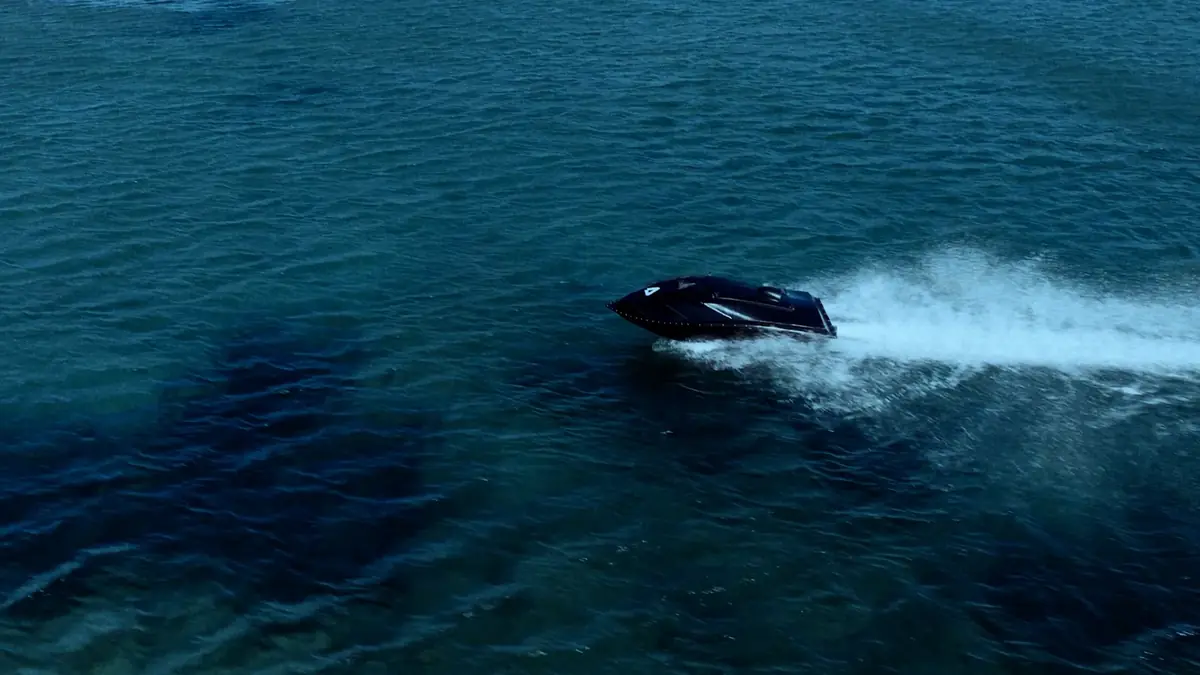
According to the Armed Forces’ official description of the parade’s systems, “Anemogiannis” is a USV of Greek design and construction for area-denial missions and for striking hostile naval targets. It reaches about 75 km/h (a little over 40 knots), carries electro-optical and infrared sensors (EO/IR, a day camera and a thermal one) and a surface radar, navigates inertially and autonomously, and communicates with its operator by satellite and radio link. The warhead in the configuration shown is 50 kg, enough to disable a landing craft or a medium-sized surface ship if it hits the right spot, and the craft can be launched either from land or from Hellenic Navy ships. The low, angular hull without a superstructure is not an aesthetic choice: it reduces the radar signature and the chance of being detected by surveillance before it reaches its target.
Delian describes the Interceptigon-N as an “attritable” naval strike platform, meaning one designed to be expendable, with EO/IR cameras for operator guidance, backup RF, satellite and cellular links, and operation up to sea state 4 (roughly Beaufort 5). The company stresses that each vessel is configured to the customer’s national requirements, which explains why the figures of the Greek version differ from those shown at DEFEA 2025, where the Interceptigon-N was presented with 45 knots, a 30 km range and a 70 kg warhead. As presented, “Anemogiannis” is slightly slower and has a lighter warhead, but it carries a surface radar and a full sensor package. The company’s earlier A2/AD weapons were covered in this article.
Hidden on the seabed: the idea behind the Interceptigon-N
The platform’s most unusual feature is how it is deployed. As Delian explained at DEFEA 2025, the Interceptigon-N can stay hidden on the seabed in an underwater launcher until activated, away from satellites and surveillance aircraft. In practice, in a strait or in front of a coast suitable for a landing, an invisible “minefield” of craft could be laid that do not wait passively to be hit by a ship but set off and hunt it. The company designed it precisely to neutralise naval assets during the landing of forces or in transit, the moments when an adversary is slowest and most exposed. The official description of “Anemogiannis” speaks of launching from land or ship and does not mention deployment from the seabed, so it is not yet clear whether the Greek version will also use that scenario.
The Greek company has invested heavily in navigation without GPS, with its OSIRIS system, which uses visual terrain matching and has been tested in Ukraine. In the Aegean, where GPS jamming from the Turkish side and from the wider Eastern Mediterranean is now an everyday occurrence, a USV’s ability to find its way when the satellite “goes dark” is not a luxury. The official description of “Anemogiannis” speaks of inertial and autonomous navigation, which is the basic prerequisite for such an environment.
Why the Aegean needs kamikaze USVs
The war in the Black Sea showed that a state without a strong fleet can drive a much larger navy out of its waters with cheap, fast craft carrying explosives, attacking in swarms and forcing big ships to keep away. Greece has an extra advantage: hundreds of islands and rocky islets where small craft can hide, be launched from improvised positions and cover the passages every landing force would have to cross. In that environment a single-use USV, costing a fraction of an anti-ship missile, turns the archipelago itself into a weapon. That is why “Anemogiannis” is presented as part of the logic of anti-access and area denial (A2/AD) on the islands, complementing coastal batteries and fighters.
Opposite, Turkey already has an active armed-USV programme, with craft such as the ULAQ and MARLIN, which it fits into its “Blue Homeland” doctrine. Greece’s answer comes later, but with two complementary types: the “Pyrpolitis” (Fireship), which the Navy itself designed and built for surveillance, reconnaissance and strike, and Delian’s “Anemogiannis”, a pure one-way weapon. The crucial question now is not the technology but the numbers: a doctrine built on cheap craft is worth something only if they are produced in the hundreds, with stockpiles, trained operators and launch sites prepared in peacetime.
The name: the fireship captain Georgios Anemogiannis
The name was not chosen at random, and it links the new craft to the “Pyrpolitis”. Georgios Anemogiannis, from Paxos, was one of the first fireship captains of the Greek Revolution: in June 1821 he took a fireship against the Ottoman ships at Nafpaktos, was captured and executed. The fireship was, in essence, the kamikaze USV of 1821, a cheap vessel loaded with combustibles and steered into a far larger and more expensive enemy ship. The difference after two hundred years is that today no one needs to sit at the helm.