
Defense Industry
“Arpyia”: the Greek mini cruise missile for deep strikes that appeared at the parade – what we know
Two Greek-designed “Arpyia” mini cruise missiles, a one-way-attack weapon for deep strikes, were shown at the October 28 parade in Thessaloniki. What is official, what is not, and why cheap mass fires matter for Greece.

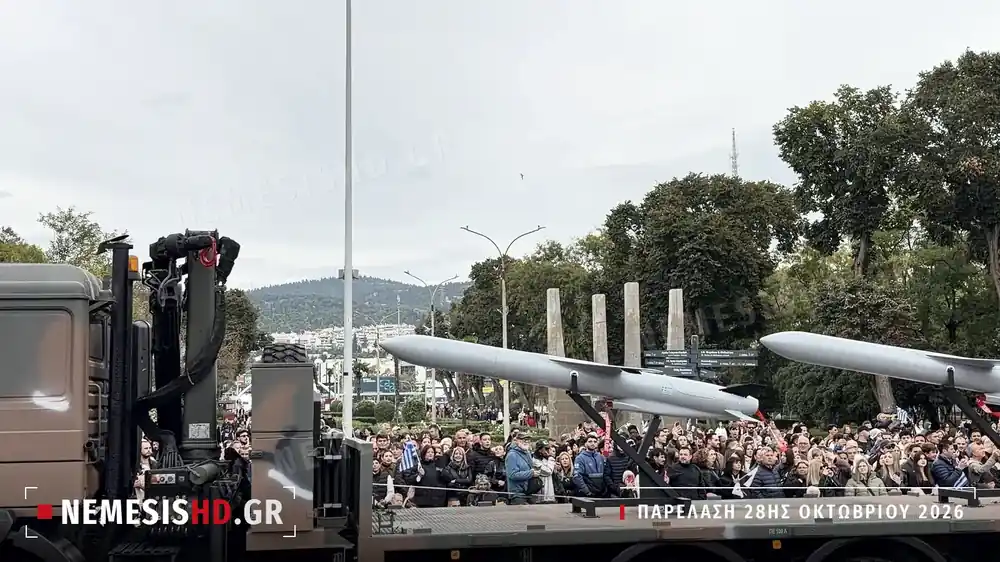
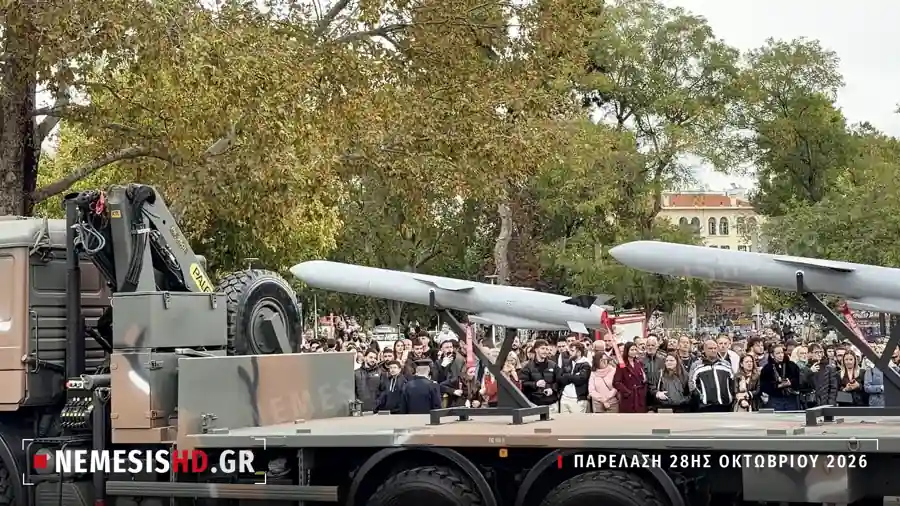
“Arpyia” (Harpy) is a Greek deep-strike weapon that is not launched from an aircraft, a ship or an expensive launcher but from a simple ground system, and that was designed from the start to be produced cheaply and in numbers. Two missiles passed in the military parade of October 28, 2026 in Thessaloniki on a truck with a hydraulic crane, with the Greek flag on the fuselage, and the “Arpyia” was one of the most significant systems of the day, even though it passed more quietly than the PULS and the Israeli air defence systems. The Armed Forces describe it as a Greek-designed and Greek-built unmanned aerial vehicle of the mini cruise, one-way attack category, in other words a small single-use cruise missile that flies on its own to the target and is destroyed with it.
What “Arpyia” is: mini cruise and one-way attack
According to the official description of the parade’s systems, “Arpyia” is intended for precision strikes at long range against weapon systems, command posts and other high-value targets, without having to send a manned aircraft over the enemy. It navigates autonomously along a programmed route, can fly at low altitude, where terrain hides it from radar, and also higher when the mission requires, has a limited radar cross-section (RCS, how “large” it looks on a radar screen) and reaches high subsonic speeds. It is launched from ground carriers, so it needs no runway. Its range, warhead and engine have not been officially announced, and the figures in circulation do not come from an official source.
In the photographs, “Arpyia” has the shape one expects from a small cruise missile rather than a drone: a slim cylindrical fuselage, a pointed nose, small mid-fuselage wings and cruciform tail fins, painted grey with red fins. That shape sacrifices the endurance and agility of a loitering munition in favour of speed and distance. The official description notes that the design know-how came from the development and manufacture of aerial targets used in firing exercises of the Armed Forces’ air defence systems. The link is logical: a target drone is already a small, fast, pilotless aircraft flying a programmed route, and if a warhead, more precise navigation and longer endurance are added, it becomes a weapon.
Why Greece needs cheap mass fires in depth
The war in Ukraine showed that deep strike is no longer solely a matter of expensive cruise missiles. Russia bases much of its attacks on the Geran-2, the Russian version of the Iranian Shahed-136, and Ukraine answers with its own long-range drones against refineries, airfields and depots. The lesson is simple: a weapon that costs as much as a car, not as much as a house, can be launched in numbers large enough to saturate the opponent’s air defence, and every air-defence missile spent against it is one fewer for fighters and ballistic missiles. Greece today has deep-strike capability mainly through the Hellenic Air Force, with the SCALP-EG and the Rampage, and soon through the PULS. They are effective weapons but expensive and limited in number.
“Arpyia” adds a different layer: mass. In a crisis scenario in the Aegean, dozens of such missiles launched from islands and from the mainland could force Turkish air-defence systems on the coast to reveal their radars and expend missiles, opening the way for fighters. They could also hit targets that do not justify a missile worth millions, such as radar sites, depots and drone launch positions. Turkey has already moved into this category, with Baykar developing the Kemankeş, a small smart cruise missile, and a whole family of loitering munitions. “Arpyia” shows that Greece wants to develop this capability itself and not buy it from abroad.
The name and what must follow
The name recalls the Harpies of mythology, the winged spirits that snatched and made vanish whatever they found. Beyond the name, the weapon’s value will be judged by what was not visible at the parade: the accuracy of navigation in a GPS-jamming environment, which in the Aegean is now routine, the cost per missile, the production rate and the ability to change target in flight. A mass weapon makes sense only if there is mass: stockpiles of hundreds of missiles, launchers dispersed across the country and units that train regularly with it. Together with the “Anemogiannis” at sea, the “Arpyia” in the air shows that Greek defence innovation is beginning to produce weapons and not only prototypes. The next step is serial production.