
Defense Industry
“Centaur”: the Greek HAI counter-drone system that jammed Houthi drones, from the Red Sea to the parade and the MEKO frigates
The Hellenic Aerospace Industry’s “Centaur” electronic-warfare counter-drone system appeared at the October 28 parade after combat experience on Greek frigates in the Red Sea. How it works and where it fits.

The “Centaur” of the Hellenic Aerospace Industry (HAI) is one of the few Greek defence systems with real combat experience: it was installed on Hellenic Navy frigates and faced Houthi drones in the Red Sea. At the military parade of October 28, 2026 in Thessaloniki it passed on a Navy vehicle, with its characteristic array of flat grey antennas on a mast, and the Armed Forces’ official description presented it as a counter-drone system developed in cooperation between the Hellenic Centre for Defence Innovation (ELKAK) and HAI and tested by Navy frigates in the EU’s Aspides operation. It is a clear example of Greek industry quickly producing a system the fleet needs and improving it on combat experience.
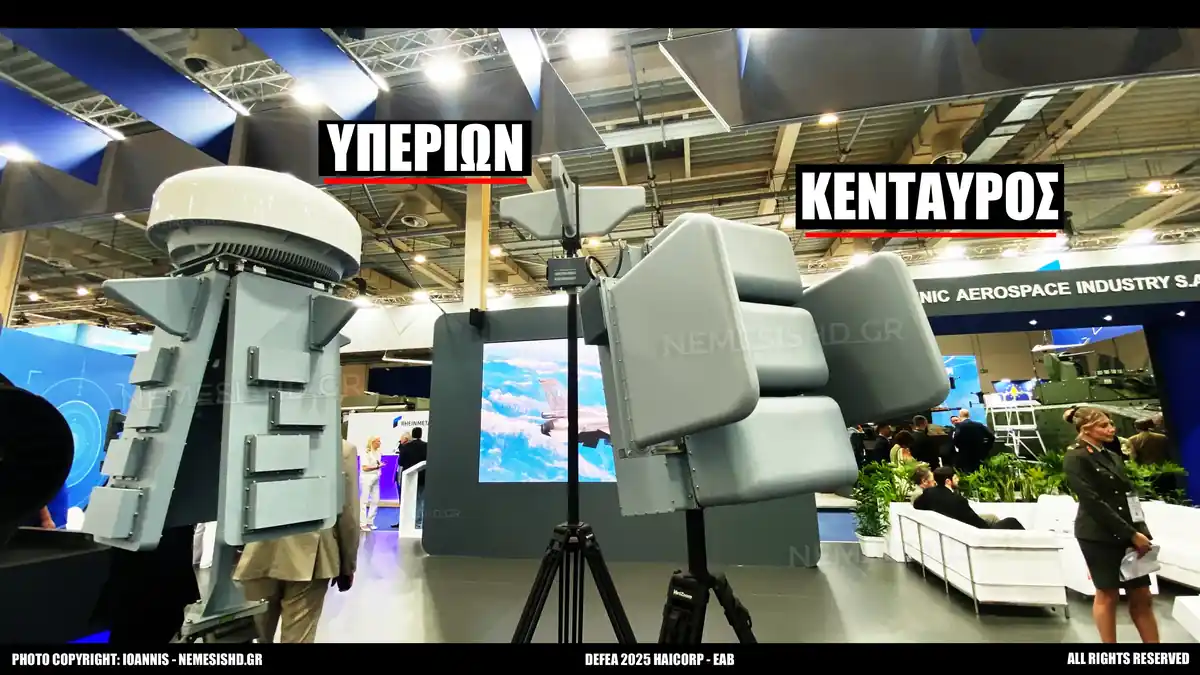
What “Centaur” does: detection, direction finding and jamming
“Centaur” is an electronic warfare (EW) and counter-UAS system. It does not shoot the drone down with a missile or a gun but defeats it in the electromagnetic spectrum. First it listens passively, without transmitting, to the drone’s radio emissions, that is the control link between the drone and its operator and the video downlink. Then it finds the direction they come from, and finally it transmits a strong jamming signal on the frequencies in use, cutting control, video and satellite navigation (GNSS). HAI states that the system detects drone emissions at distances above 150 kilometres in line-of-sight conditions (where terrain or the curvature of the Earth does not block the signal) and that it also counters frequency-hopping signals, a technique military drones use precisely to escape jammers.
Passive operation is what makes “Centaur” valuable on a ship. A frigate that switches on its radars reveals its position to anyone listening, whereas a system that merely “hears” drones can give early warning without revealing anything. Its open architecture, as an HAI representative has explained, allows installation on different types of vehicles and ships and the addition of sensors such as radar and electro-optics, as well as hard-kill means for drones that do not stop at jamming.
From the Red Sea to the MEKO frigates: the operational path
When Greek frigates took on escort missions in the EU’s Aspides operation (EUNAVFOR Aspides), the threat from Houthi drones and missiles was immediate. “Centaur” was fitted to MEKO 200HN frigates and, according to HAI, achieved jamming (soft kill) of Houthi drones. That experience quickly became a permanent requirement. “Centaur” is already installed on two of the four “Hydra”-class frigates, and with the MEKO 200HN upgrade it becomes a permanent part of their configuration on all the ships.
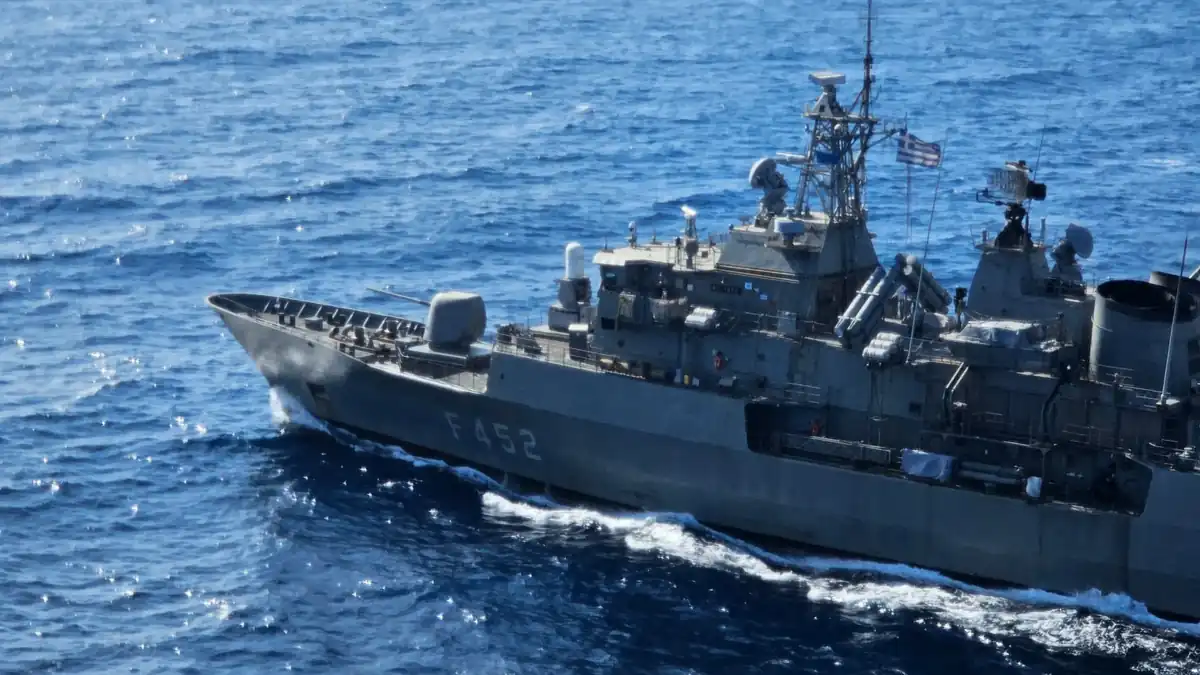
In the upgrade, “Centaur” will not work alone. According to Terma’s announcement in September 2026, HAI will integrate into the system the SCANTER 6002 radar, which specialises in detecting small, low-flying targets, and both will be linked to Thales’s new TACTICOS combat management system. The result is a chain in which the radar sees a drone that may not be transmitting, “Centaur” confirms and jams it, and the frigate’s combat system decides whether a gun or a missile is needed. The data, as HAI’s Electronics Plant director Kyriakos Enotiadis noted in the Terma announcement, will also give valuable input to the ship’s overall situational awareness.
Its place in the Achilles Shield and on land
In land-based air defence, “Centaur” and HAI’s complementary “Hyperion” sit on the lowest tier of the Achilles Shield, below the Barak MX, SPYDER and David’s Sling. The logic is economic as much as military: a swarm of cheap drones cannot be met with missiles costing hundreds of thousands of euros each, and electronic jamming costs essentially only electricity. “Centaur” covers the longer distances, while “Hyperion” takes the close zone, against small drones and mass attacks. Alongside them Greece has also bought the Israeli Drone Dome, which also passed in the parade.
The limits of the system are those of every jammer. A drone flying autonomously, without a link to an operator, or one guided by optical fibre, like many FPV drones in Ukraine, cannot be “heard” or jammed. That is why the next phase, which HAI has spoken about openly, is adding an active radar and hard-kill means to the same node. Electronic warfare, as argued in this opinion piece, needs a plan and funding beyond drones. “Centaur” shows the know-how exists. What is needed is production in numbers for all the ships, islands and units.