Military & Defense
U.S. Navy shows Blackbeard missile flying beneath an F/A-18 Super Hornet for the first time
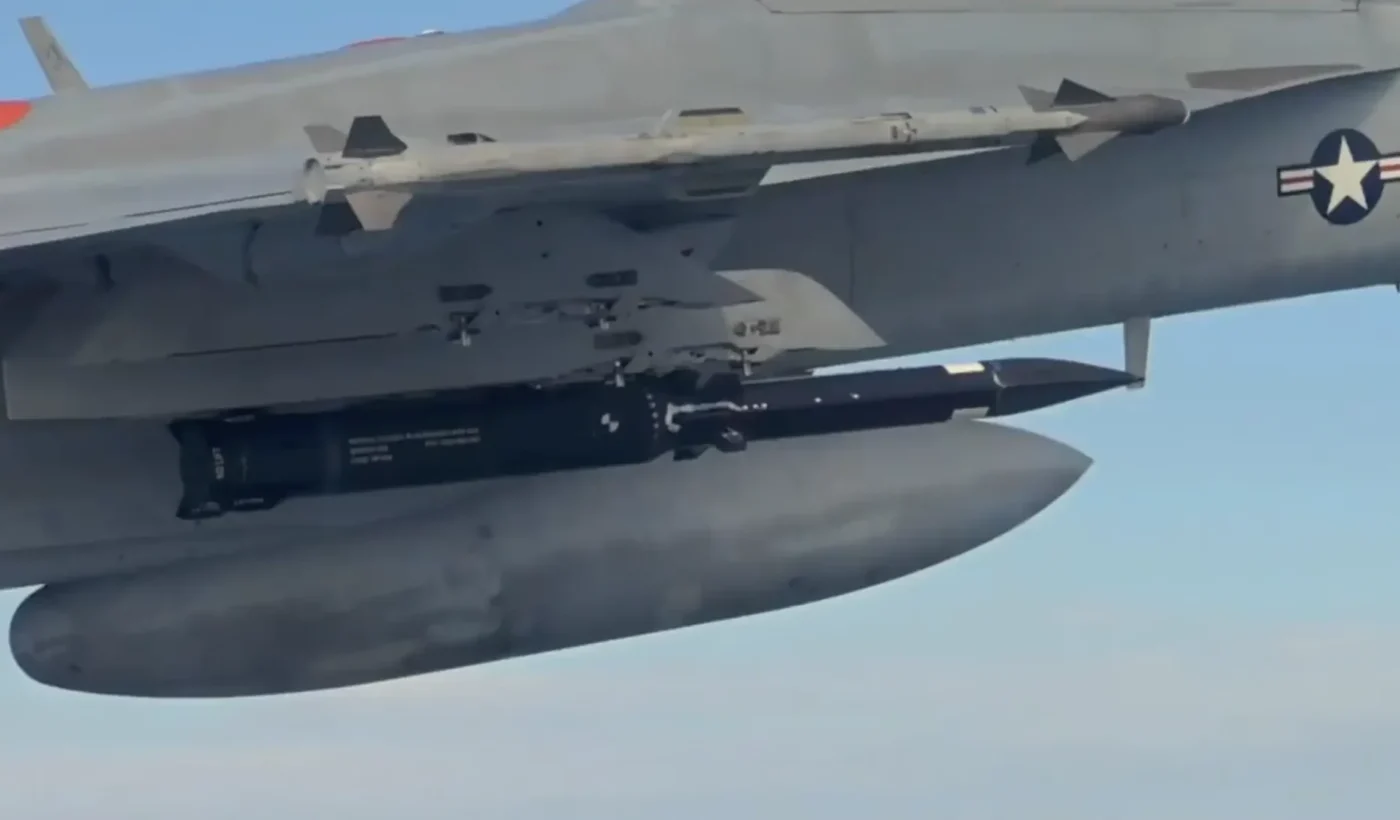
NAVAIR footage shows BLACKBEARD carried beneath a U.S. Navy F/A-18E/F Super Hornet in flight. The images mark an integration step, not a missile launch.

The U.S. Navy has released the first public footage of its BLACKBEARD missile carried in flight beneath an F/A-18E/F Super Hornet. The Naval Air Systems Command (NAVAIR) posted the video on September 25, 2026. The images show the weapon attached to the carrier-based fighter; they do not show a missile launch or establish that the weapon has entered operational service.
Two BLACKBEARD test articles can be seen under the aircraft’s wing. Earlier photographs had shown missiles mounted on a Super Hornet on the ground, but the new footage documents airborne carriage. That is a distinct integration step for a weapon intended to be deployed from the U.S. Navy’s carrier air wing.
NAVAIR accompanied the footage with the message, “Coming soon to a theater near you…BLACKBEARD!” and tagged U.S. Indo-Pacific Command and U.S. Central Command. The social media wording indicates the Navy’s interest in the program across more than one theater, but provides no deployment date.
A missile for the carrier air wing
BLACKBEARD is being developed by the U.S. company Castelion as an air-launched, high-speed strike weapon. The F/A-18E/F is its initial aircraft integration target. An April 2026 Navy contract worth about $105 million covers hardware and software integration, flight testing, safety work and the airworthiness certification needed before the weapon could be carried and employed from a carrier-based aircraft.
The missile is associated with the Navy’s Multi-mission Affordable Capacity Effector, or MACE, effort. The aim is to add long-range strike capacity at a cost and production rate that would permit larger inventories than those of many previous hypersonic weapons. Castelion and Navy descriptions emphasize affordability alongside speed and reach, but publicly available information does not establish the missile’s exact range or detailed flight profile.
For an F/A-18E/F, a stand-off strike weapon could allow a carrier air wing to attack targets while reducing the need for the aircraft to approach defended areas. The program has been discussed in relation to both land and maritime targets. That intended role should be kept separate from what the September video proves: carriage in flight, rather than a completed operational test of target engagement.
What the footage confirms
The visible configuration matters for practical integration. A missile can be displayed as a model or carried by an aircraft on the ground without demonstrating its behavior under flight loads. Airborne carriage provides evidence that the weapon and aircraft have moved into flight-test activity. It does not reveal release characteristics, guidance performance, terminal accuracy or the outcome of a live firing.
The Navy has sought a deeper magazine of weapons for prolonged operations as it examines how to sustain carrier aviation against advanced air defenses. BLACKBEARD’s proposed combination of high speed, long-range strike and larger-scale production is intended to address that demand. Whether it meets those goals will depend on testing, certification, manufacturing and procurement decisions still ahead.
NAVAIR did not specify a live-fire test date or an operational deployment date in its September 25 post.