Analysis
Why Greece did not acquire 76 AAV-7 amphibious vehicles: Cost, accidents and the remaining need
Greece’s proposed 2023 purchase of 76 AAV-7 amphibious vehicles stalled amid cost and safety questions. The Marines’ ship-to-shore transport need remains.

Greece’s proposed acquisition of 76 U.S. Marine Corps AAV-7A1 amphibious vehicles did not become a contract. The case remains relevant because the vehicles were intended to give Greek Marines protected movement from ship to shore, a requirement that the end of the procurement effort did not erase.
The U.S. State Department approved a possible Foreign Military Sale on March 17, 2023. Greece had requested 63 AAVP-7A1 personnel carriers, nine AAVC-7A1 command vehicles and four AAVR-7A1 recovery vehicles. The package also covered weapons, equipment, spare parts, training and support. Its estimated ceiling was $268 million, not an agreed final price. The proposed financing described in the U.S. notification comprised $243 million in Greek national funds and $25 million in U.S. Foreign Military Financing.
Why the vehicles mattered to Greece
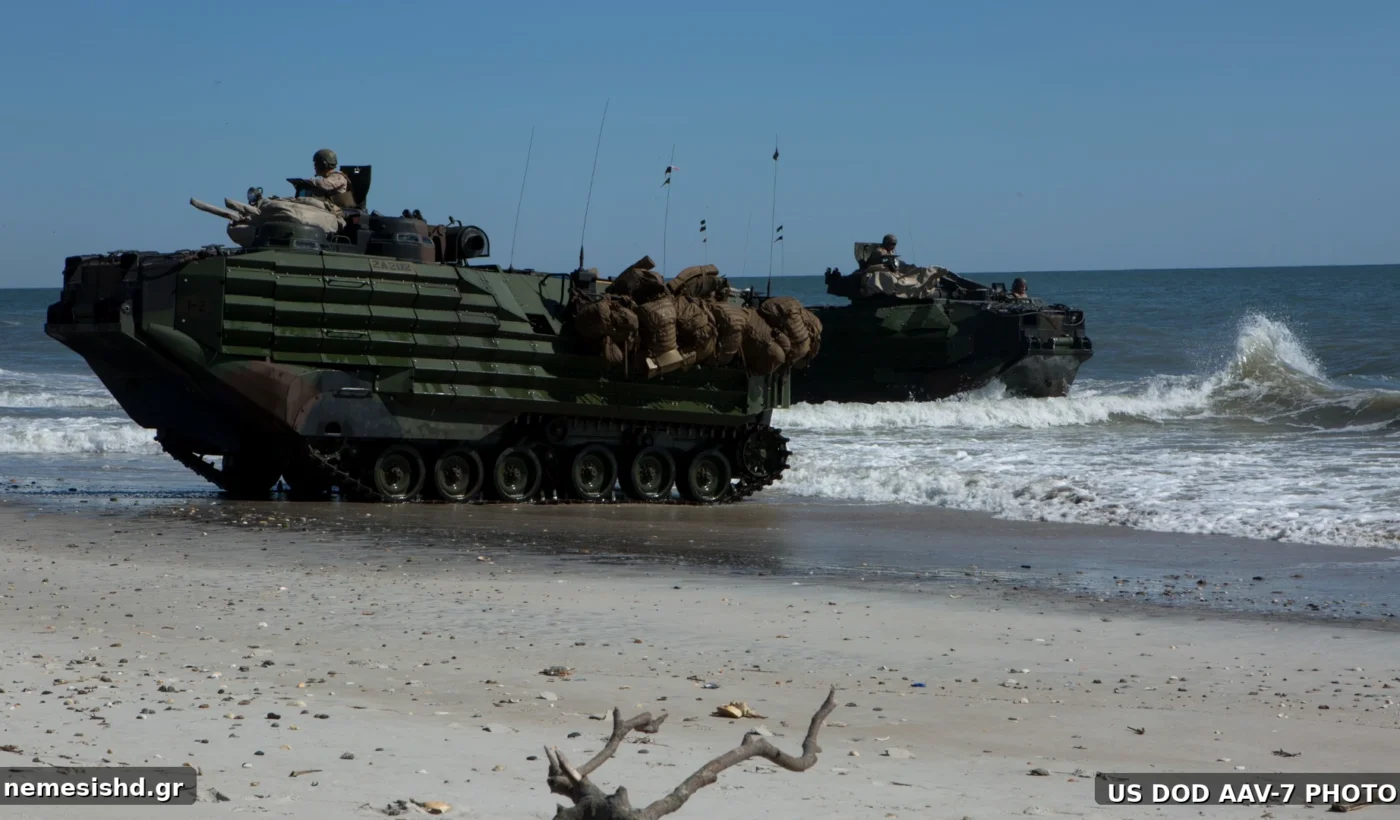
The AAV-7 family offered a particular capability: Marines could embark aboard an amphibious ship, cross the water, reach a beach and continue inland in the same armored vehicle. For a country whose defense planning includes islands and dispersed coastal areas, that ability had a clear operational appeal. The 32nd Marine Brigade stood to gain a dedicated vehicle for a task that drones and precision weapons cannot themselves perform.
The platform was also old. Its lineage reaches back to the LVTP-7 of the 1970s, although later versions received substantial upgrades. Acquiring used vehicles from the U.S. inventory would have required a support and maintenance system as well as the vehicles themselves. The $268 million estimate therefore represented a broader capability package, rather than the cost of simply taking delivery of surplus hulls.
Safety questions and the U.S. retirement
A July 30, 2020 sinking near San Clemente Island killed eight U.S. Marines and one Navy sailor. The Marine Corps investigation described a chain of equipment, maintenance, training and command failures. It did not reduce the tragedy to a single design defect. After the accident, the service suspended waterborne AAV operations pending review and introduced further safety measures.
In December 2021, the Marine Corps said AAVs would no longer be used for regularly scheduled deployments or waterborne training, except when required for crisis response. Its broader transition to the Amphibious Combat Vehicle continued. The retirement of the U.S. fleet by 2026 highlighted an uncomfortable question for a prospective buyer: how much should Greece invest in a legacy vehicle as its principal user was leaving it behind?
There is no public evidence establishing that the 2020 accident alone caused Athens to abandon the proposed purchase. Safety, cost, maintenance and competing priorities all belong in an assessment of the program, but the precise internal reasoning behind the Greek decision has not been documented publicly. Treating the U.S. approval as a completed Greek acquisition, or claiming a definitive cause for its failure, would misstate the record.
The Aegean operating problem
The AAV’s ability to travel through water did not make it fast at sea. U.S. specifications put the AAVP7A1 RAM/RS maximum at about 7.2 knots in calm water. Sea state, load and currents affect performance. In a monitored littoral environment, longer transit times can increase exposure to coastal surveillance and fire. The vehicle might still have been valuable for reinforcing a friendly island or reaching a less defended shore, while facing a different risk profile against a heavily watched coastline.
The Greek program was put on hold as investment priorities shifted toward unmanned systems and precision strike. Those weapons can help locate and suppress threats, including threats to an amphibious force. They do not provide the protected ship-to-shore transport for personnel that the AAV proposal addressed. The choice is therefore more complicated than a comparison of an old vehicle with a new drone: the two answer different operational needs, even when they compete for the same defense budget.
The enduring question for Greek planners is what capability will carry Marines from ships to shore in a contested Aegean environment. A newer amphibious armored vehicle, faster landing craft or a revised concept of operations would each have different costs and limits. The decision against this specific AAV-7 package left that underlying requirement to be addressed.